Testing & Validation · Study deck
IoT Deployment Failures: Connectivity
This first route establishes the post-mortem method and applies it to early connectivity failures.
Test Tessa is your guide for this deck.

After studying this chapter
Learning objectives
You will be able to:
- Analyze root causes of IoT project failures across connectivity, power, security, scaling, and integration domains
- Apply prevention checklists to avoid common deployment mistakes before they occur
- Explain why testing in actual deployment conditions is critical for connectivity and power budget validation
- Evaluate security design decisions using lessons learned from known breach patterns
Major section
Start With the Assumption That Broke
The fault is costly.
- The useful lesson is not "wireless is unreliable." It is that a hidden belief about the real site was never tested.
- The review team should rebuild the event in order.
- It might be a field walk, a power measure, a failed-login drill, or a load test.
Major section
Start With the Assumption That Broke (continued)
One page can hold the promise, event line, first bad sign, cause path, repair, new control, owner, and retest date.
- A case earns its place when it changes a design choice or test, not when it only proves that failure once happened.
- One story rarely proves a single cause.
- Practitioner shows how to collect incident evidence.
- Under the Hood follows linked causes, timing, and system-wide failure paths.
Major section
Read Failures as Evidence
A failure case is useful when it shows the chain from assumption to symptom to control.
- In IoT, that chain often crosses hardware, radio links, firmware, cloud services, mobile apps, support operations, and user behavior.
- A battery story is not just about a cell.
- A radio story is not just about distance.
- This structure keeps the lesson transferable.
Major section
Read Failures as Evidence (continued)
The technology names matter, but the repeated discipline is to connect evidence to a design control.
- If a story stops at "the devices failed," it has not yet become engineering knowledge.
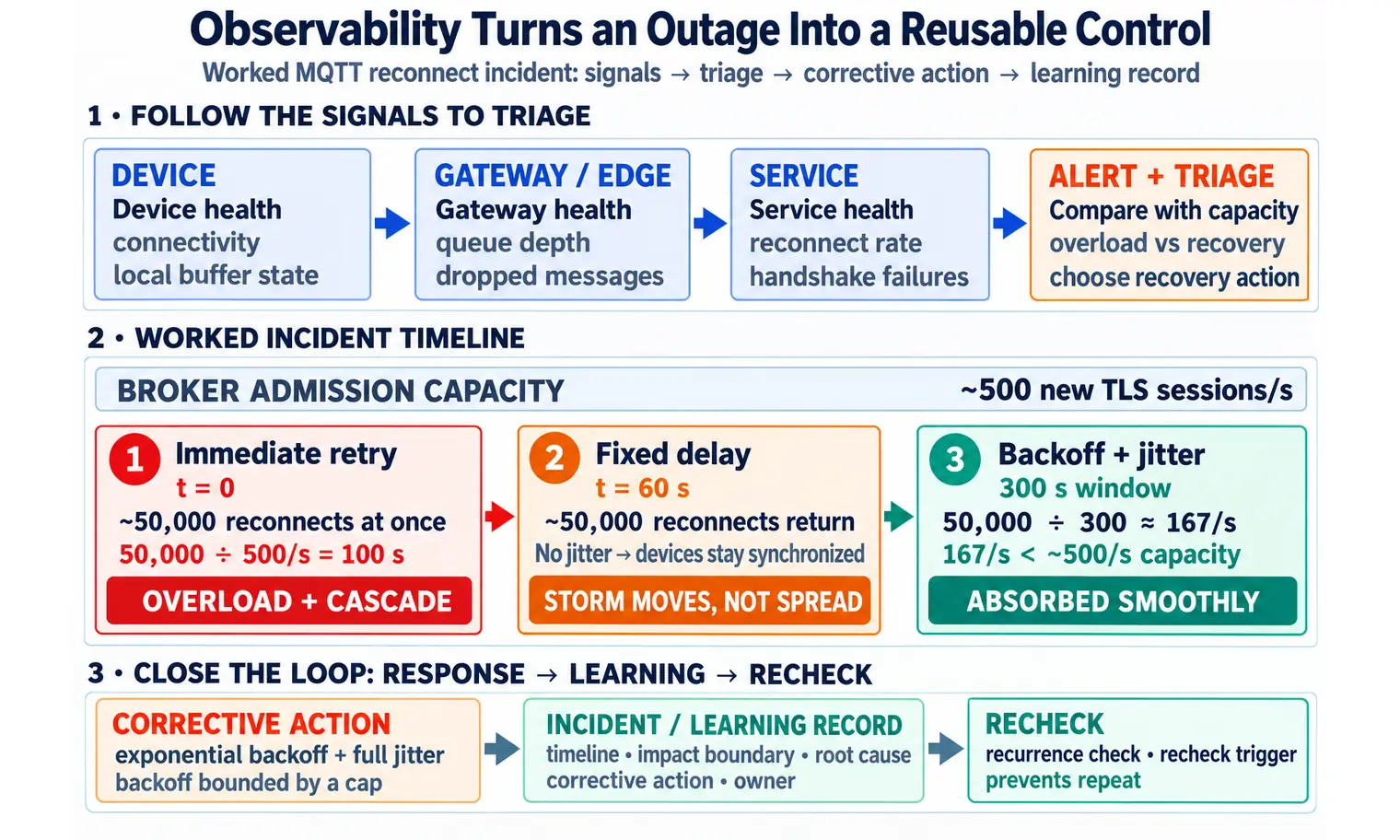
- Incident review then connects those observations to a causal chain; corrective action changes a control; and the learning record preserves the decision and recheck trigger for the next design.
- This loop is the structure used to interpret every case that follows.
Major section
Read Failures as Evidence (continued)
A missing link matters: without signals there is no early warning, and without the learning record the same assumption can return.
- A battery recall is not only a procurement mistake; it may reveal missing sleep-current measurement, no pilot under production firmware, no threshold alert, and no operational plan for field replacement.
- The reusable lesson is the relationship between the failed assumption, the missing signal, and the prevention control.
- That sequence turns the story into a control the next project can actually run.
Major section
Convert Stories Into Controls
For LoRaWAN, inspect link budget, spreading factor, ADR behavior, duty-cycle limits, gateway placement, antenna height, vegetation, terrain, and backhaul.
- Collect signals from the device, gateway, cloud service, application logs, monitoring system, and support channel.
- The goal is to separate cause, contributing factor, detection gap, and recovery gap.
- A practical failure review should produce a small control that can be run before the next deployment.
Major section
Convert Stories Into Controls (continued)
For vendor-dependent integrations, add an API contract review, certificate expiry monitor, webhook retry test, and fallback behavior for rate limits or schema changes.
- The output should be reviewable by someone who was not in the incident meeting.
- If the review cannot name where the control will live, it will probably be forgotten before the next project pressure arrives.
- Each move depends on the previous one, so the final control addresses measured evidence rather than a vague recollection of failure.
Major section
Small State Errors Cause Incidents
The incident is the moment those mismatches become visible to a user, but the conditions often existed earlier.
- A battery sensor wakes, samples, timestamps, encrypts, queues, transmits, waits for acknowledgement, sleeps, and later receives an OTA update.
- The gateway buffers, forwards, reconnects, and may translate protocols.
- The database accepts or rejects schema changes, retention policies, and timestamps.
Major section
Small State Errors Cause Incidents (continued)
Any unobserved transition can become the place where the failure hides.
- The MQTT broker tracks client identifiers, session persistence, subscriptions, retained messages, ACLs, Last Will and Testament, and queue limits.
- The dashboard aggregates by time window and may silently hide missing devices.
- The deeper lesson is to review interfaces and state transitions, not just components.
Major section
Small State Errors Cause Incidents (continued)
A support tool maps a customer complaint to a device model, firmware version, location, and ownership record.
- Known incidents such as Mirai show why a small device-level choice can become an Internet-scale failure when weak/default credentials, open management ports, exposed services, and absent update paths line up.
- The same systems thinking applies to less dramatic projects: one hardcoded MQTT topic, one missing TLS certificate renewal path, one unbounded retry loop, or one unsupported vendor API can turn into a fleet problem.
- The best case study therefore explains not only what broke, but why the break propagated as far as it did.
Major section
Failure Analysis Examples
Beginner Example: A classroom LoRaWAN demo works across one hallway but fails behind two concrete walls.
- The failed assumption is clear line-of-sight.
- The signal is packet delivery ratio plus RSSI/SNR by location.
- The control is a site walk before promising coverage.
- The failed assumption is that production firmware sleeps like the datasheet example.
Major section
Failure Analysis Examples (continued)
The signal is measured sleep current, wake frequency, transmit current, and retry count.
- The control is a current trace with the release firmware.
- Advanced Example: A building platform works with one vendor but slips when five vendor APIs change independently.
- The failed assumption is stable integration semantics.
Deck summary
Key takeaways
The fault is costly.
- One page can hold the promise, event line, first bad sign, cause path, repair, new control, owner, and retest date.
- A failure case is useful when it shows the chain from assumption to symptom to control.
- The technology names matter, but the repeated discipline is to connect evidence to a design control.
- A missing link matters: without signals there is no early warning, and without the learning record the same assumption can return.
Retrieval practice
Recall check

Test Tessa says: answer from memory, then check your reasoning.
Q1What is the best way to use an IoT failure case study?
Show answer
Answer: D Failure cases are for extracting patterns, causes, controls, and evidence that transfer to new designs.
Q2Complete the adaptive LoRa transmission with retry logic:
Show answer
Answer: A LoRa spreading factors (SF7-SF12) trade speed for range.
Print reference
Answers
Answer key.
- D · Failure cases are for extracting patterns, causes, controls, and evidence that transfer to new designs.
- A · LoRa spreading factors (SF7-SF12) trade speed for range.