Applications & Use Cases · Study deck

IoT Project Failure: Cost and Resilience Risks

A smart home can trap its data in one vendor's system.

Blueprint Bina is your guide for this deck.

iotclass.org

After studying this chapter

Learning objectives

You will be able to:

  • Define related chapters and resources with explicit inputs, errors, and change rules.
  • Validate iot total cost of ownership with a concrete scenario and pass criteria.
  • define related chapters and resources with explicit inputs, errors, and change rules
  • validate iot total cost of ownership with a concrete scenario and pass criteria
iotclass.org

Major section

Common Pitfall: Vendor Lock-in
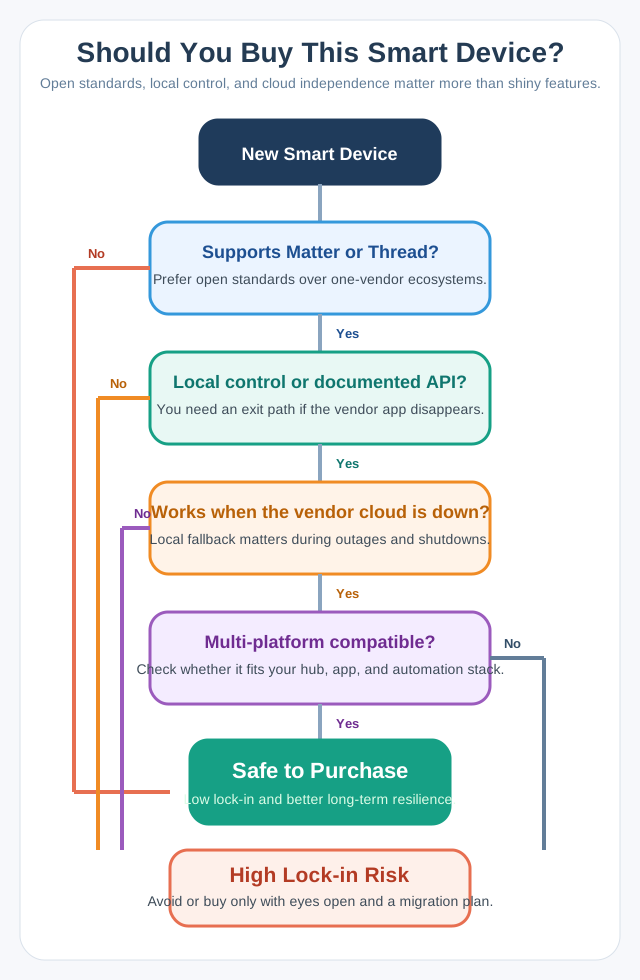
The mistake: Choosing smart home devices and platforms based on features alone, without considering interoperability, resulting in a fragmented ecosystem where devices cannot communicate across brands.

  • The fix: Prioritize devices that support open standards like Matter, Thread, and local API access.
  • The fourth asks whether it fits the hub and automations you already run.

Why it matters

Maintain an inventory of device protocols and ensure new purchases are compatible with existing infrastructure.

Smart device purchase decision flow for avoiding vendor lock-in.
iotclass.org

Major section

Interactive TCO Calculator

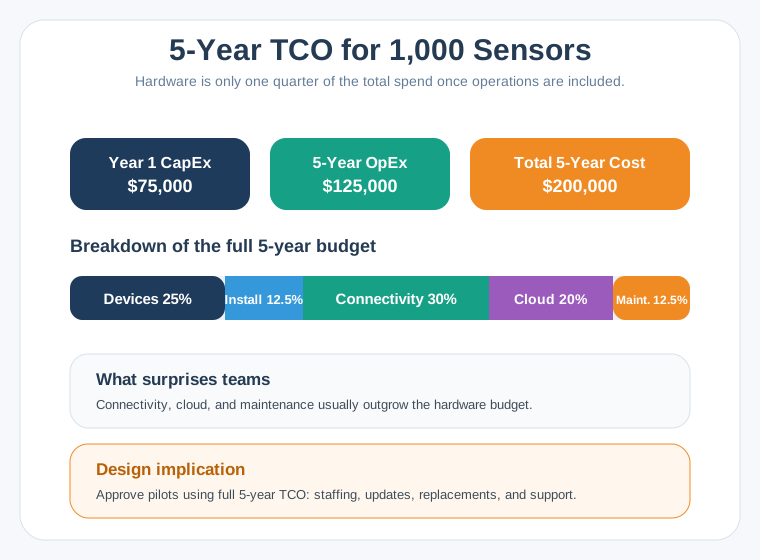
In this thousand-sensor case, devices take a quarter of the five-year budget, connectivity takes 30 percent, and cloud another 20 percent, with installation and maintenance splitting the rest evenly.

  • Devices and installation are the year-one capital spend; everything else arrives again next year.
Five-year TCO breakdown for a 1,000-sensor IoT deployment.

Try it: Interactive TCO Calculator in the chapter

iotclass.org

Major section

Edge Cases and Failure Modes

Testing schedules are rushed.

  • Edge cases are "rare" and deprioritized.
  • Security testing requires specialized skills often absent from development teams.
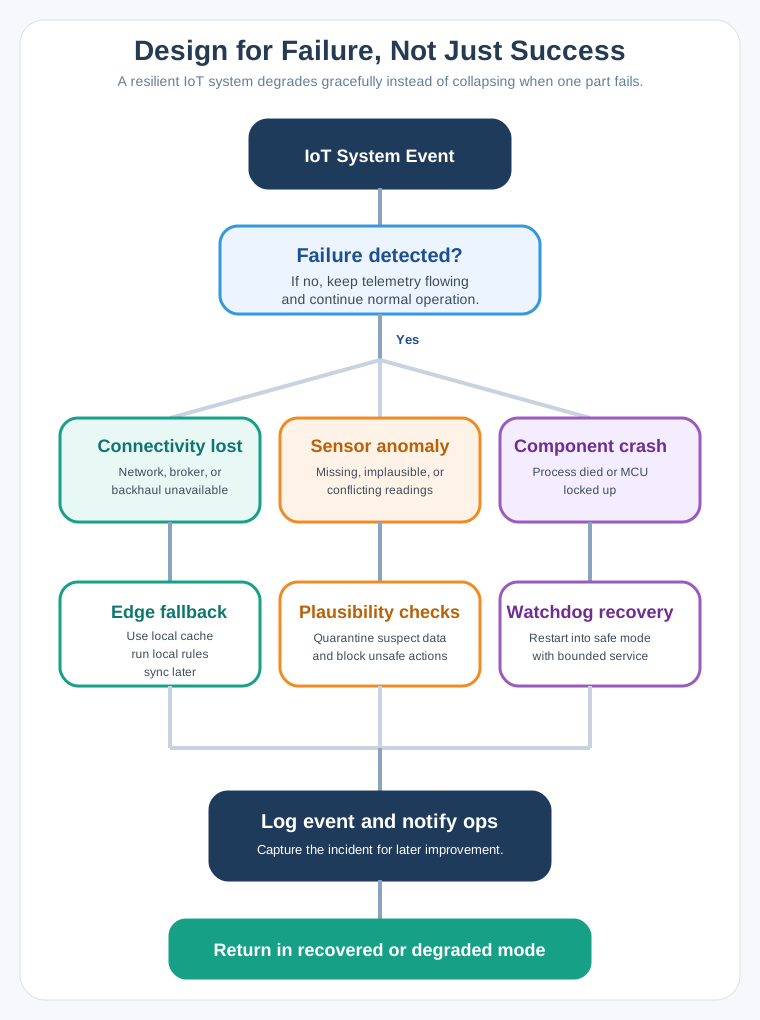
  • The first diamond only asks whether a failure was detected, and the no branch keeps normal telemetry running, so detection has to be cheap enough to sit in the hot path.
Failure-mode response flow for graceful IoT degradation.
iotclass.org

Major section

IoT Total Cost of Ownership

Key insight: Organizations budgeting only upfront hardware costs run out of funding in Year 2.

  • The "invisible" 75% (connectivity $48K, cloud $32K, maintenance $20K over 4 years) explains why 60-75% of IoT projects fail to move beyond pilots.
  • Question 4: An IoT weather station reports a temperature of 847 degrees Celsius.
  • A plausibility check recognizes that 847C is physically impossible for a weather station (outside the range of -60C to +60C for typical deployments).
iotclass.org

Deck summary

Key takeaways

The mistake: Choosing smart home devices and platforms based on features alone, without considering interoperability, resulting in a fragmented ecosystem where devices cannot communicate across brands.

  • In this thousand-sensor case, devices take a quarter of the five-year budget, connectivity takes 30 percent, and cloud another 20 percent, with installation and maintenance splitting the rest evenly.
  • Testing schedules are rushed.
  • Key insight: Organizations budgeting only upfront hardware costs run out of funding in Year 2.
iotclass.org

Retrieval practice

Recall check 1 of 4

Blueprint Bina says: answer from memory, then check your reasoning.

Q1A startup budgets $75,000 for a 200-sensor IoT deployment (hardware + installation). After 18 months, they have spent $110,000 due to unexpected connectivity and cloud fees. Using the TCO rule that hardware is ~25% of 5-year cost, what should their original 5-year budget have been?

A$75,000 -- the hardware budget was correct; the overrun was due to poor vendor negotiation
B$150,000 -- double the hardware cost covers operational expenses
C$300,000 -- hardware is ~25% of 5-year TCO, so $75K / 0.25 = $300K
D$110,000 -- the actual 18-month spend is the best predictor of total cost
Show answer

Answer: C The TCO rule of thumb states hardware is approximately 25% of the 5-year total cost.

iotclass.org

Retrieval practice

Recall check 2 of 4

Blueprint Bina says: answer from memory, then check your reasoning.

Q2A homeowner has 15 smart devices from 5 different manufacturers, all connected to the main home Wi-Fi network alongside laptops and phones with banking apps. Which action provides the MOST immediate security improvement?

AUpdate firmware on all devices
BCreate a separate VLAN or guest network for IoT devices
CChange the Wi-Fi password
DInstall a new smart home hub
EVoice assistant support + smartphone app + nice design
FMatter support + local API + works without cloud
Show answer

Answer: Review the source

Q3You are shopping for a smart thermostat. Which combination of features BEST protects against vendor lock-in?

AVoice assistant support + smartphone app + nice design
BMatter support + local API + works without cloud
CLowest price + good reviews + energy star rating
DCloud dashboard + remote access + subscription analytics
Show answer

Answer: Review the source

iotclass.org

Retrieval practice

Recall check 3 of 4

Blueprint Bina says: answer from memory, then check your reasoning.

Q4A factory deploys 1,000 temperature sensors with a Year 1 budget of $100,000 covering devices and installation. Using the TCO framework, what is the approximate 5-year total cost?

A$100,000
B$125,000
C$200,000
D$500,000
Show answer

Answer: Review the source

Q5An IoT weather station reports a temperature of 847 degrees Celsius. What is the CORRECT system response?

ALog the value and forward it to the cloud dashboard
BIgnore the reading and wait for the next one
CReject the value, use last known good reading, and alert operations
DShut down the sensor immediately
EThe cloud platform has a bug
FThe devices have manufacturing defects
Show answer

Answer: Review the source

iotclass.org

Retrieval practice

Recall check 4 of 4

Blueprint Bina says: answer from memory, then check your reasoning.

Q6A startup builds an IoT prototype with 10 devices that works perfectly in the lab. When deploying 2,000 devices in production, they experience frequent message drops and timeouts. What is the MOST LIKELY root cause?

AThe cloud platform has a bug
BThe devices have manufacturing defects
CNetwork contention and insufficient capacity planning for concurrent connections
DThe lab prototype used different firmware
Show answer

Answer: Review the source

iotclass.org

Print reference

Answers

Answer key.

  1. C · The TCO rule of thumb states hardware is approximately 25% of the 5-year total cost.
  2. Review the source
  3. Review the source
  4. Review the source
  5. Review the source
  6. Review the source
iotclass.org