Prototyping · Study deck
Reference: IoT Code Pattern Library
Picture a learner copying a sensor example that works once on a desk.
Voltage Vera is your guide for this deck.
After studying this chapter
Learning objectives
You will be able to:
- Implement common IoT code patterns for sensor reading, MQTT messaging, and HTTP communication on ESP32
- Use JSON serialization and ring buffers for efficient IoT data handling
- Configure BLE beacons and LoRa point-to-point communication for wireless IoT projects
- Implement common ESP32/Arduino patterns for sensor reading, MQTT messaging, and HTTP communication
Major section
Start With the Behavior to Prove
In the project, the pin differs, the reply arrives late, and a missing field causes a restart.
- Code that runs is not yet code that fits the new boundary.
- A protocol is an agreed set of message and timing rules.
- Bluetooth Low Energy (BLE) is a short-range radio system.
- Hardware, libraries, and field conditions differ.
Major section
Start With the Behavior to Prove (continued)
Hypertext Transfer Protocol (HTTP) carries web requests and replies.
- JavaScript Object Notation (JSON) is a text shape for named data.
- Message Queuing Telemetry Transport (MQTT) carries named messages through a service.
- This process does not make a snippet production-ready.
- A snippet should prove one behavior before it becomes project code.
Major section
Snippets Are Starting Points
A snippet is not a finished design record.
- Even a short DHT22 example carries assumptions about sampling interval and invalid reads.
- A PubSubClient example carries assumptions about broker reachability, keepalive timing, topic policy, client identity, and payload length.
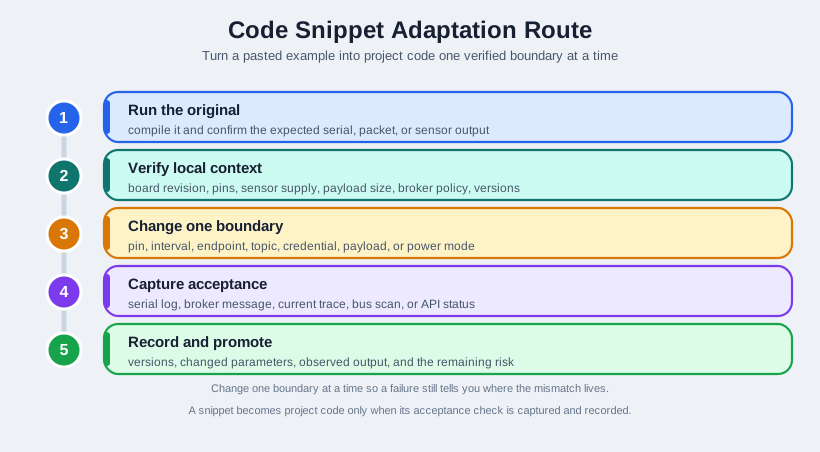
- The library is therefore organized for transfer, not blind copying.
Major section
Adapt One Boundary at a Time
Logic-analyzer traces can prove an I2C or SPI transaction is actually leaving the board.
- The safest way to reuse snippets is to change one boundary, run it, and inspect the result before moving to the next boundary.
- For I2C scanner code, confirm pullups, SDA/SCL pins, bus speed, address conflicts, and whether Wi-Fi is using ESP32 ADC or bus resources.
- ArduinoJson Assistant can size JSON documents before heap pressure appears on the board.
Major section
Adapt One Boundary at a Time (continued)
For MQTT or HTTP snippets, confirm client ID, topic policy, QoS choice, timeout, retry delay, TLS need, and payload size.
- If several of those change at once, a failure no longer tells you where the real mismatch lives.
- PlatformIO or Arduino IDE can pin board and library versions, which keeps a working example reproducible after the next library update.
- PubSubClient buffer settings should be checked before a payload is blamed on the broker.
Major section
Adapt One Boundary at a Time (continued)
Broker logs and Wireshark captures show whether MQTT, HTTP, DNS, TCP, and TLS are failing in the firmware, the network, or the server.
- Measured current traces are the only reliable way to check whether a sleep snippet saves the power it claims to save.
- As the snippet grows, move magic values out of the example body and into a visible configuration boundary: pins, topics, endpoints, thresholds, retry limits, and sleep intervals should be easy to review.
- ESP32 deep-sleep wake reasons should be logged before a wakeup path is trusted.
Major section
Snippets Hide State Boundaries
Small snippets look linear, but IoT behavior is stateful.
- Each boundary can succeed in isolation while the whole device still fails under timing, network, or power pressure.
- The hidden boundary is ownership.
- The learner owns hardware limits, credentials, timing, error handling, security, logging, and maintainability.
- The state-machine view helps explain why.
Major section
Snippets Hide State Boundaries (continued)
A production path must replace placeholder credentials, public brokers, blocking loops, unbounded retries, and demo delays with project-specific configuration, timeouts, observability, and failure handling.
- A reliable device is usually not "read sensor, publish, delay" forever.
- Interrupts, timers, queues, and network callbacks may enter that state machine at awkward times.
- Without bounded retries, a radio outage can turn into a battery drain.
- Without input validation, one malformed payload can poison downstream logic.
Deck summary
Key takeaways
In the project, the pin differs, the reply arrives late, and a missing field causes a restart.
- Hypertext Transfer Protocol (HTTP) carries web requests and replies.
- A snippet is not a finished design record.
- Logic-analyzer traces can prove an I2C or SPI transaction is actually leaving the board.
- For MQTT or HTTP snippets, confirm client ID, topic policy, QoS choice, timeout, retry delay, TLS need, and payload size.
Retrieval practice
Recall check 1 of 3

Voltage Vera says: answer from memory, then check your reasoning.
Q1A learner finds a code snippet that almost matches their project. What should they do?
Show answer
Answer: D Code snippets should be adapted, tested, and documented before they become project code.
Q2Complete the robust sensor reading with retry pattern:
Show answer
Answer: A Robust sensor reading combines validation (is_valid checks physical plausibility) with specific exception handling (SensorError) and progressive backoff between retries.
Retrieval practice
Recall check 2 of 3
Voltage Vera says: answer from memory, then check your reasoning.
Q3You find an MQTT code snippet that publishes hospital heart-rate alerts using QoS 0. Which change first addresses the risk that a publish is silently lost on an MQTT delivery hop?
Show answer
Answer: C QoS 1 or 2 adds MQTT delivery acknowledgements on each sender-to-receiver hop.
Retrieval practice
Recall check 3 of 3
Voltage Vera says: answer from memory, then check your reasoning.
Q4Complete the MQTT broker message routing function:
Show answer
Answer: A MQTT message routing parses the topic hierarchy with split('/'), decodes the binary payload to JSON, extracts the device ID from the topic path, and republishes to a processed topic.
Print reference
Answers
Answer key.
- D · Code snippets should be adapted, tested, and documented before they become project code.
- A · Robust sensor reading combines validation (is_valid checks physical plausibility) with specific exception handling (SensorError) and progressive backoff between retries.
- C · QoS 1 or 2 adds MQTT delivery acknowledgements on each sender-to-receiver hop.
- A · MQTT message routing parses the topic hierarchy with split('/'), decodes the binary payload to JSON, extracts the device ID from the topic path, and republishes to a processed topic.