Industrial IoT and Business Operations · Study deck
IoT Unit Economics Metrics Contracts
Imagine a firm sells one more connected tracker and wants to know when that sale will pay back its full cost.
Ada is your guide for this deck.

After studying this chapter
Learning objectives
You will be able to:
- Explain why IoT financial metrics must include hardware, connectivity, cloud, support, warranty, and field-service costs.
- Separate one-time hardware margin from recurring service contribution margin.
- Build cohort metrics from acquisition, activation, recurring revenue, churn, support load, returns, and data cost.
- Identify the telemetry, billing, support, and operations records needed for reliable LTV, CAC, payback, and TCO calculations.
Major section
Check the Tracker Cohort Margin
Tie billing, device state, support work, and cloud cost to the same cohort.
- The team must decide whether the customer and device can be served at a fair gain.
- Telemetry means reports that a device sends so people can check its use and health from afar.
- The Practitioner depth tests payback, churn, and cost attribution over time.
Major section
Hardware, Cloud, Ops Economics
IoT financial metrics are not just SaaS metrics with devices attached.
- The business may pay for hardware manufacturing, installation, connectivity, cloud ingestion, long-term storage, warranty returns, support calls, firmware maintenance, security updates, and field service.
- Those costs change the meaning of margin, LTV, CAC, and payback.
- It also separates provider economics from customer economics.
Major section
Hardware, Cloud, Ops Economics (continued)
The metrics are only as good as the records that agree underneath.
- A smart lock, fleet tracker, industrial vibration sensor, and cold-chain monitor may all report monthly recurring revenue, but each has a different bill of materials, installation pattern, support risk, and data-cost curve.
- Churn comes from device lifecycle state, which in a connected product is rarely a clean field.
- TCO: The customer-side and provider-side costs that continue after the device is activated.
Major section
Hardware, Cloud, Ops Economics (continued)
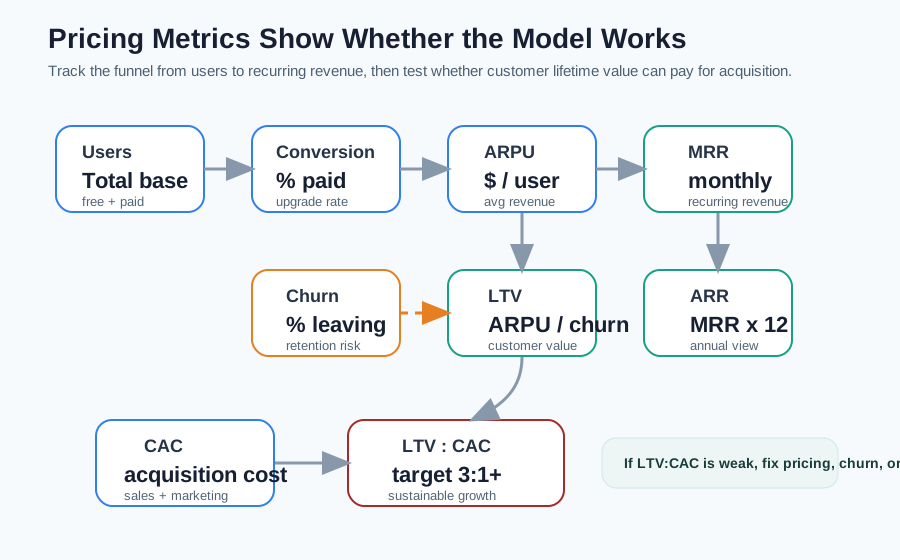
Lifetime value is then built from two of those numbers, so it inherits both of their errors.
- The final comparison against acquisition cost is the only box that tests the business, and for hardware it must absorb subsidy and installation as well as sales spend.
- A connected product can look healthy if revenue is counted but device subsidy, SIM data, video storage, message processing, truck rolls, and support labor are hidden.
- A useful financial model separates one-time hardware margin from recurring service contribution margin, then checks whether retention and expansion can pay back acquisition and deployment costs.
Major section
Cohorts and Cost Drivers
Track activation rate, paid conversion, ARPU or ARPA, gross margin, churn, net revenue retention, support contacts, device returns, and data cost over time.
- Cohorts reveal whether a channel is profitable or simply producing short-lived customers.
- IoT products need cost-driver metrics beside revenue metrics.
- Without those drivers, discounting decisions are guesses.
Major section
Cohorts and Cost Drivers (continued)
Finance can own the definitions, but product and engineering must own the signals that feed them.
- For each customer segment, estimate messages per device, storage GB per month, video minutes retained, API calls, firmware-download volume, notification volume, cellular data, replacement rate, warranty reserve, and support minutes.
- These numbers explain why two customers on the same plan can have very different margins.
- Rework packaging when support tickets cluster around one feature.
Major section
Reliable Event and Billing Data
Financial metrics depend on product telemetry and billing records agreeing.
- The platform needs durable customer ids, account ids, device ids, plan ids, activation timestamps, usage events, invoice lines, refund events, support tickets, warranty replacements, and cancellation reasons.
- Cost attribution is equally important.
- Billing systems provide invoices, credits, discounts, renewals, and plan changes.
Major section
Reliable Event and Billing Data (continued)
The data pipeline should preserve the pricing dimension that matters: device count, message count, payload size, retained days, query volume, alert count, support case, field visit, or entitlement.
- The same physical device may be sold by a reseller, assigned to a site, transferred to another account, replaced under warranty, and later reactivated, so identity and lifecycle state must be modeled deliberately.
- Financial health also has operational signals.
- Metrics should trigger product decisions, not just board slides.
Major section
Reliable Event and Billing Data (continued)
Version those definitions because a small change in churn or margin logic can change investment decisions.
- Message brokers, IoT hubs, object storage, time-series databases, data warehouses, video processing, notification services, and observability tools can each create recurring costs.
- Under the hood, this usually means a governed metrics mart rather than a dashboard-only spreadsheet.
- A rising cloud bill may be acceptable if paid usage and retention rise faster.
Deck summary
Key takeaways
Tie billing, device state, support work, and cloud cost to the same cohort.
- IoT financial metrics are not just SaaS metrics with devices attached.
- The metrics are only as good as the records that agree underneath.
- Lifetime value is then built from two of those numbers, so it inherits both of their errors.
- Track activation rate, paid conversion, ARPU or ARPA, gross margin, churn, net revenue retention, support contacts, device returns, and data cost over time.
Retrieval practice
Recall check 1 of 5

Ada says: answer from memory, then check your reasoning.
Q1A connected camera has a profitable device sale but costly storage and support. How should its offer be reviewed?
Show answer
Answer: D The two margins show whether the ongoing promise pays for itself.
Retrieval practice
Recall check 2 of 5
Ada says: answer from memory, then check your reasoning.
Q2Per this chapter, why can't IoT financial metrics be treated as 'SaaS metrics with devices attached'?
Show answer
Answer: B Those costs change the meaning of margin, LTV, CAC, and payback.
Retrieval practice
Recall check 3 of 5
Ada says: answer from memory, then check your reasoning.
Q3Cloud costs spike only for customers that send far more data than the base plan assumes. Which offer change follows the cost evidence?
Show answer
Answer: A The cost driver varies with usage, so the offer should make that usage visible and priced.
Retrieval practice
Recall check 4 of 5
Ada says: answer from memory, then check your reasoning.
Q4Per this chapter's cohort example, how do a distributor-led agriculture cohort and a direct enterprise manufacturing cohort typically differ, even on the same devices and dashboard?
Show answer
Answer: B a distributor-led agriculture cohort may have lower CAC but higher support cost during irrigation season, while a direct enterprise manufacturing cohort may have high CAC, longer payback, and stronger expansion revenue once the integration is stable.
Retrieval practice
Recall check 5 of 5
Ada says: answer from memory, then check your reasoning.
Q5Why should IoT financial metrics join telemetry, billing, support, and cost records instead of relying only on invoice totals?
Show answer
Answer: A An invoice total only shows what was billed, not which devices are actually active, what each one costs to serve, or whether its usage is even billable.
Print reference
Answers 1 of 2
Answer key.
- D · The two margins show whether the ongoing promise pays for itself.
- B · Those costs change the meaning of margin, LTV, CAC, and payback.
- A · The cost driver varies with usage, so the offer should make that usage visible and priced.
- B · a distributor-led agriculture cohort may have lower CAC but higher support cost during irrigation season, while a direct enterprise manufacturing cohort may have high CAC, longer payback, and stronger expansion revenue once the integration is stable.
Print reference
Answers 2 of 2
Answer key.
- A · An invoice total only shows what was billed, not which devices are actually active, what each one costs to serve, or whether its usage is even billable.