Applications & Use Cases · Study deck
IoT Pricing: Revenue Models and Selection
A connected service now has clear tiers, but the team still has to decide what customers pay for each month.
Blueprint Bina is your guide for this deck.
After studying this chapter
Learning objectives
You will be able to:
- Explain: Transaction fees grow with ecosystem activity and therefore need enough market volume, while freemium lowers the adoption barrier but depends on a small share converting to paid features.
- Explain: Users become paying users through a conversion rate, average revenue per user turns those into monthly recurring revenue, and twelve months of it gives the annual view.
- Explain: The first split asks whether you sell a connected device or a software platform, because a device carries hardware cost that the model has to repay.
- Explain: The note at the foot states the tree's bias towards recurring revenue.
Major section
Revenue Model Types
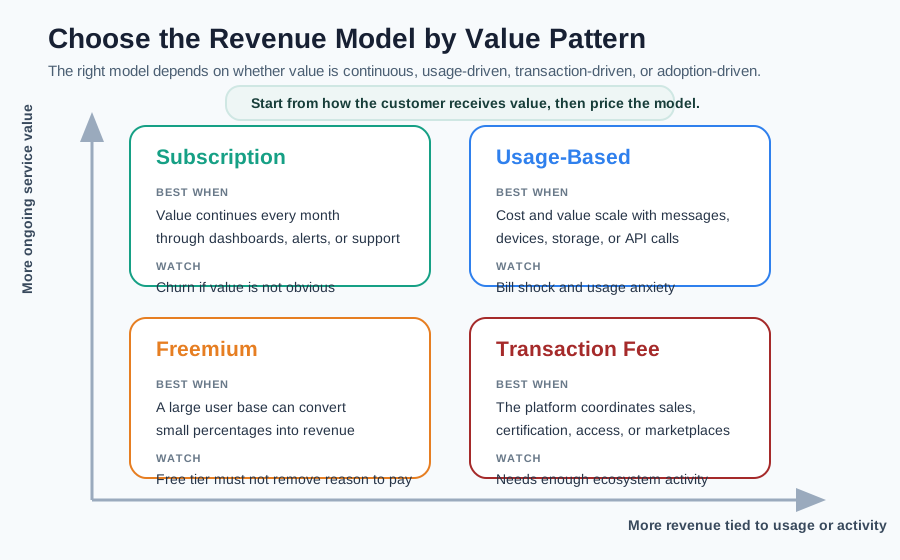
Understanding the four primary IoT revenue models helps you choose the right approach for your product, market, and growth stage.
- Usage pricing aligns payment with consumption, although revenue then varies with use.
- Subscription models provide predictable recurring income with continuous value demonstration.
- Examples:: Nest Aware, Ring Protect, Fitbit Premium.
- Usage-based models align costs with customer consumption through metering.
Major section
Revenue Model Types (continued)
Transaction fees grow with ecosystem activity and therefore need enough market volume, while freemium lowers the adoption barrier but depends on a small share converting to paid features.
- Revenue varies with usage patterns.
- Revenue grows with ecosystem activity.
- The note at the foot states the tree's bias towards recurring revenue.
Major section
Revenue Model Types (continued)
The second asks whether revenue should recur or arrive once, which is a choice about the obligation you accept, not about the price tag.
- The third asks what the data is worth, and it is the question that separates a subscription from a plain sale.
- Every leaf is a named model rather than a slogan, from hardware as a service to metered usage to a perpetual licence.
- The first split asks whether you sell a connected device or a software platform, because a device carries hardware cost that the model has to repay.
Major section
Pricing Metrics Dashboard
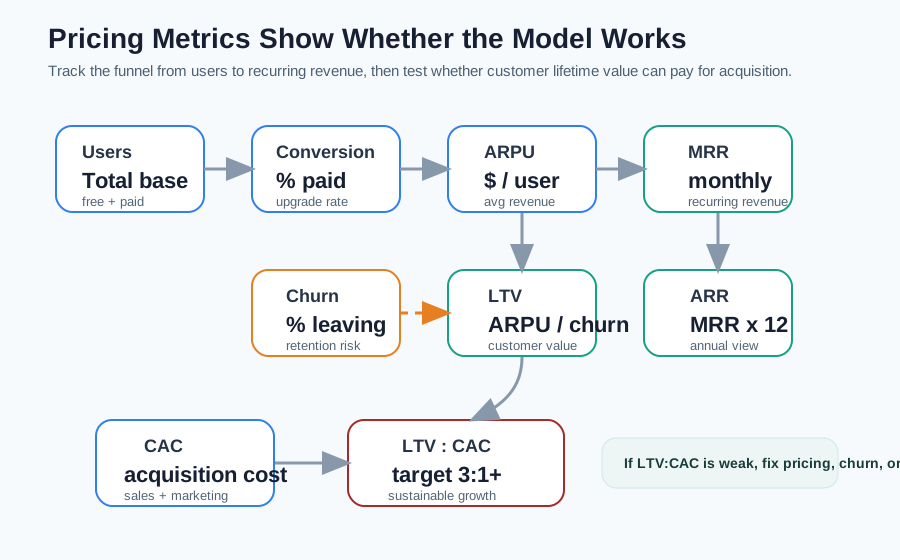
Understanding pricing effectiveness requires tracking the right metrics.
- This diagram shows the key metrics and their relationships.
- Users become paying users through a conversion rate, average revenue per user turns those into monthly recurring revenue, and twelve months of it gives the annual view.
Major section
Price by Value, Not Cost
The Error: A smart energy monitor costs $85 to build (BOM + manufacturing).
- The company prices it at $149 (75% markup) feeling this is generous.
- Meanwhile, the device saves customers $200/month in electricity costs by detecting HVAC inefficiencies.
- Companies fear customers will reject high prices and gravitate toward "reasonable" markups (50-100%) common in consumer electronics.
Deck summary
Key takeaways
Understanding the four primary IoT revenue models helps you choose the right approach for your product, market, and growth stage.
- Transaction fees grow with ecosystem activity and therefore need enough market volume, while freemium lowers the adoption barrier but depends on a small share converting to paid features.
- The second asks whether revenue should recur or arrive once, which is a choice about the obligation you accept, not about the price tag.
- Understanding pricing effectiveness requires tracking the right metrics.
- The Error: A smart energy monitor costs $85 to build (BOM + manufacturing).
Retrieval practice
Recall check 1 of 5

Blueprint Bina says: answer from memory, then check your reasoning.
Q1A smart home security company offers: Free tier (live camera view only), Basic ($3/month for 7-day video history), Premium ($10/month for 30-day history + AI alerts). They have 500K free users, 75K Basic (15% conversion), and 25K Premium (5% total, 33% of paid). What should they optimize?
Show answer
Answer: B Correct!
Retrieval practice
Recall check 2 of 5

Blueprint Bina says: answer from memory, then check your reasoning.
Q2A smart building IoT platform serves three customer segments: Startups (10-50 sensors, limited budget, need ease of use), Growth companies (200-500 sensors, need API integrations), Enterprises (5000+ sensors, need SLAs and custom features). How should they structure tiered pricing?
Show answer
Answer: B Correct!
Retrieval practice
Recall check 3 of 5

Blueprint Bina says: answer from memory, then check your reasoning.
Q3The chapter describes emerging business model trends including edge computing integration, AI/ML enhancement, and 5G connectivity. How does edge computing shift IoT business model economics compared to pure cloud processing?
Show answer
Answer: A Edge computing processes data locally (on devices or edge servers), reducing bandwidth costs by transmitting only insights (not raw data) to cloud.
Retrieval practice
Recall check 4 of 5

Blueprint Bina says: answer from memory, then check your reasoning.
Q4An agricultural IoT startup provides soil moisture sensors to farmers. Sensor data is uploaded daily via LoRaWAN. Farmers check dashboards weekly to decide irrigation schedules. The startup currently charges $500 per sensor (one-time purchase) but is losing money on cloud hosting. Which revenue model transition would best fix their economics?
Show answer
Answer: B Correct!
Retrieval practice
Recall check 5 of 5

Blueprint Bina says: answer from memory, then check your reasoning.
Q5Place each pricing responsibility where it lives so you can test whether the billed metric follows customer value while still covering metered device and cloud costs.
Show answer
Answer: A Healthy IoT pricing connects a customer-visible value metric to a trustworthy entitlement meter and a cost floor that includes the entire connected service.
Q6Complete the pricing gate for an IoT subscription tier:
Show answer
Answer: A A pricing gate should reject tiers with weak LTV:CAC economics or low gross margin before the team invests in launch, sales collateral, and billing configuration.
Print reference
Answers 1 of 2
Answer key.
- B · Correct!
- B · Correct!
- A · Edge computing processes data locally (on devices or edge servers), reducing bandwidth costs by transmitting only insights (not raw data) to cloud.
- B · Correct!
- A · Healthy IoT pricing connects a customer-visible value metric to a trustworthy entitlement meter and a cost floor that includes the entire connected service.
Print reference
Answers 2 of 2
Answer key.
- A · A pricing gate should reject tiers with weak LTV:CAC economics or low gross margin before the team invests in launch, sales collateral, and billing configuration.