Applications & Use Cases · Study deck
IoT Go-to-Market: Launch Gates and Channels
The product team has a price and a plausible LTV:CAC ratio, but that does not say who should sell, install, support, and expand the system.
Blueprint Bina is your guide for this deck.

After studying this chapter
Learning objectives
You will be able to:
- choose a go-to-market framework for an IoT offer
- design proof-of-concept and phased-launch gates
- compare channels and calculate blended acquisition cost
- Explain: Selecting the right pricing model for a B2B IoT product depends on the customer's risk tolerance, the vendor's cash position, and the ability to measure outcomes.
Major section
GTM Strategy Frameworks
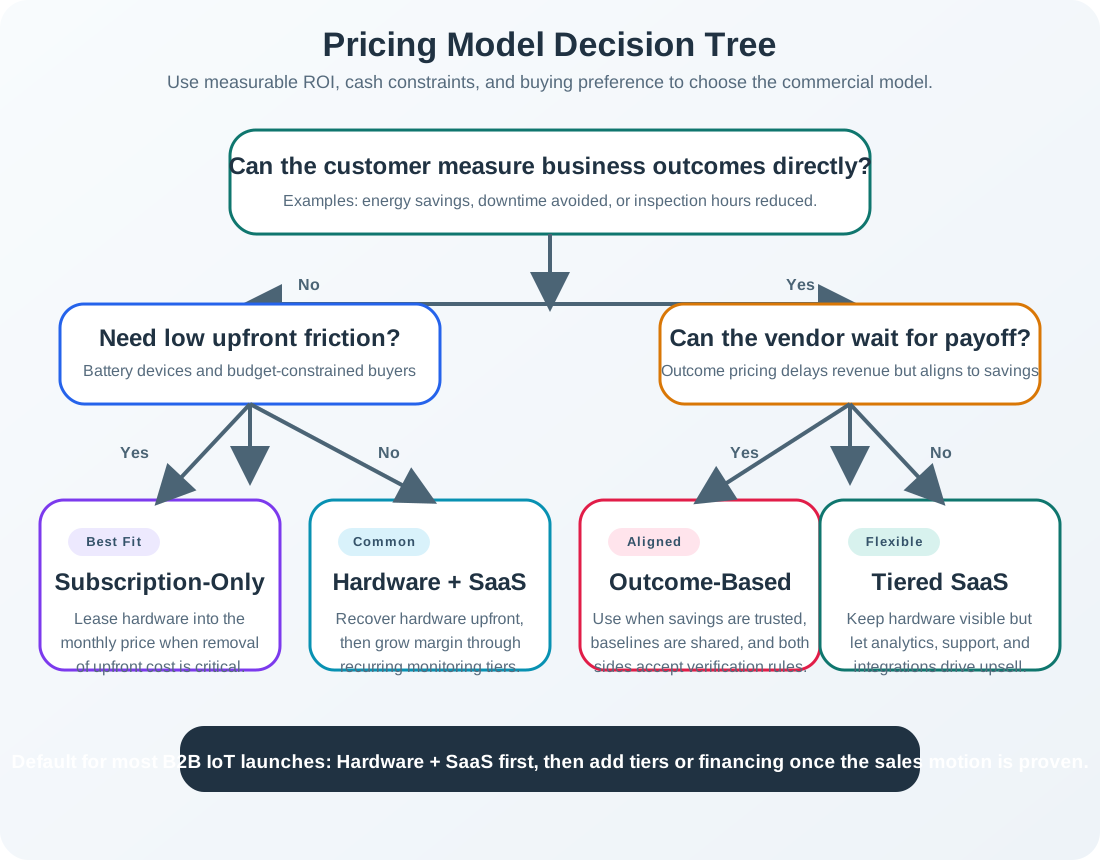
Selecting the right pricing model for a B2B IoT product depends on the customer's risk tolerance, the vendor's cash position, and the ability to measure outcomes.
- The decision tree above helps product leaders evaluate alternatives based on their specific market conditions.
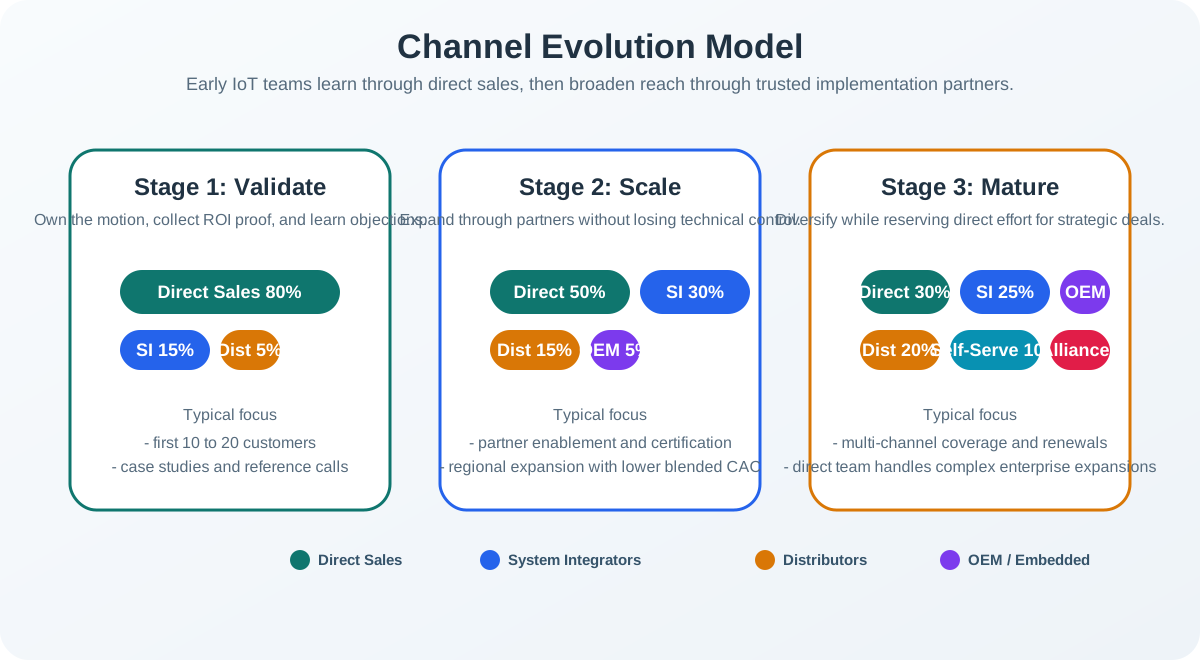
- The decision in channel evolution model must preserve that labelled boundary.
Major section
GTM Strategy Frameworks (continued)
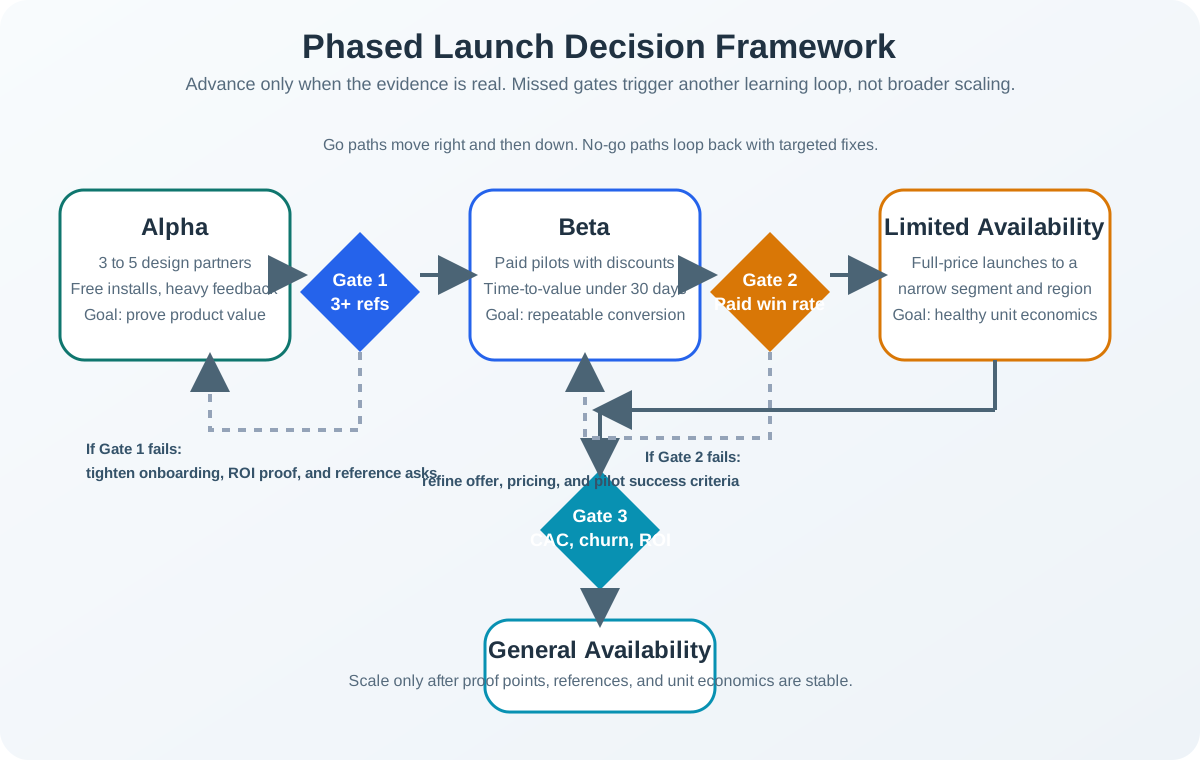
The following diagram shows the gate criteria between phases.
- By Year 2-3 (teal), partner channels scale reach while direct sales handles complex enterprise deals.
- At maturity (orange), revenue is diversified across five channels with self-serve emerging for smaller accounts.
- Each gate (diamond) represents a go/no-go decision.
Major section
GTM Strategy Frameworks (continued)
The decision to advance from one launch phase to the next should be governed by objective metrics, not calendar time.
- Failing a gate is not failure -- it is a signal to iterate.
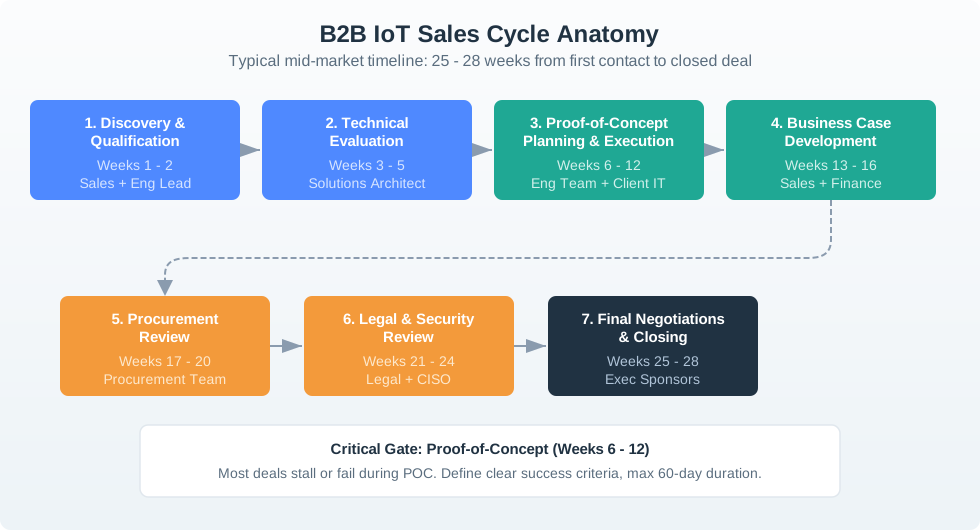
- Understanding the typical B2B IoT sales cycle helps teams plan resource allocation and forecast accurately.
- Together those labels make b2b iot sales cycle diagram showing seven sequential stages from initial contact through contract signature: discovery and qualification (weeks 1-2), testable.
Major section
IoT GTM Pitfalls
Scaling sales before product-market fit is proven.: Hiring a VP Sales and 5 account executives before securing 3+ paying reference customers burns $1M+ with no validated sales playbook.
- Ignoring Net Revenue Retention.: Growing new logos while existing customers churn or contract is an expensive treadmill.
- NRR above 110% means existing customers expand faster than they leave, compounding growth.
- Below 100% means you must acquire new customers just to maintain revenue.
Major section
Channel Mix and Blended CAC
Model your go-to-market channel strategy by adjusting the percentage of customers acquired through each channel and their respective acquisition costs.
- Scenario: An IoT fleet tracking company currently uses 100% direct sales with a $25,000 CAC.
- They're considering adding system integrators (SIs) who can acquire customers at $10,000 CAC but take 25% of first-year revenue as margin.
- SI takes 25% margin in Year 1 ONLY, not recurring years.
Major section
Channel Mix and Blended CAC (continued)
But SI takes 25% of first-year revenue: 0.25 × $50,000 = $12,500 margin share.
- Effective SI CAC = $10,000 + $12,500 = $22,500 (you still "pay" via margin share).
- SI customers have 10% lower LTV due to first-year margin share.
- The value is in incremental volume, not cost reduction.
Major section
Channel Mix and Blended CAC (continued)
While effective CAC is higher than it first appears ($22,500 vs nominal $10,000) and LTV decreases slightly, the volume increase (+20% customers) is the key benefit.
- Blended CAC improves modestly (5%), but the real win is scaling beyond what the direct team can reach.
- Key Insight: When evaluating partner channels, account for margin share as part of CAC.
- A "$10K CAC" channel that takes 25% margin is really a "$22.5K CAC" channel.
Deck summary
Key takeaways
Selecting the right pricing model for a B2B IoT product depends on the customer's risk tolerance, the vendor's cash position, and the ability to measure outcomes.
- The following diagram shows the gate criteria between phases.
- The decision to advance from one launch phase to the next should be governed by objective metrics, not calendar time.
- Scaling sales before product-market fit is proven.: Hiring a VP Sales and 5 account executives before securing 3+ paying reference customers burns $1M+ with no validated sales playbook.
- Model your go-to-market channel strategy by adjusting the percentage of customers acquired through each channel and their respective acquisition costs.
Retrieval practice
Recall check 1 of 5

Blueprint Bina says: answer from memory, then check your reasoning.
Q1A smart energy management IoT system reduces a facility's electricity bill by $5,000/month (verified through utility meter data). The system costs $500/month subscription + $10,000 one-time installation. The customer questions whether the price is 'fair.' How should the company justify the pricing using value-based principles?
Show answer
Answer: C Correct!
Retrieval practice
Recall check 2 of 5

Blueprint Bina says: answer from memory, then check your reasoning.
Q2An IoT platform startup wants to compete with established players (AWS IoT, Azure IoT). They plan to differentiate through lower transaction fees (10% vs competitors' 30%). Initial market research shows 200 potential device manufacturers and 500 developers interested. What's the biggest risk to this strategy?
Show answer
Answer: A Correct!
Retrieval practice
Recall check 3 of 5

Blueprint Bina says: answer from memory, then check your reasoning.
Q3A connected fitness equipment company currently generates 80% of revenue from hardware sales ($2000/device, 30% margin) and 20% from subscriptions ($39/month workout classes). They want to reduce hardware dependency. Leadership proposes: A) Launch advertising-supported free tier, B) Sell aggregated workout data to insurance companies, C) Increase subscription price to $59/month. Which creates the most sustainable diversification?
Show answer
Answer: C Correct!
Retrieval practice
Recall check 4 of 5

Blueprint Bina says: answer from memory, then check your reasoning.
Q4An IoT company selling fleet tracking devices has a CAC (Customer Acquisition Cost) of $25,000 through direct sales and an LTV (Lifetime Value) of $75,000 (LTV:CAC = 3:1). They want to improve this ratio. Which channel strategy change would have the biggest impact?
Show answer
Answer: A Correct!
Retrieval practice
Recall check 5 of 5

Blueprint Bina says: answer from memory, then check your reasoning.
Q5Place each go-to-market decision where it lives so you can move from a chosen customer through a viable offer to evidence-gated scale.
Show answer
Answer: A Follow segment, commercial design, and launch gate so you can avoid scaling channels before customer value and economics are proven.
Q6Complete the B2B IoT launch-gate evaluator:
Show answer
Answer: A A GTM launch gate should hold the product in beta when references or POC evidence are weak, then block general availability when LTV:CAC or payback does not support scaling.
Print reference
Answers
Answer key.
- C · Correct!
- A · Correct!
- C · Correct!
- A · Correct!
- A · Follow segment, commercial design, and launch gate so you can avoid scaling channels before customer value and economics are proven.
- A · A GTM launch gate should hold the product in beta when references or POC evidence are weak, then block general availability when LTV:CAC or payback does not support scaling.