Applications & Use Cases · Study deck

IoT Business Models: Platforms and Revenue Strategy

A connected service has a clear customer outcome and a pricing idea, but it depends on devices, developers, connectivity, and support partners.

Blueprint Bina is your guide for this deck.

businessmodels
Blueprint Bina, the module guide, in a scene from this chapter.
iotclass.org

After studying this chapter

Learning objectives

You will be able to:

  • Explain: You now know why transaction fees such as 15-30% can compound at scale but also create pressure to keep every side of the ecosystem healthy.
  • Explain: The critical metric is not total users but the conversion rate from free to paid tiers, combined with average revenue per paying user (ARPU).
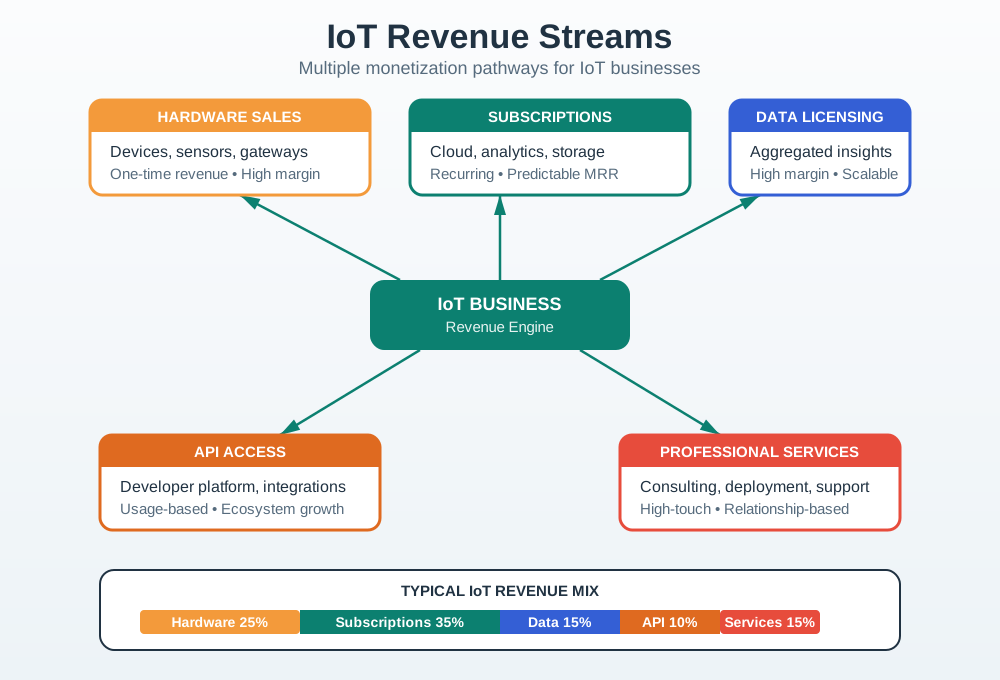
  • Explain: Hardware and professional services can be transaction-led, subscriptions are recurring, while data licensing and API access require a defensible information or integration product.
  • Explain: The simulator turns participant balance into a value and revenue estimate, but those outputs still need an economic interpretation.
iotclass.org

Major section

IoT Ecosystem Value Flows

IoT platforms coordinate several participant groups, but participation becomes a business only through a funded exchange.

  • The percentage bar is an illustrative mix, not a prescription.
iotclass.org

Major section

Network Effects Sim

The simulator turns participant balance into a value and revenue estimate, but those outputs still need an economic interpretation.

  • Hardware and professional services can be transaction-led, subscriptions are recurring, while data licensing and API access require a defensible information or integration product.
  • That constraint connects the simulator to the earlier value stack.
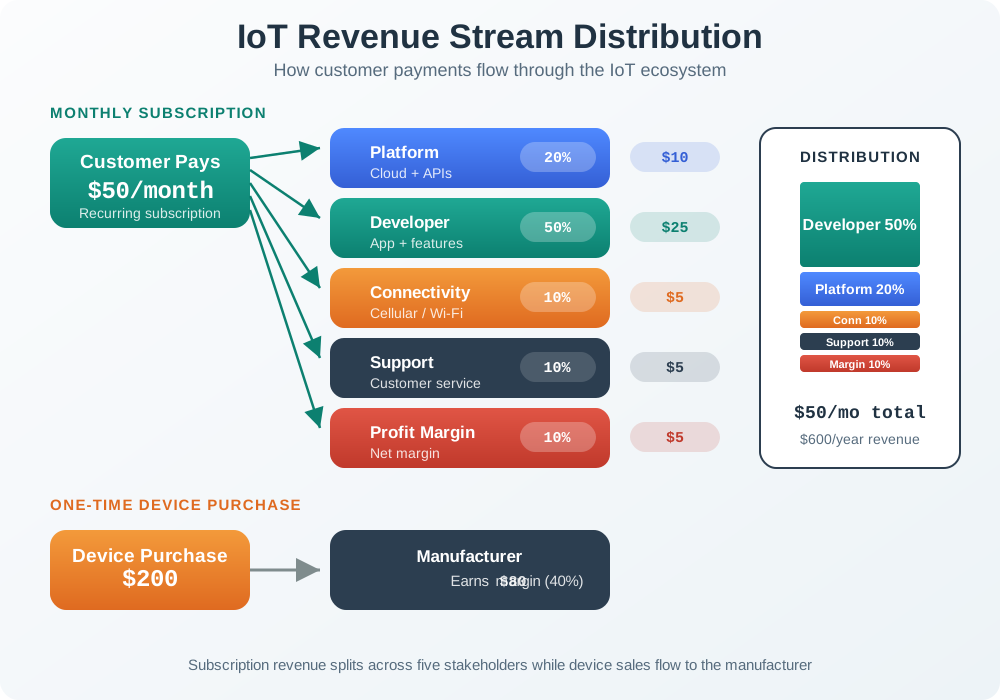
When a customer pays $50/month subscription, it splits: Platform takes 20% ($10), Developer receives 50% ($25), Connectivity costs 10% ($5), Support takes 10% ($5), leaving 10% ($5) profit margin.
iotclass.org

Major section

Checkpoint: Ecosystem Economics

You now know why platform value depends on balanced participation from device makers, app developers, and consumers.

  • You now know why transaction fees such as 15-30% can compound at scale but also create pressure to keep every side of the ecosystem healthy.
  • You now know why a $50/month subscription split across platform, developer, connectivity, support, and margin leaves less room than headline revenue suggests.
  • After the ecosystem view, the quizzes start checking whether you can recompute profit and predict network-effect failures without relying on the diagrams.
iotclass.org

Major section

Interactive Revenue Model Comparison

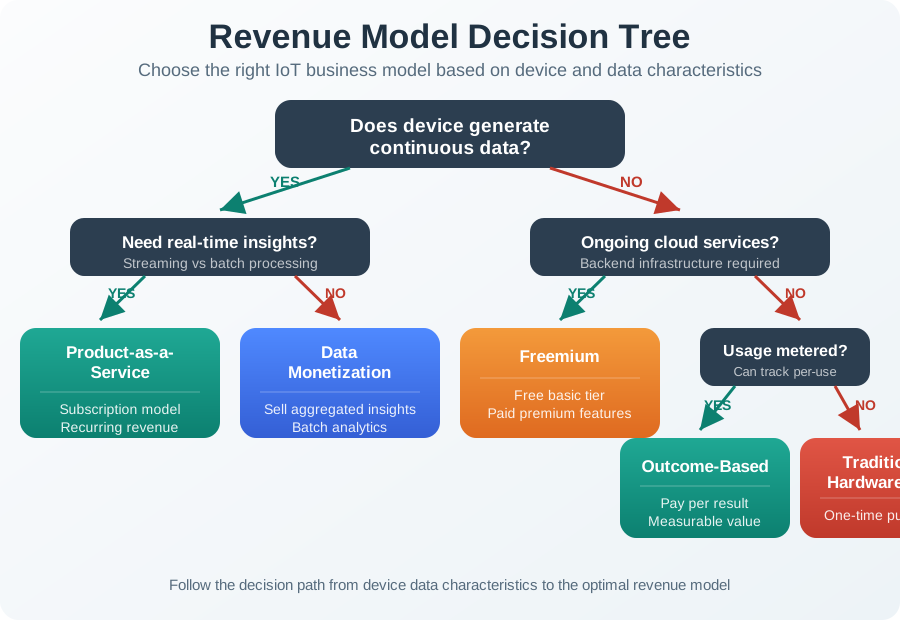
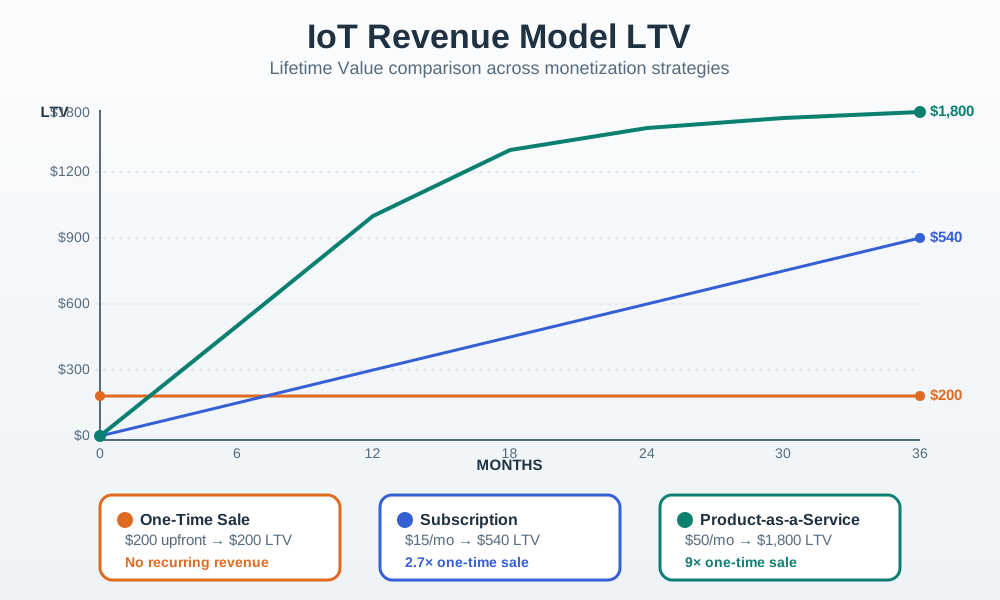
Revenue-model choice should follow from the service obligation, data cadence, and measurable customer value established earlier.

  • The endpoint does not settle willingness to pay, privacy, delivery cost, or risk.
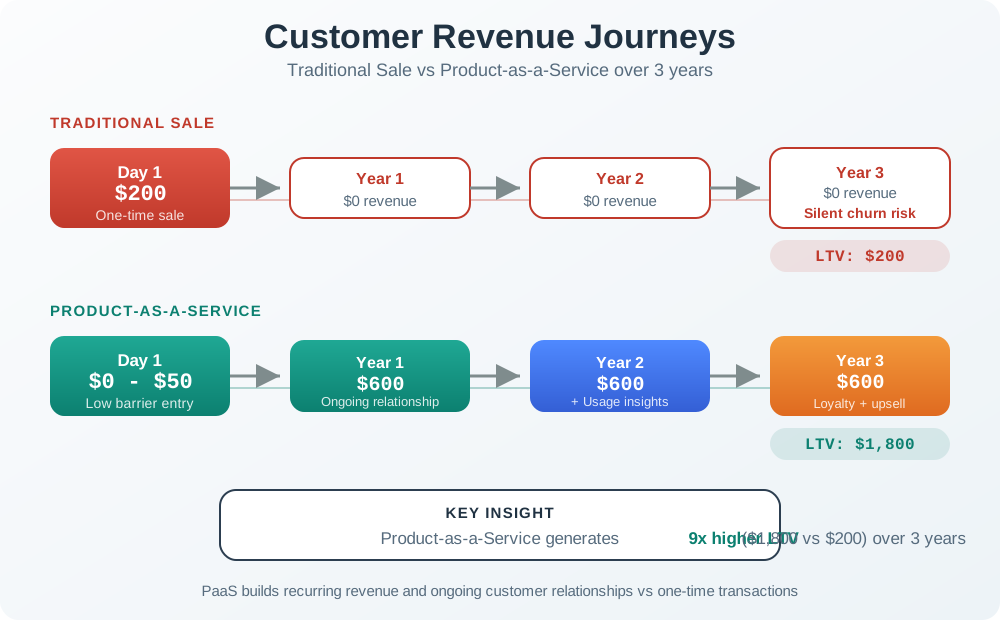
  • Its values follow the printed scenario assumptions; they are not promises that one model intrinsically produces higher lifetime value.

Key terms

Once a candidate
Once a candidate is chosen, compare the cash-flow shapes rather than ranking labels in isolation.

Try it: Interactive Revenue Model Comparison in the chapter

iotclass.org

Major section

IoT Business Model Pitfalls

The result is a device that functions perfectly without the paid service, giving customers no reason to subscribe.

  • Misconception 2: "More users automatically means more revenue.": Platform business models depend on network effects, but raw user counts are vanity metrics.
  • Raw sensor readings have minimal market value.
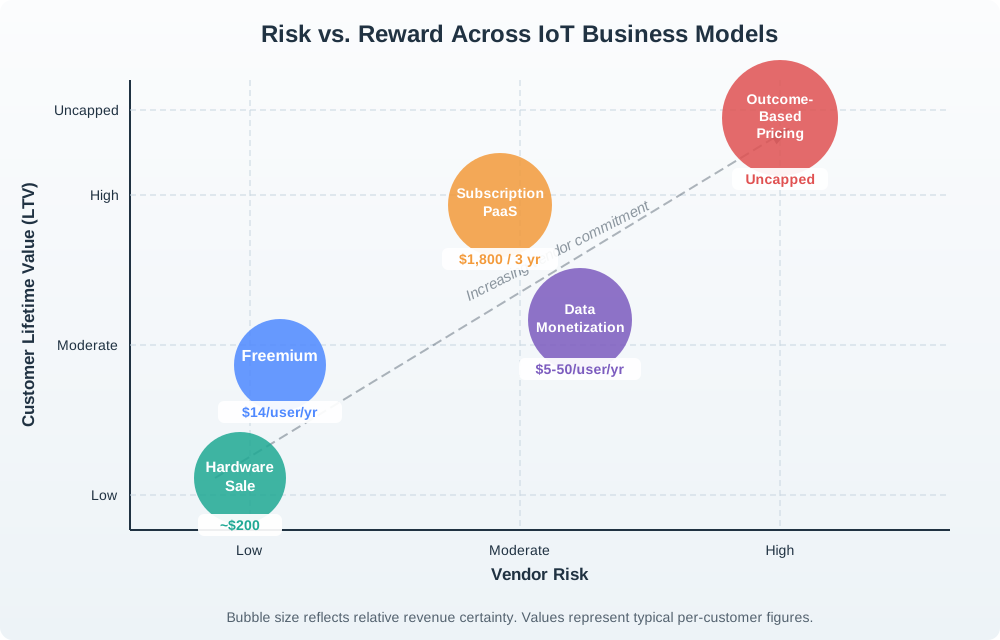
  • The positions are a reasoning aid, not empirical guarantees.

Key terms

Revenue potential
Revenue potential is only one axis of a model decision; the supplier's exposure changes with the promise being made.
iotclass.org

Major section

IoT Business Model Pitfalls (continued)
The critical metric is not total users but the conversion rate from free to paid tiers, combined with average revenue per paying user (ARPU).

  • The value lies in derived insights -- anomaly patterns, predictive models, benchmarking indices -- which require analytics investment.
  • Involuntary retention creates fragile revenue: these customers churn catastrophically when contracts expire or alternatives emerge.
  • If external factors (weather, market conditions, user behavior) affect outcomes, the vendor absorbs losses that are not their fault.
iotclass.org

Deck summary

Key takeaways

IoT platforms coordinate several participant groups, but participation becomes a business only through a funded exchange.

  • The simulator turns participant balance into a value and revenue estimate, but those outputs still need an economic interpretation.
  • You now know why platform value depends on balanced participation from device makers, app developers, and consumers.
  • Revenue-model choice should follow from the service obligation, data cadence, and measurable customer value established earlier.
  • The result is a device that functions perfectly without the paid service, giving customers no reason to subscribe.
iotclass.org

Retrieval practice

Recall check 1 of 5

Blueprint Bina says: answer from memory, then check your reasoning.

Q1A connected fitness equipment company currently sells treadmills for $2,000 each (one-time) with 25% gross margin. They are considering adding a $40/month subscription for live classes and performance analytics, reducing the treadmill price to $1,500. Over a 30-month customer lifetime, which model generates higher gross profit?

AOne-time model: $500 profit ($2,000 x 0.25) is more because subscription costs reduce margins
BSubscription model: $375 hardware + $960 subscription profit ($40 x 30 x 80% margin) = $1,335 total
CBoth are equal when accounting for the $500 hardware price reduction
DOne-time model is safer because subscription revenue depends on customer retention
Show answer

Answer: B Correct!

iotclass.org

Retrieval practice

Recall check 2 of 5

Blueprint Bina says: answer from memory, then check your reasoning.

Q2A startup is building a smart thermostat. Option A sells the device for $250 with a $120 manufacturing cost. Option B sells it for $99 with the same manufacturing cost and charges $8/month for analytics over a 24-month average customer lifetime. No analytics-service costs are supplied. What can the team conclude?

AOption A is more profitable because its known hardware contribution is $130
BOption B is more profitable because $99 + ($8 x 24) - $120 = $171
CNeither model's profit is determined; Option A contributes $130, while Option B contributes $171 before its unspecified service costs
DOption B has the stronger economics because the recurring relationship creates opportunities for renewals, upgrades, and additional analytics sales beyond the hardware transaction
Show answer

Answer: C The supplied figures establish Option A's $130 contribution and Option B's $171 before recurring service costs.

iotclass.org

Retrieval practice

Recall check 3 of 5

Blueprint Bina says: answer from memory, then check your reasoning.

Q3A smart lighting company offers a freemium model: free basic controls (on/off, dimming) and a $4.99/month premium tier (scheduling, energy analytics, scenes). They have 100,000 users. Industry average freemium conversion is 5-15%. If they achieve 10% conversion, what is their monthly recurring revenue (MRR), and what strategy would most effectively increase it?

AMRR = $49,900. Best strategy: Raise the premium price to $9.99/month to double revenue
BMRR = $49,900. Best strategy: Add a mid-tier at $2.99/month to capture users who find $4.99 too expensive
CMRR = $499,000. Best strategy: Focus on user acquisition to grow the free tier
DMRR = $49,900. Best strategy: Remove the free tier entirely to force all users to pay
Show answer

Answer: B Correct!

iotclass.org

Retrieval practice

Recall check 4 of 5

Blueprint Bina says: answer from memory, then check your reasoning.

Q4A fleet management company collects GPS, fuel, and driver behavior data from 50,000 trucks. They currently sell this data to insurance companies for $2/truck/month. A data broker offers to buy ALL raw data for $500,000/year. Which is the better data monetization strategy, and why?

ATake the $500,000/year broker deal to consolidate sales into one buyer and reduce direct customer management
BKeep selling to insurers but also sell to city planners and logistics companies to diversify revenue streams
CStop selling data entirely and use it only to improve the core fleet management product
DSell raw data to the broker AND continue the insurance deal for maximum revenue
Show answer

Answer: B Correct!

iotclass.org

Retrieval practice

Recall check 5 of 5

Blueprint Bina says: answer from memory, then check your reasoning.

Q5Place each business-model responsibility where it lives so you can test whether a connected offer delivers a paid outcome while covering the service and device cost base.

AConnected Device Cost Base
BEntitlement and Service Delivery
CCustomer Outcome and Value
Show answer

Answer: A A durable IoT model links a measurable customer outcome to a repeatable entitled service and the full connected-device cost base needed to sustain it.

Q6Complete the subscription viability gate for an IoT business model:

Aratio = ltv / max(cac, 1)
Bratio = cac / max(ltv, 1)
Cratio = ltv + monthly_margin
Dratio = monthly_margin / cac
Show answer

Answer: A A subscription IoT model should clear the LTV:CAC threshold and still produce positive monthly margin after device, connectivity, cloud, support, and service costs.

iotclass.org

Print reference

Answers

Answer key.

  1. B · Correct!
  2. C · The supplied figures establish Option A's $130 contribution and Option B's $171 before recurring service costs.
  3. B · Correct!
  4. B · Correct!
  5. A · A durable IoT model links a measurable customer outcome to a repeatable entitled service and the full connected-device cost base needed to sustain it.
  6. A · A subscription IoT model should clear the LTV:CAC threshold and still produce positive monthly margin after device, connectivity, cloud, support, and service costs.
iotclass.org