Applications & Use Cases · Study deck
IoT Financial Metrics: Forecasting and TCO
The unit-economics calculation passes on today's inputs, but a forecast can still fail when adoption, churn, support, cloud, and replacement costs move.
Blueprint Bina is your guide for this deck.

After studying this chapter
Learning objectives
You will be able to:
- Explain: Business decision: With this $22,607 LTV, the company can justify spending up to $7,500 CAC (3:1 ratio) or $4,500 CAC (5:1 target ratio) on sales and marketing.
- Explain: Key insight: The 1.8% monthly churn (vs hypothetical 3% churn) adds $5,200 to LTV -- a massive difference justifying significant investment in customer success to maintain low churn.
- Explain: Peloton's trajectory from 2019-2023 provides a cautionary case study in IoT subscription economics -- illustrating how metrics that look exceptional during growth can conceal structural fragility.
- build an IoT revenue and cost projection
Major section
IoT Platform TCO Analysis
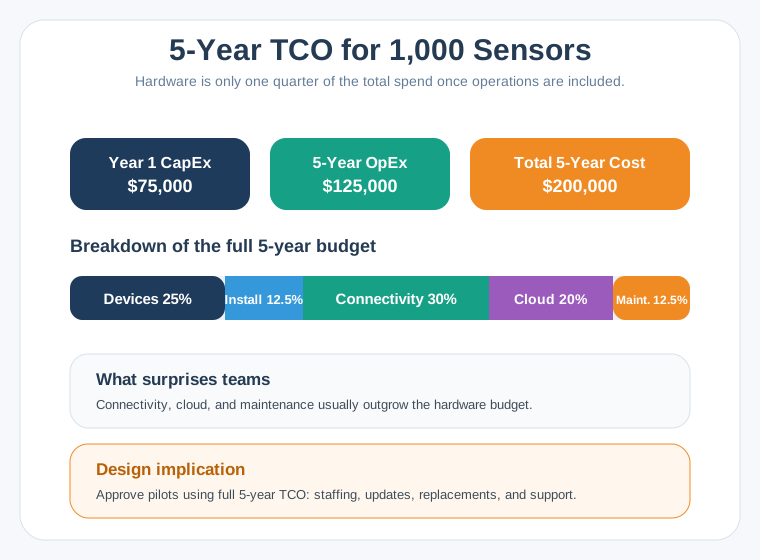
Evaluating IoT platform costs requires looking far beyond the initial quote.
- This section provides a comprehensive framework for calculating true Total Cost of Ownership (TCO) and avoiding common financial pitfalls.
- Most IoT platform vendors quote only the visible portion of costs.
Major section
Interactive TCO Comparison Calculator
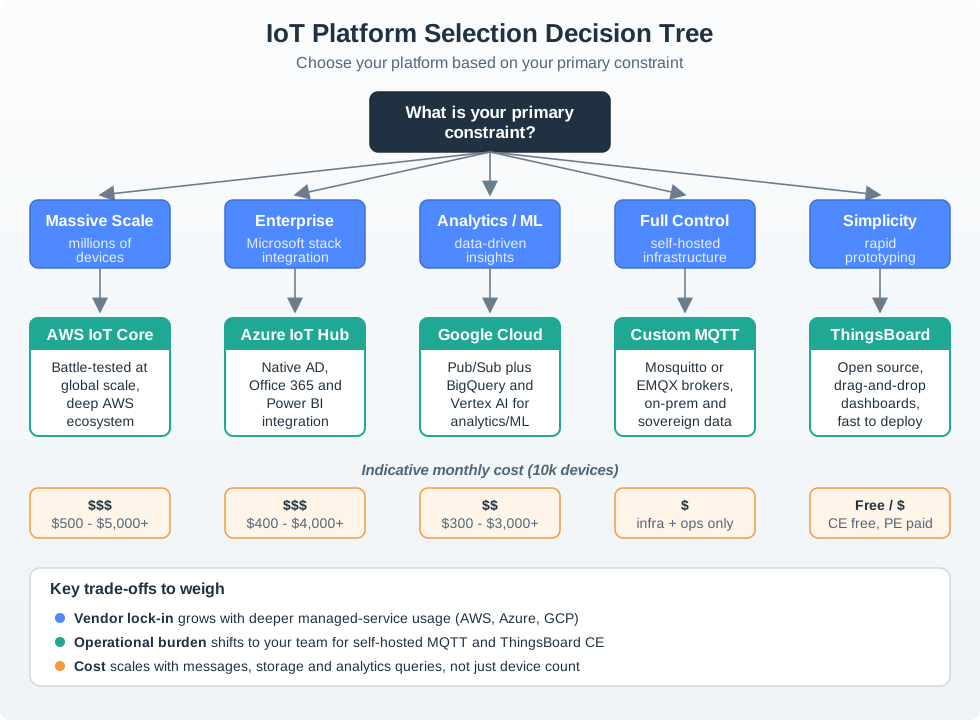
Integration is consistently underestimated.
- That labelled check bounds iot platform selection decision tree comparing aws iot core, azure iot hub, google cloud, custom mqtt, and thingsboard based on scale, enterprise.
- For platform decision framework, retain: What is your primary as evidence for the resulting choice.
Try it: Interactive TCO Comparison Calculator in the chapter
Major section
Peloton Unit Economics Collapse
Instead, customers simply stopped using the bike -- the hardware became an expensive clothes rack, but subscription cancellation was one click away.
- Peloton's trajectory from 2019-2023 provides a cautionary case study in IoT subscription economics -- illustrating how metrics that look exceptional during growth can conceal structural fragility.
- Churn sensitivity: The LTV formula (ARPU / churn) means that doubling churn halves LTV.
- Lesson for IoT businesses: Hardware subsidies only work when churn is extremely low AND stable.
Major section
Smart Building 5-Year LTV
You need to calculate the 5-year customer lifetime value to justify a high customer acquisition cost.
- Business decision: With this $22,607 LTV, the company can justify spending up to $7,500 CAC (3:1 ratio) or $4,500 CAC (5:1 target ratio) on sales and marketing.
- At current CAC of $6,200, the business has healthy 3.6:1 unit economics, suitable for moderate growth investment.
- Key insight: The 1.8% monthly churn (vs hypothetical 3% churn) adds $5,200 to LTV -- a massive difference justifying significant investment in customer success to maintain low churn.
Major section
CAC Payback in Cash Flow
Six months later, despite "profitable" unit economics on paper, the company runs out of cash and must raise emergency funding at a down round.
- Cumulative cash burn through month 6: $3.2 million -- despite every customer being "profitable" in LTV terms!
- The median payback period among these failures was 26 months vs 11 months for successful peers.
- Key lesson: LTV:CAC ratio measures eventual profitability, but payback period determines cash requirements.
Major section
Common Pitfalls
LTV:CAC says whether a customer can eventually become profitable; it does not say whether the company can afford acquisition today.
- A 5:1 ratio can still create a cash crisis when CAC is paid upfront and contribution margin arrives over 18-24 months.
- Calculating LTV from subscription price alone hides device subsidy, connectivity, storage, support, warranty, payment fees, and field operations.
- Portfolio averages can hide failing cohorts.
Deck summary
Key takeaways
Evaluating IoT platform costs requires looking far beyond the initial quote.
- Integration is consistently underestimated.
- Instead, customers simply stopped using the bike -- the hardware became an expensive clothes rack, but subscription cancellation was one click away.
- You need to calculate the 5-year customer lifetime value to justify a high customer acquisition cost.
- Six months later, despite "profitable" unit economics on paper, the company runs out of cash and must raise emergency funding at a down round.
Retrieval practice
Recall check 1 of 6

Blueprint Bina says: answer from memory, then check your reasoning.
Q1A smart lighting IoT service has $25,000 monthly operating expenses and acquires 8 new customers per month at $5,000 CAC each. With $500 ARPU and 70% gross margin, customers generate $350 monthly profit. What is the payback period in months to recover CAC?
Show answer
Answer: D Payback period calculation requires monthly profit (ARPU x gross margin), not gross revenue.
Retrieval practice
Recall check 2 of 6

Blueprint Bina says: answer from memory, then check your reasoning.
Q2The model selection framework evaluates three options: Smart Lighting PaaS ($500K investment, $5K CAC, $500 ARPU, 75% margin, 3% churn), Smart Home Freemium ($200K investment, $50 CAC, $15 ARPU, 85% margin, 8% churn), and Predictive Maintenance ($750K investment, $15K CAC, $2K ARPU, 65% margin, 2% churn). Which has the best LTV:CAC ratio?
Show answer
Answer: B LTV:CAC ratio calculation depends on proper LTV modeling with churn.
Retrieval practice
Recall check 3 of 6

Blueprint Bina says: answer from memory, then check your reasoning.
Q3A startup sells 100 IoT devices for $500 each and charges 5% of hardware revenue for first-year support. What is the total first-year revenue?
Show answer
Answer: B Hardware revenue is 100 x $500 = $50,000.
Retrieval practice
Recall check 4 of 6

Blueprint Bina says: answer from memory, then check your reasoning.
Q4Two identical IoT companies both have: $30 ARPU, $120 CAC, 75% gross margin. Company A has 2% monthly churn (98% retention), Company B has 5% monthly churn (95% retention). How does this 3% churn difference impact their business viability over 3 years?
Show answer
Answer: B Correct!
Retrieval practice
Recall check 5 of 6

Blueprint Bina says: answer from memory, then check your reasoning.
Q5An IoT ecosystem faces the challenge of managing multiple stakeholders: device manufacturers want high volumes, connectivity providers need stable traffic, platform operators seek transaction fees, and developers want low costs. What mitigation strategy best addresses this complexity?
Show answer
Answer: D Complex ecosystem management requires aligning incentives through revenue sharing models reflecting each stakeholder's value contribution.
Retrieval practice
Recall check 6 of 6

Blueprint Bina says: answer from memory, then check your reasoning.
Q6Complete the unit economics gate for an IoT business model:
Show answer
Answer: A A scaling gate should reject cohorts whose LTV:CAC ratio is below the target or whose payback period ties up cash for too long.
Print reference
Answers
Answer key.
- D · Payback period calculation requires monthly profit (ARPU x gross margin), not gross revenue.
- B · LTV:CAC ratio calculation depends on proper LTV modeling with churn.
- B · Hardware revenue is 100 x $500 = $50,000.
- B · Correct!
- D · Complex ecosystem management requires aligning incentives through revenue sharing models reflecting each stakeholder's value contribution.
- A · A scaling gate should reject cohorts whose LTV:CAC ratio is below the target or whose payback period ties up cash for too long.