Applications & Use Cases · Study deck
Business Model Cases: Proposals and Economics
A facilities team understands why lighting could become a service, but it still has to approve a contract.
Blueprint Bina is your guide for this deck.

After studying this chapter
Learning objectives
You will be able to:
- build an evidence-bound Lighting-as-a-Service proposal
- compare lifetime cost, payback timing, and discount-rate effects
- evaluate razor-and-blade and governed data-revenue models
- Explain: A facilities team understands why lighting could become a service, but it still has to approve a contract.
Major section
Start With the Story · Overview
A facilities team understands why lighting could become a service, but it still has to approve a contract.
- The proposal must show cash flows, risks, payback timing, and what changes if equipment life, energy prices, or service promises differ from the sales case.
Major section
Lighting-as-a-Service Proposal · Checkpoint: Service Economics
This proposal comparison is an illustrative campus-scale model.
- It uses round numbers to teach TCO and NPV reasoning; it is not reported Schiphol contract pricing.
- Scenario: A university campus facilities manager receives two proposals for replacing 50,000 aging fluorescent fixtures across 15 buildings.
Major section
Deep dive: Discount Rates in Long Contracts · Philips Business Model Journey
The Mistake: Comparing 15-year contract costs without applying time-value-of-money discounting. $540K paid in Year 15 is worth far less than $540K paid in Year 1.
- LaaS reaches airports, hospitals, warehouses, and offices while Philips leans on service operations and financing at scale.
- 2023 Service becomes strategic.
Major section
IoT Business Model Comparison Framework · Razor-Blade Economics
Signal:: Provider retains asset and service responsibility.
- Lighting-as-a-Service keeps the provider close to the asset.
- The next pattern does the opposite at first: it lowers the entry-device price and bets that recurring ecosystem value will repay the subsidy before churn catches up.
Major section
Razor-and-Blade Check
Scenario:: A smart-speaker provider sells a hub below cost to grow its installed base.
- The point is to test whether the recurring attach-rate revenue repays the hardware subsidy.
- Ecosystem lock-in: Voice shopping, music, smart home create switching costs.
- Calculation note: The $594 LTV is a scenario assumption, not a reported company metric.
Major section
Razor-and-Blade Check · Checkpoint: Subsidy Payback
For razor-and-blade check, the useful result is the reasoning chain: observed condition, governing constraint, calculation or classification, and operational consequence.
- Where the panel supplies several choices, reject each distractor against the chapter's named mechanism instead of relying on wording cues.
Major section
Common Misconception: Data Monetization · More Data Is Not More Revenue
Once recurring value is clear, data can look like the obvious next revenue stream.
- This section slows that instinct down: telemetry becomes revenue only when a buyer, consent model, and insight product already exist.
- Data Without Insights Has No Value: Raw sensor readings (temperature: 22.3C, humidity: 45%) are worthless.
Major section
Checkpoint: Governed Data Revenue
You now know why data monetization starts with the buyer's decision instead of a broad collection plan.
- You can use the agricultural telemetry example to test whether insight revenue and farmer value exchange are both defensible.
Major section
Data Monetization Decision Framework · Data Monetization Knowledge Check
This flowchart illustrates the correct decision process for IoT data monetization, contrasting the common "collect everything" mistake with a consent-led approach that starts from a buyer problem.
- Collect only the telemetry needed to support that decision instead of warehousing every possible sensor feed.
- Raw data has little value on its own.
Major section
Business Model Quiz · Business Case Links
The final activities ask you to classify the models without flattening them into "recurring revenue." Use the proof metric from each checkpoint: service margin, subsidy payback, governed insight value, network effects, or metered usage.
- This turns business case links into evidence that can be reviewed, recalculated, and connected to the running design narrative.
Major section
Common Pitfalls · Illustrative Math Is Not Proof
Scenario models are useful for learning, but they are not public company financials unless the source actually reports them.
- If those assumptions change, the business-model conclusion may flip.
Major section
2. Ignoring Payback Timing · Consent Before Monetizing
A model can show attractive lifetime value and still fail in cash terms.
- Subsidized hardware, installation labor, onboarding, and service operations are paid early, while recurring revenue arrives slowly.
- Data monetization fails when the provider collects broadly and searches for a buyer later.
Major section
Summary · In 60 Seconds
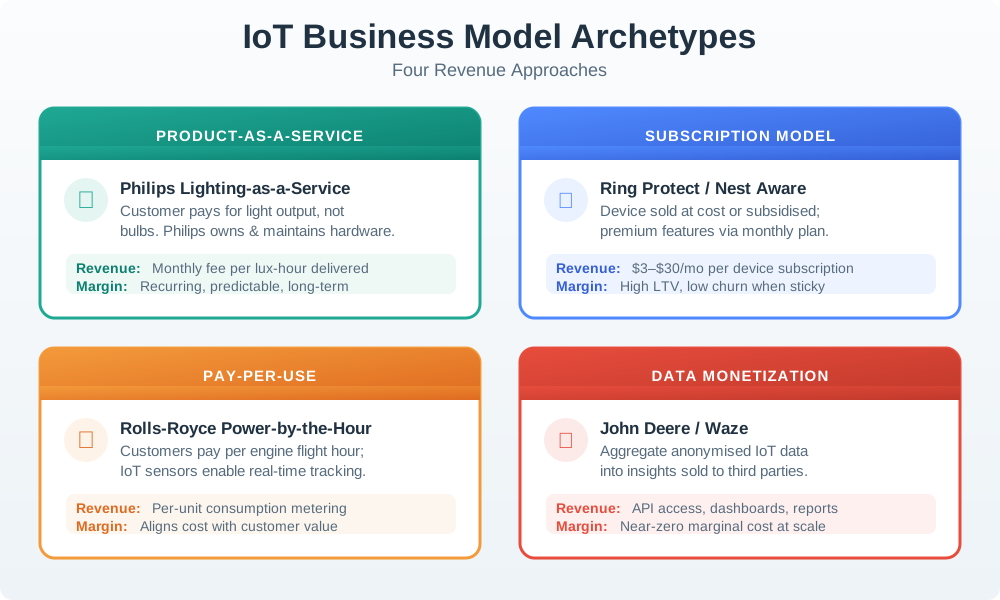
Product-as-a-Service changes ownership and risk: Philips/Signify's Lighting-as-a-Service at Schiphol shows how a provider can retain lighting assets, manage performance, and sell an operating outcome rather than only fixtures.
- Collecting everything without a plan creates storage, governance, and trust costs with no revenue path.
Deck summary
Key takeaways
A facilities team understands why lighting could become a service, but it still has to approve a contract.
- This proposal comparison is an illustrative campus-scale model.
- The Mistake: Comparing 15-year contract costs without applying time-value-of-money discounting. $540K paid in Year 15 is worth far less than $540K paid in Year 1.
- Signal:: Provider retains asset and service responsibility.
- Scenario:: A smart-speaker provider sells a hub below cost to grow its installed base.
Retrieval practice
Recall check 1 of 5

Blueprint Bina says: answer from memory, then check your reasoning.
Q1An industrial IoT predictive maintenance company charges customers based on downtime prevented: $100 for every hour of downtime avoided (verified through equipment sensors). The customer's downtime costs them $500/hour in lost production. In Year 1, the system prevents 120 hours of downtime. What's the value proposition challenge?
Show answer
Answer: B Correct!
Retrieval practice
Recall check 2 of 5

Blueprint Bina says: answer from memory, then check your reasoning.
Q2A smart home startup sells a hub device for $49 (manufacturing cost: $85, loss of $36 per unit). The hub enables smart device purchases through their platform (15% transaction fee on average $40/month in device purchases by 60% of users) and a premium subscription ($8/month, 25% adoption). After 24 months, is this razor-and-blade strategy viable?
Show answer
Answer: B Correct!
Retrieval practice
Recall check 3 of 5

Blueprint Bina says: answer from memory, then check your reasoning.
Q3Rolls-Royce's "Power-by-the-Hour" charges airlines for engine usage rather than only selling engines outright. The provider remains responsible for maintenance outcomes. What business model type and value proposition apply?
Show answer
Answer: B Power-by-the-Hour exemplifies Product-as-a-Service (PaaS) where customers pay subscription/usage fees for outcomes (flight hours) while the provider maintains ownership and handles all maintenance/upgrades.
Retrieval practice
Recall check 4 of 5

Blueprint Bina says: answer from memory, then check your reasoning.
Q4A smart home platform connects device manufacturers, app developers, and consumers. As more devices join, more developers create apps, attracting more consumers, which attracts more device makers. The platform charges transaction fees and takes a share of app revenue. What business characteristic drives value creation?
Show answer
Answer: C Platform business models thrive on network effects where value compounds as more participants join.
Retrieval practice
Recall check 5 of 5

Blueprint Bina says: answer from memory, then check your reasoning.
Q5Place each business model where it lives so you can distinguish asset outcomes, recurring access, and value priced from usage or governed data.
Show answer
Answer: A Separate asset outcome, recurring relationship, and measured value so you can choose a revenue model that matches what the customer actually buys.
Q6Complete the business-model gate for subsidized IoT hardware:
Show answer
Answer: A A subsidized hardware model needs positive recurring margin and an expected customer life longer than the subsidy payback period.
Print reference
Answers 1 of 2
Answer key.
- B · Correct!
- B · Correct!
- B · Power-by-the-Hour exemplifies Product-as-a-Service (PaaS) where customers pay subscription/usage fees for outcomes (flight hours) while the provider maintains ownership and handles all maintenance/upgrades.
- C · Platform business models thrive on network effects where value compounds as more participants join.
- A · Separate asset outcome, recurring relationship, and measured value so you can choose a revenue model that matches what the customer actually buys.
Print reference
Answers 2 of 2
Answer key.
- A · A subsidized hardware model needs positive recurring margin and an expected customer life longer than the subsidy payback period.