IoT Value and Product Strategy · Study deck
IoT Business Models: Canvas and Entitlements
A customer paid for a feature, but the device is offline when it checks the licence.
Ada is your guide for this deck.

After studying this chapter
Learning objectives
You will be able to:
- Map partners, costs, channels, and revenue in an IoT business canvas.
- Design licensing and entitlement rules for connected and offline use.
- Explain why an IoT business model must fund the connected service after the device is installed.
- Map each paid tier to a payer, recurring value signal, entitlement, and operating cost driver.
Major section
The IoT Business Model Canvas
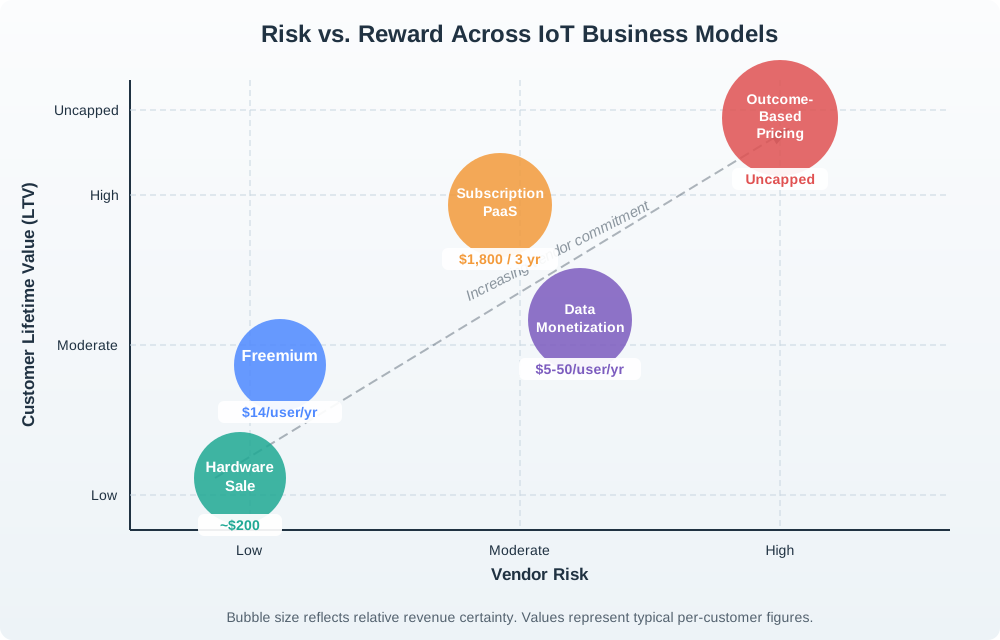
The centre asks how each continuing capability is funded; the right asks whether it produces cost savings, operational efficiency, a new capability, or reduced risk.
- The arrows are hypotheses to test, not automatic consequences of connecting a device.
- This frame carries the running narrative from application examples into a model whose costs and evidence can be examined.

Major section
The IoT Business Model Canvas (continued)
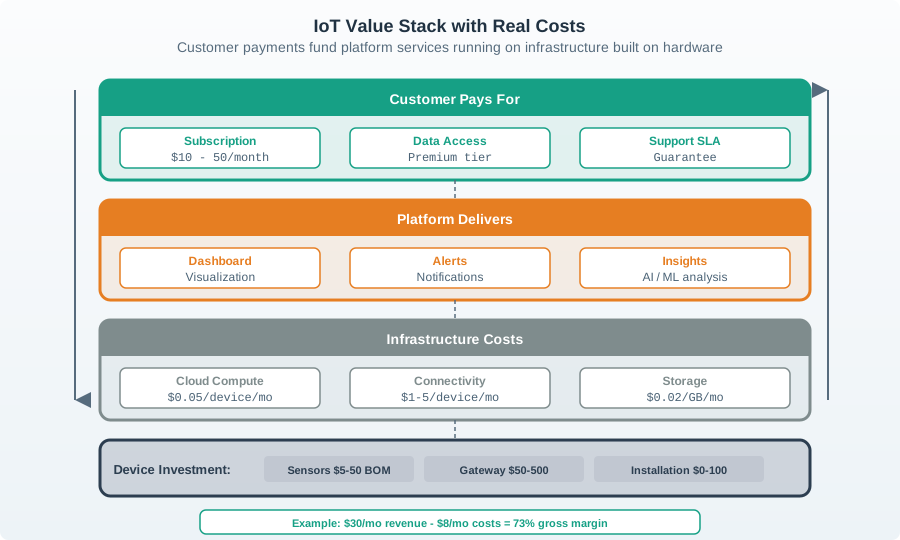
In Figure: Customer payments (top) fund platform services which run, revenue enters through subscriptions, data access, or support commitments.
- It must fund the platform functions customers experience, the compute, connectivity, and storage those functions consume, and the deployed hardware beneath them.
- The printed amounts are illustrative inputs for a model, not universal prices.
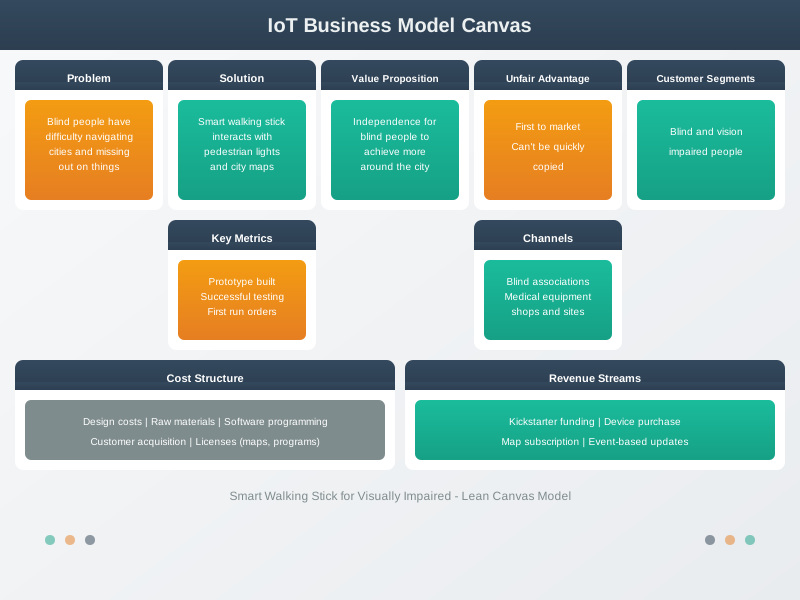
- The framework becomes useful when its fields constrain one another rather than remaining generic labels.
Major section
Licensing and Entitlement Models
Payment later fails during a storm.
- The product team must protect the paid service without disabling a local frost warning or leaving the farmer unsure which features still work.
- Separate paid advice from any local action needed to prevent harm.
- Include support, storage, link use, updates, payment fees, returns, and exit work.
- Entitlement enforcement should fail safely.
Major section
Licensing and Entitlement Models (continued)
The same person should not appear active in one place and blocked in another without a clear recovery path.
- A feature that sells well but creates heavy field support may not fund the service it promises.
- Practitioner builds the permission states and review record.
- An IoT business model is not just a price tag on a device.
Major section
Licensing and Entitlement Models (continued)
A smart thermostat may be sold as hardware with an optional energy service.
- Under the Hood explains signed records, time limits, copied state, reconciliation, and why business rules must never overrule an urgent safe local path.
- The same sensor product can support different models.
- A fleet tracker may be priced per vehicle per month.
Major section
Licensing and Entitlement Models (continued)
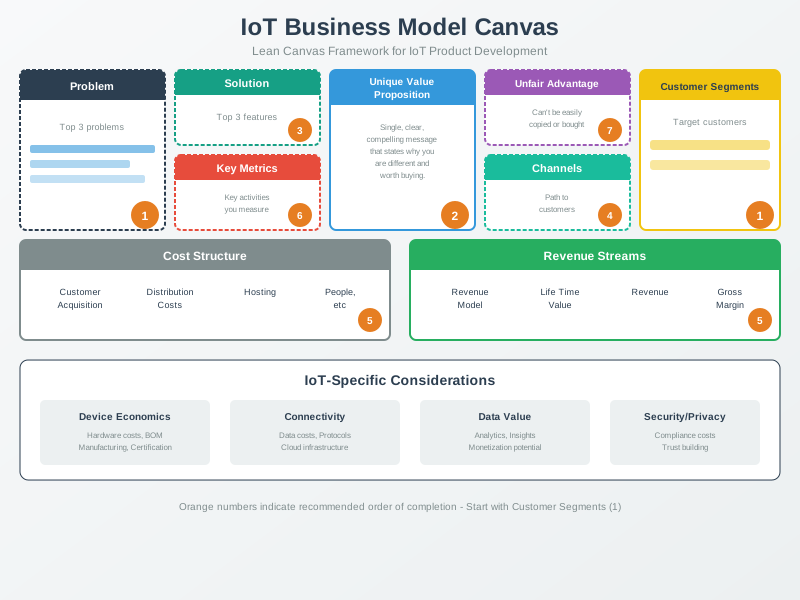
The quadrant is useful because it separates two questions that are often mixed together.
- This contract chapter turns entitlement into an operating story: who is allowed to use what, how the device knows, and what remains safe when billing or connectivity fails.
- The values are scenario assumptions, not benchmarks.
- Pricing also has to match operating cost.
Major section
Licensing and Entitlement Models (continued)
This page isolates the contract behind those models: which customer receives value, what the paid tier unlocks, which operating costs scale with use, and which product systems must enforce the promise.
- Connectivity creates continuing costs and continuing value: cloud ingestion, storage, analytics, app support, OTA updates, cellular data plans, warranties, security response, and customer success.
- The model has to explain who pays for that system after the device is installed, which value signal keeps them paying, and which operating costs could grow faster than revenue.
- An industrial monitoring system may bundle gateways, installation, dashboards, support, and service-level commitments into a managed subscription.
Major section
Licensing and Entitlement Models (continued)
Hardware sale: Revenue happens early, but support, warranty, cloud, and update costs continue.
- The right model depends on whether the customer values ownership, convenience, risk transfer, regulatory evidence, avoided downtime, or access to an ecosystem.
- The middle band holds subscription, where $50 a month over three years is worth far more than the device, and data monetisation, where the amount per user varies widely.
- Subscription: Value must recur through insight, automation, compliance, uptime, safety, or convenience.
Major section
Licensing and Entitlement Models (continued)
A quick test is to write the model as a value loop.
- Moving up and right means accepting monitoring, incident response and cloud operations for as long as the device runs.
- A low-risk hardware sale may still require warranty support and firmware updates, but the customer carries most operational risk.
- The device observes something, the platform turns that observation into a decision or service, and the customer pays because that decision remains useful.
Major section
Licensing and Entitlement Models (continued)
The practical check is to connect each paid feature to a measurable product behavior.
- A subscription or outcome-based offer shifts more responsibility to the vendor, so the business must fund monitoring, incident response, cloud operations, and customer success for as long as the device is active.
- If the loop stops at "we collect data," the model is unfinished.
- Energy analytics may require interval metering, tariff data, weather normalization, and a user-facing recommendation loop.
Major section
Licensing and Entitlement Models (continued)
If the loop names the payer, the recurring outcome, the cost driver, and the renewal trigger, it is ready for pricing work.
- Predictive maintenance may require vibration capture, edge filtering, model scoring, alert triage, and maintenance workflow integration.
- Remote unlock may require identity proof, revocation, audit logs, and fallback access.
- The paid tier should map to a capability the product can actually enforce and prove.
- This keeps pricing tied to usage instead of vague feature labels.
Major section
Licensing and Entitlement Models (continued)
Recurring IoT revenue needs infrastructure that can enforce and observe the offer.
- For each tier, list the number of devices, retention period, alert rules, integrations, API limits, firmware support, service-level commitments, and human support included.
- A device that publishes high-frequency telemetry over LTE-M or NB-IoT has a different cost profile from a Wi-Fi device that sends summary events.
- Provisioning records connect ownership, location, firmware version, warranty status, and allowed services.
Major section
Licensing and Entitlement Models (continued)
A product that promises OTA fixes needs release operations, staged rollout, rollback policy, and support scripts.
- For example, a fleet cold-chain monitor might charge per trailer per month, but the internal model should split that fee across cellular data, cloud ingestion, retention, alert routing, dashboard access, compliance reporting, and support.
- If a customer asks for one-minute temperature samples instead of five-minute samples, the practitioner can show the cost and battery impact immediately.
- If the product team adds a premium compliance report, it should identify the data retention, audit trail, and export workflow that justify the premium price.
Major section
Licensing and Entitlement Models (continued)
Billing systems such as Stripe Billing, Chargebee, Recurly, Apple In-App Purchase, Google Play Billing, or enterprise invoicing need clean entitlement signals from the product, not spreadsheet reconciliation after the fact.
- MQTT topics, HTTP APIs, webhook deliveries, data-retention jobs, and customer exports can all become billable boundaries or cost leaks.
- A product using AWS IoT Core, Azure IoT Hub, EMQX, Kafka, Snowflake, BigQuery, or similar services should tag events with customer, device, firmware, region, plan, and feature identifiers before data enters shared pipelines.
- That agreement is what turns a pricing page into an operable service.
Deck summary
Key takeaways
The centre asks how each continuing capability is funded; the right asks whether it produces cost savings, operational efficiency, a new capability, or reduced risk.
- In Figure: Customer payments (top) fund platform services which run, revenue enters through subscriptions, data access, or support commitments.
- Payment later fails during a storm.
- The same person should not appear active in one place and blocked in another without a clear recovery path.
- A smart thermostat may be sold as hardware with an optional energy service.
Retrieval practice
Recall check 1 of 3

Ada says: answer from memory, then check your reasoning.
Q1Per this chapter's cold-chain monitor example, why should the internal model split the per-trailer-per-month fee across cellular data, cloud ingestion, retention, alert routing, dashboard access, compliance reporting, and support?
Show answer
Answer: A The chapter states: 'a fleet cold-chain monitor might charge per trailer per month, but the internal model should split that fee across cellular data, cloud ingestion, retention, alert routing, dashboard access, compliance reporting, and support.
Retrieval practice
Recall check 2 of 3
Ada says: answer from memory, then check your reasoning.
Q2A paid cloud feature expires while a device is offline. Which entitlement rule is safest?
Show answer
Answer: B Safety actions stay available, while the expired paid service follows its stated rule.
Retrieval practice
Recall check 3 of 3
Ada says: answer from memory, then check your reasoning.
Q3Why should an IoT subscription or outcome-based business model define entitlements, meters, and lifecycle states before pricing is finalized?
Show answer
Answer: B see answers page
Print reference
Answers 1 of 2
Answer key.
- A · If a customer asks for one-minute temperature samples instead of five-minute samples, the practitioner can show the cost and battery impact immediately.
- B · Safety actions stay available, while the expired paid service follows its stated rule.
Print reference
Answers 2 of 2
Answer key.
- B · A subscription or outcome-based offer is only operable once product, billing, telemetry, and lifecycle systems agree on what each plan entitles the customer to, what usage or condition drives cost, and what happens at trial expiry, renewal, downgrade, cancellation, and safety-critical fallback.