Industrial IoT and Business Operations · Study deck
Business Model Cases: Unit Economics
An asset tag saves search time but adds hardware, install, network, and support costs.
Ada is your guide for this deck.

After studying this chapter
Learning objectives
You will be able to:
- Calculate asset-tracking cost, benefit, payback, and sensitivity.
- Set evidence thresholds for adopting or rejecting the case.
- Explain why subsidised IoT hardware shifts attention from sale price to per-device recurring margin.
- Calculate hardware payback from monthly subscription revenue, connectivity cost, cloud cost, and support allocation.
Major section
Deep dive: Putting Numbers to It
The purchase model is about −$7.47M, so LaaS reduces present-value customer cost by about $2.63M; neither option is a customer profit.
- Both options have a customer cost.
- Under these assumptions, LaaS has about $2.63M lower present-value cost than purchasing.
- Customer Relationship: Long service contracts keep the provider engaged after installation.
Major section
Deep dive: Putting Numbers to It (continued)
Strategic: Cash timing differs; balance-sheet and tax treatment depend on contract classification and applicable rules.
- Service Learning: Retained ownership gives the provider incentives to improve durability and maintainability.
- Ecosystem Platform: Lighting infrastructure becomes IoT platform for building management.
- The sale becomes an operational performance promise, not only a fixture shipment.
Major section
Deep dive: Putting Numbers to It (continued)
Retained provider ownership can support circular-economy goals because the provider has responsibility for reuse and recycling.
- Technology Risk: LED lifespan guarantees (50,000 hours = 10-15 years) might fail.
- Observed Lesson: The reported Schiphol arrangement is important because it shows a real enterprise buyer accepting a service model for a physical asset.
- Data May Create Second Revenue Stream: Connected lights can support smart building analytics, but only with clear permission and value exchange.
Major section
Asset Tracking Unit Economics Contracts
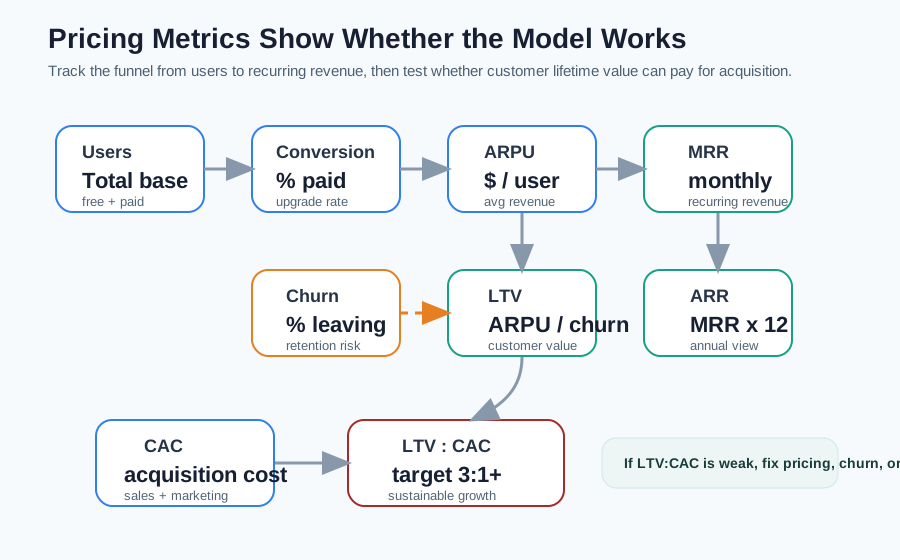
The team must decide when the tag pays back its full share of the service.
- Firmware means software stored in a device.
- Telemetry means reports that a device sends so people can check it from afar.
- A missing link between a bill and a device leaves payback unproven, even if fleet revenue looks healthy.
Major section
Asset Tracking Unit Economics Contracts (continued)
A tag can be active but expensive to serve, or shipped without ever earning a fee.
- This contract chapter turns asset tracking into a unit-economics story where shrinkage, utilization, delay, labor, and exception handling must pay for the system.
- Every IoT-as-a-service model reduces to this arithmetic.
- The recurring revenue is the subscription.
Major section
Asset Tracking Unit Economics Contracts (continued)
The closing note names the only three levers left when the ratio is weak.
- This page isolates one financial contract underneath those cases: a subsidised connected device only works when recurring margin survives connectivity, cloud, support, churn, and hardware payback.
- Whether this business survives is decided not by the pitch deck but by unit economics: the recurring cost and revenue of a single device over its life.
- Hardware revenue is captured once at shipment.
Major section
Asset Tracking Unit Economics Contracts (continued)
The recurring costs are the device's cellular connectivity and its cloud footprint: ingestion, storage, and processing.
- The one-time cost is the subsidised hardware, which must be recovered before the device is profitable.
- The same case can look attractive or fragile depending on which denominator is used.
- Cost instrumentation should be designed into the platform.
Major section
Asset Tracking Unit Economics Contracts (continued)
Counting total connected devices rewards growth, but the subscription model is healthier when it tracks activated devices, billable devices, retained devices, and devices past payback separately.
- Service revenue is captured only if the device remains useful, connected, supported, and trusted long enough for lifetime value to exceed hardware subsidy, customer acquisition cost, and operating cost.
- The model is proven by renewal behavior, not by activation count alone.
- Gross margin answers whether one active month is profitable.
Major section
Asset Tracking Unit Economics Contracts (continued)
Payback answers how many active months are needed to recover the device subsidy.
- Worked example: The device costs $40 to build and is given away.
- At $6/month margin, hardware payback is $40 / $6 = about 7 months.
- LTV answers whether the expected customer life covers subsidy, customer acquisition cost, replacements, support, refunds, and cloud operations.
Major section
Asset Tracking Unit Economics Contracts (continued)
High churn among short-lived subscribers can make every new device a money-loser even as the subscriber count climbs.
- The team should not approve a reporting interval, roaming SIM plan, dashboard retention period, or support SLA without showing which line item changes.
- A healthy pilot should report all three, with sensitivity cases for churn, battery replacement, lost devices, and lower-than-expected utilization.
- Under the hood, the business metric depends on telemetry quality.
Major section
Asset Tracking Unit Economics Contracts (continued)
LTE-M coverage may be essential for containers that travel outside Wi-Fi range, but the plan must include roaming policy, overage handling, inactive-device suspension, and firmware behavior when the device cannot attach.
- Because the device only starts earning after the roughly 7-month payback, a customer who cancels in month 3 leaves the business at a loss: the subsidy was never recovered.
- A model that ignores churn can show growing revenue while quietly losing money on every subsidised unit that cancels early.
- Subsidised connected-device models are not validated by activations alone.
Major section
Asset Tracking Unit Economics Contracts (continued)
Worked example: Two cohorts of 1,000 devices each carry a $40 subsidy and $6/month margin, so payback takes about 7 months.
- Cohort B churns at 4 months average, before payback, so each device loses about $16: only $24 of margin against the $40 subsidy.
- The backend should keep a device lifecycle state separate from billing state: manufactured, provisioned, shipped, activated, attached to network, reporting, suspended, lost, replaced, cancelled, refurbished, or decommissioned.
- They need retained billable devices, per-device margin, payback visibility, and lifecycle telemetry that proves whether each device has moved from subsidy recovery into profit.
Deck summary
Key takeaways
The purchase model is about −$7.47M, so LaaS reduces present-value customer cost by about $2.63M; neither option is a customer profit.
- Strategic: Cash timing differs; balance-sheet and tax treatment depend on contract classification and applicable rules.
- Retained provider ownership can support circular-economy goals because the provider has responsibility for reuse and recycling.
- The team must decide when the tag pays back its full share of the service.
- A tag can be active but expensive to serve, or shipped without ever earning a fee.
Retrieval practice
Recall check 1 of 5

Ada says: answer from memory, then check your reasoning.
Q1Per this chapter's opening framing, why is 'total connected devices' a misleading headline metric for a subsidised IoT tracking service?
Show answer
Answer: D A tracker in a warehouse drawer still has sunk hardware cost; a tracker sending excessive location updates still creates cellular and cloud cost; a tracker that delivers avoided loss or faster claims settlement is the device that justifies renewal.
Retrieval practice
Recall check 2 of 5
Ada says: answer from memory, then check your reasoning.
Q2Per this chapter's worked example, why does switching the tracker's reporting interval from every 5 minutes to every minute roughly double the hardware payback period?
Show answer
Answer: D Switch it to every minute and data rises about 5x, pushing connectivity toward $4-$5 and cutting the margin roughly in half, which nearly doubles the payback period.
Retrieval practice
Recall check 3 of 5
Ada says: answer from memory, then check your reasoning.
Q3A tracker is reporting but its subscription is cancelled. Which records must finance join to see the true margin?
Show answer
Answer: C Joined records reveal cost after cancellation and the billing state.
Retrieval practice
Recall check 4 of 5
Ada says: answer from memory, then check your reasoning.
Q4Why is churn the decisive risk for a subsidised-hardware IoT subscription?
Show answer
Answer: A In a subsidised-hardware model, the subscription only starts recovering the up-front device cost after payback -- so a customer who cancels before that point leaves the business having spent more on the device than it ever collected in revenue.
Retrieval practice
Recall check 5 of 5
Ada says: answer from memory, then check your reasoning.
Q5An asset-tracking pilot reports many activations but has no retained paid-device count or payback evidence. What is the sound launch gate?
Show answer
Answer: D Activation alone does not show whether the deployed device earns back its cost.
Print reference
Answers 1 of 2
Answer key.
- D · A tracker in a warehouse drawer still has sunk hardware cost; a tracker sending excessive location updates still creates cellular and cloud cost; a tracker that delivers avoided loss or faster claims settlement is the device that justifies renewal.
- D · Switch it to every minute and data rises about 5x, pushing connectivity toward $4-$5 and cutting the margin roughly in half, which nearly doubles the payback period.
- C · Joined records reveal cost after cancellation and the billing state.
Print reference
Answers 2 of 2
Answer key.
- A · In a subsidised-hardware model, the subscription only starts recovering the up-front device cost after payback -- so a customer who cancels before that point leaves the business having spent more on the device than it ever collected in revenue.
- D · Activation alone does not show whether the deployed device earns back its cost.