Privacy & Compliance · Study deck
Which Privacy Laws Apply to IoT
Picture a wearable sold online, used by a child, and supported by a team in another country.
Privacy Priya is your guide for this deck.

After studying this chapter
Learning objectives
You will be able to:
- map an IoT situation to the regulations that actually apply instead of memorizing law text
- run a mapping workflow that covers data type, jurisdiction, and role
- explain why mapping the situation is safer than a memorized checklist
- Explain: A rule remembered from one launch meeting may not cover the person, place, data, or role involved today.
Major section
Start Simple
A rule remembered from one launch meeting may not cover the person, place, data, or role involved today.
- A policy sentence is weak evidence if the system cannot carry out the promised action.
- This map is not legal advice and does not decide every edge case.
- Laws and guidance change.
Major section
Overview: Map the Situation, Do Not Memorize the Law
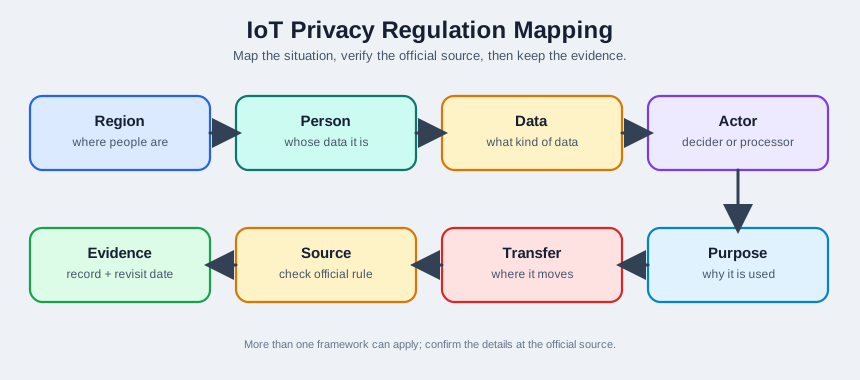
Privacy regulation for IoT is less about reciting statutes and more about mapping: given a specific product and deployment, which frameworks apply, to which data, and in which role.
- The reason to map rather than memorize is practical.
- Privacy mapping is the same discipline applied to data.
Major section
Overview: Map the Situation, Do Not Memorize the Law (continued)
More than one framework can apply, and you confirm the details at the official source rather than from memory.
- Privacy laws differ by place, change over time, and frequently overlap, so a remembered figure or deadline goes stale quickly.
- The durable skill is to identify the applicable frameworks and then verify the current specifics against the official source.
- That discipline prevents a memorized regulation name from replacing a current, situation-specific mapping.
Major section
Overview: Map the Situation, Do Not Memorize the Law (continued)
Who decides why and how data is used shapes who owes which obligations.
- If you only need the intuition, this layer is enough: ask whose data you handle (jurisdiction), what kind it is (sensitivity), and what your role is (decider or processor).
- Each resulting row needs an owner and revisit date because the map is operational evidence.
- If you can ask the three mapping questions, you have the core idea.
Major section
Practitioner: A Mapping Workflow
The workflow does not require you to know every clause; it requires you to identify what applies and to confirm the current specifics at the official source.
- Whether your role is covered and what that entails.
- No evidence the request was handled.
- If you can run the mapping and build a reusable request path, you can stop here.
Major section
Under the Hood: Why Mapping Beats Memorizing
Many obligations hinge on whether your organization decides the purposes and means of processing or acts on another's instructions.
- The deeper layer explains the reasoning behind a source-checking, evidence-keeping approach, and names the assumptions that quietly produce non-compliance.
- Specifics stay current as law changes.
- Classification of what the system can produce.
Major section
Under the Hood: Why Mapping Beats Memorizing (continued)
A sensor stream that looks mundane can contain sensitive data once it is interpreted.
- None of the traps here is about a specific number; they are about misreading the situation.
- A team that hard-codes a remembered deadline or fine into its process will eventually be wrong.
- The mapping can be reviewed and trusted.
Major section
Under the Hood: Why Mapping Beats Memorizing (continued)
For the connected-camera example, make one row for visitor clips: identify where the visitors are, classify the captured data, and name who decides its purpose.
- Response windows, monetary penalties, qualifying thresholds, and even the list of applicable laws shift as regulations are amended and as new ones are enacted in more jurisdictions.
- The durable practice is to record where the authoritative answer lives and to check it when it matters, so the process stays correct as the law moves.
- In GDPR terms this is the controller-versus-processor distinction; other frameworks draw a similar line with different words.
Major section
Under the Hood: Why Mapping Beats Memorizing (continued)
Getting the role wrong misassigns who must honor rights, who must hold a lawful basis, and who must put agreements in place.
- Motion and timing can reveal health or household patterns; audio can capture identifiable speech; coarse location over time can expose a home and a workplace.
- Because the derived meaning can be more sensitive than the raw feed, the mapping has to classify what the system can produce, not only what it nominally collects, or it will under-rate its duties.
- No proof the analysis was done or kept current.
Deck summary
Key takeaways
A rule remembered from one launch meeting may not cover the person, place, data, or role involved today.
- Privacy regulation for IoT is less about reciting statutes and more about mapping: given a specific product and deployment, which frameworks apply, to which data, and in which role.
- More than one framework can apply, and you confirm the details at the official source rather than from memory.
- Who decides why and how data is used shapes who owes which obligations.
- The workflow does not require you to know every clause; it requires you to identify what applies and to confirm the current specifics at the official source.
Retrieval practice
Recall check 1 of 3

Privacy Priya says: answer from memory, then check your reasoning.
Q1An IoT company is headquartered in one country but its devices are used by people in several others. What most directly drives which privacy frameworks apply?
Show answer
Answer: A Applicability commonly follows the people, the data type, and the organization's role, so a company can owe duties in places where it has no office.
Retrieval practice
Recall check 2 of 3
Privacy Priya says: answer from memory, then check your reasoning.
Q2A connected toy is sold in several regions and collects voice data from young children. How should the team approach the regulatory mapping?
Show answer
Answer: D Multiple frameworks can apply at once; the team maps jurisdiction, data type, and role, then confirms specifics at the source rather than from memory.
Retrieval practice
Recall check 3 of 3
Privacy Priya says: answer from memory, then check your reasoning.
Q3A team argues that because its event records are pseudonymized, privacy regulations do not apply and no requests need to be honored. Which statement best explains why this is risky?
Show answer
Answer: C Pseudonymization reduces exposure but does not remove the data from scope, so the mapping and request paths must still cover it.
Print reference
Answers
Answer key.
- A · Applicability commonly follows the people, the data type, and the organization's role, so a company can owe duties in places where it has no office.
- D · Multiple frameworks can apply at once; the team maps jurisdiction, data type, and role, then confirms specifics at the source rather than from memory.
- C · Pseudonymization reduces exposure but does not remove the data from scope, so the mapping and request paths must still cover it.