Privacy & Compliance · Study deck
Building an IoT Privacy Program
Picture a team about to ship a new smart-home feature.
Privacy Priya is your guide for this deck.

After studying this chapter
Learning objectives
You will be able to:
- Explain: Although regimes differ in detail, most modern privacy laws share a common backbone, and understanding that backbone lets a team design once and map to many jurisdictions rather than chasing each rule separately.
- Explain: Across major regimes such as the European Union's General Data Protection Regulation and California's consumer privacy law, a recurring set of obligations appears, even where the wording and thresholds differ.
- Explain: The practical heart of compliance is accountability: you must be able to demonstrate, with records, that you handle personal data lawfully and as you promised.
Major section
Overview: Compliance Is the Floor, Not the Ceiling
Privacy compliance is meeting the legal and regulatory obligations that apply when a product handles personal data.
- The crucial mindset is that compliance is a floor, not a ceiling.
- A product can satisfy every rule and still over-collect or treat people poorly, so compliance does not guarantee privacy.
Major section
Overview: Compliance Is the Floor, Not the Ceiling (continued)
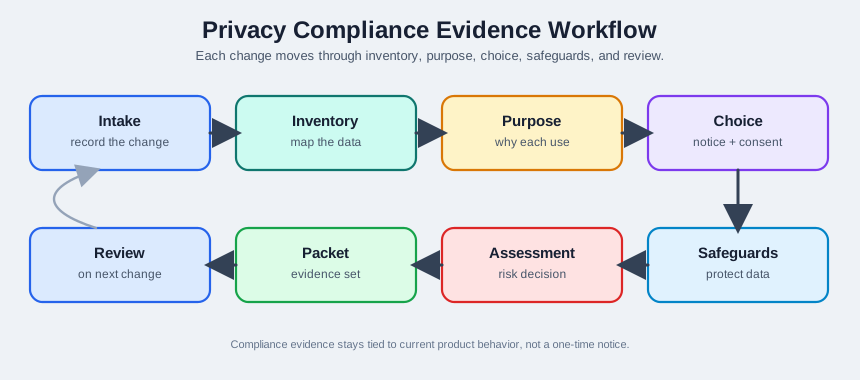
The practical heart of compliance is accountability: you must be able to demonstrate, with records, that you handle personal data lawfully and as you promised.
- Compliance is meeting the food-safety code and being able to show the inspection log on request.
- For an IoT product, the useful program starts before the privacy notice is written.
- Maintain records that demonstrate compliance, and update them whenever the product or its data flows change.
Major section
Overview: Compliance Is the Floor, Not the Ceiling (continued)
A smart-camera release should inventory clips, metadata, identifiers, storage, retention, and vendors before it updates the notice.
- The public promise stays tied to measured behavior only if every stage has an owner and current artifact.
- That continuing loop is why compliance is a floor for accountable operation rather than a one-time policy-writing exercise.
- If you can see compliance as demonstrable accountability and a minimum bar, you have the core idea.
Major section
Practitioner: Build an Evidence-First Program
Many devices have no display, so plan how notice and choice reach the user and any bystanders.
- A notice that matches the inventory and the basis on record.
- Purpose records and checks against secondary use.
- Collect only what each purpose needs.
- A workflow that fulfills requests across all stores.
Major section
Practitioner: Build an Evidence-First Program (continued)
A request tool that clears one table while copies remain.
- Current inventory, assessments, and choice records.
- Assertions of compliance with no records.
- Bundled SDKs and cloud vendors create recipients that the inventory and vendor records must cover.
- A smart camera streams video and audio, derives motion events, and stores clips in the cloud.
Major section
Under the Hood: Obligations, Roles, and Accountability
Compliance is meeting external rules.
- The deeper layer explains the structure beneath specific laws.
- Although regimes differ in detail, most modern privacy laws share a common backbone, and understanding that backbone lets a team design once and map to many jurisdictions rather than chasing each rule separately.
- The records compared with actual behavior.
Major section
Under the Hood: Obligations, Roles, and Accountability (continued)
The distinction matters because obligations and contracts attach differently to each role, and an IoT vendor is frequently both, depending on the data flow.
- Purpose limitation and minimization: Specified purposes and only the data they need.
- Privacy is the broader goal of respecting people and limiting exposure.
- The change history versus the inventory date.
Major section
Under the Hood: Obligations, Roles, and Accountability (continued)
Security is protecting the data, which is a means that supports both.
- Across major regimes such as the European Union's General Data Protection Regulation and California's consumer privacy law, a recurring set of obligations appears, even where the wording and thresholds differ.
- The privacy notice no longer matches what the product does.
- The inventory was not updated after a change.
- Compliance is treated as a launch task, not ongoing.
Deck summary
Key takeaways
Privacy compliance is meeting the legal and regulatory obligations that apply when a product handles personal data.
- The practical heart of compliance is accountability: you must be able to demonstrate, with records, that you handle personal data lawfully and as you promised.
- A smart-camera release should inventory clips, metadata, identifiers, storage, retention, and vendors before it updates the notice.
- Many devices have no display, so plan how notice and choice reach the user and any bystanders.
- A request tool that clears one table while copies remain.
Retrieval practice
Recall check 1 of 4
Privacy Priya says: answer from memory, then check your reasoning.
Q1A product adds a new use for a door event. Which record should be updated before the use ships?
Show answer
Answer: B A privacy claim should follow the actual product use and its protections.
Retrieval practice
Recall check 2 of 4
Privacy Priya says: answer from memory, then check your reasoning.
Q2A team says their IoT product is fully compliant, so no further privacy work is needed. What is the most accurate response?
Show answer
Answer: C Compliance sets a minimum bar, so a product can meet the rules and still over-collect or treat people poorly; privacy work continues beyond compliance.
Retrieval practice
Recall check 3 of 4
Privacy Priya says: answer from memory, then check your reasoning.
Q3Which data inventory is most useful for IoT privacy compliance?
Show answer
Answer: C A useful inventory covers each personal-data category, why it is used, where it goes, how long it is kept, who owns the row, and when a product change requires an update.
Retrieval practice
Recall check 4 of 4
Privacy Priya says: answer from memory, then check your reasoning.
Q4A regulator asks an IoT company to demonstrate that it handles personal data lawfully. Under an accountability-based regime, what is expected?
Show answer
Answer: C Accountability means showing current evidence: inventories, lawful-basis or choice records, high-risk assessments, safeguards, vendor oversight, and the change history that keeps them accurate.
Print reference
Answers 1 of 2
Answer key.
- B · A privacy claim should follow the actual product use and its protections.
- C · Compliance sets a minimum bar, so a product can meet the rules and still over-collect or treat people poorly; privacy work continues beyond compliance.
- C · A useful inventory covers each personal-data category, why it is used, where it goes, how long it is kept, who owns the row, and when a product change requires an update.
Print reference
Answers 2 of 2
Answer key.
- C · Accountability means showing current evidence: inventories, lawful-basis or choice records, high-risk assessments, safeguards, vendor oversight, and the change history that keeps them accurate.