Integration & Gateways · Study deck
The Industrial Protocol Landscape
Picture a line where one late message stops motion and another only delays a chart.
Gateway Gus is your guide for this deck.

After studying this chapter
Learning objectives
You will be able to:
- separate field access, information model, and enterprise telemetry as distinct protocol layers
- apply the brownfield gateway pattern to bridge legacy field protocols upward
- identify which cycle, jitter, topology, and diagnostic properties a protocol choice must preserve
- state the boundary rules an industrial protocol choice must survive under review
Major section
Start With the Machine Consequence
Those two paths should not share the same proof.
- One common link may ease support, but it can blur safety and time bounds.
- More than one link adds work, yet it can keep fast control close to the machine.
- The records and tests later in the chapter supply the needed proof.
Major section
Overview: Industrial Protocols Follow the Physical Process
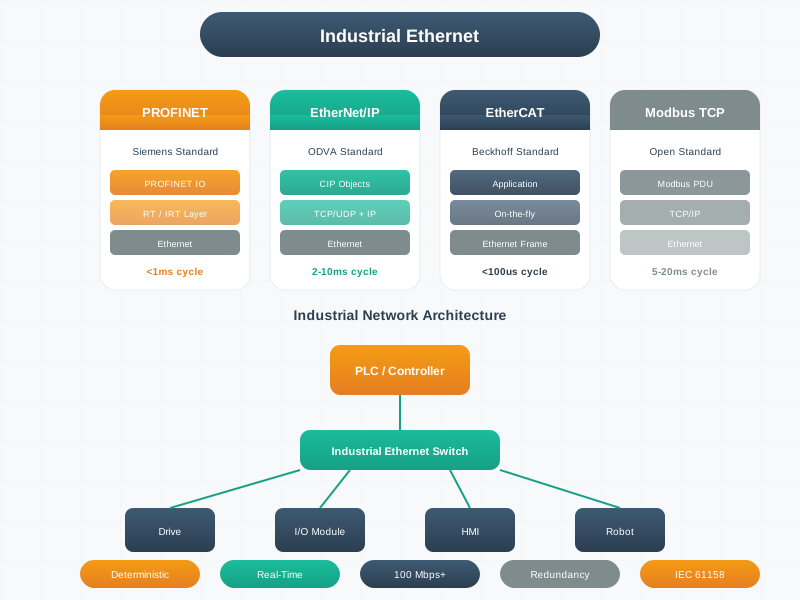
Industrial IoT protocol choices start with the machine, cell, line, or plant process being connected.
- A dashboard update, a meter read, a PLC scan, and a servo motion loop do not need the same communication behavior.
- A field device may speak Modbus or an industrial Ethernet family to a controller.
Major section
Overview: Industrial Protocols Follow the Physical Process (continued)
The architecture is normal when each boundary has a clear job.
- The protocol is only correct when its timing, data model, diagnostics, and security boundary fit the physical consequence of the exchange.
- A controller or gateway may expose structured data through OPC UA.
- A defensible landscape diagram therefore separates command paths from observation paths.
Major section
Overview: Industrial Protocols Follow the Physical Process (continued)
An edge service may publish selected telemetry through MQTT/Sparkplug after the OT boundary.
- The protocol choice is then tied to consequence: late drive I/O can stop motion, stale alarm context can slow maintenance, and noisy cloud publishing can hide the few variables that operators actually need.
- If you only need the intuition, remember this: keep fast control local, expose plant meaning through a reviewable integration layer, and send only selected enterprise telemetry beyond the OT boundary.
- Enterprise telemetry Filtered events and state changes sent beyond the plant boundary after ownership, rate, and identity are defined.
Major section
Overview: Industrial Protocols Follow the Physical Process (continued)
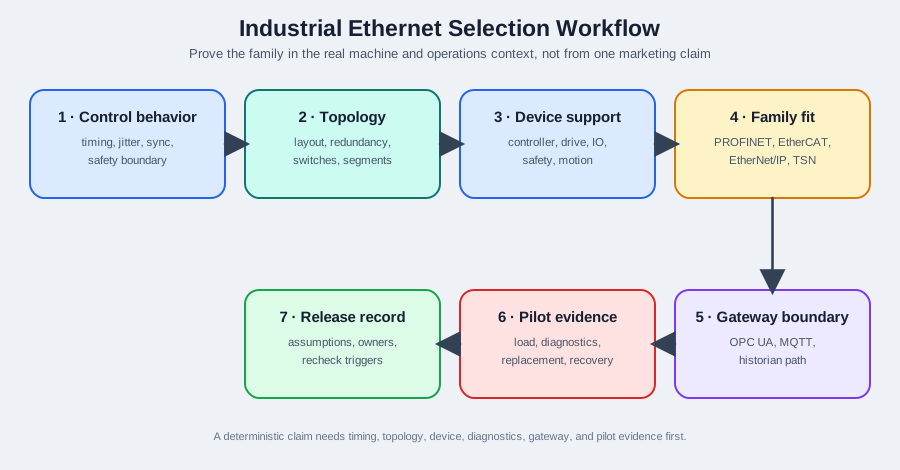
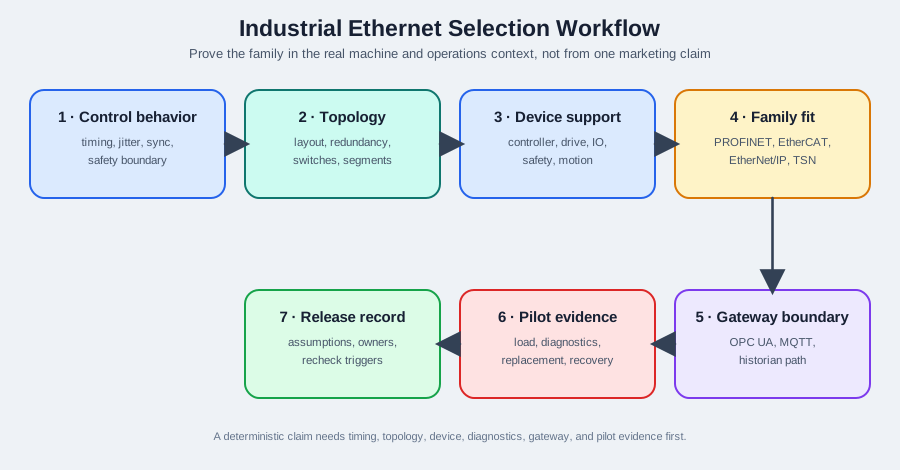
A release decision about the “prove the family in the real machine and operations context, not from one marketing claim”–“1 · control behavior” decision needs “timing, jitter, sync”, not a slogan.
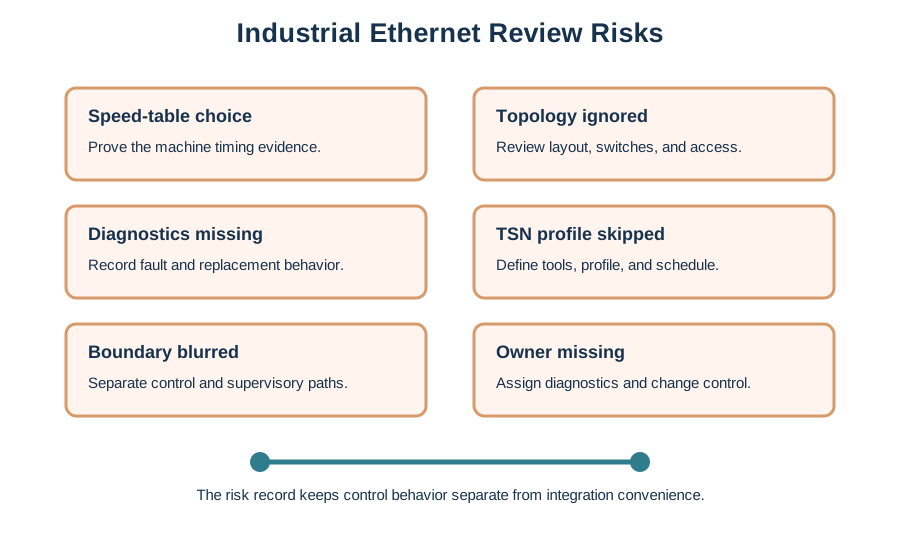
- Risk boundary Physical processes need documented timing, failure behavior, maintenance access, and security controls.
- The answer supports Protocol families have different jobs; a plant may use several when each boundary is reviewable.
- Those labels make Protocol families have different jobs; a plant may use several when each boundary is reviewable a traceable part of the “siemens standard”–“profinet io” decision, not an unsupported assertion.
Major section
Practitioner: Build the Industrial Protocol Evidence Record
A practical industrial protocol decision is an evidence record.
- It states the process, timing class, installed assets, data model, security boundary, diagnostics path, owner, and recheck trigger.
- The record also keeps brownfield projects honest.
- Runbook, spare-device procedure, backup, and change record.
Major section
Under the Hood: Determinism Is Proven, Not Implied
Industrial determinism is not created by writing "real-time" in a protocol description.
- A protocol family can provide mechanisms, but the plant design has to prove the behavior.
- TSN is a good example.
- Without that engineering record, the label does not prove the machine behavior.
Major section
Under the Hood: Determinism Is Proven, Not Implied (continued)
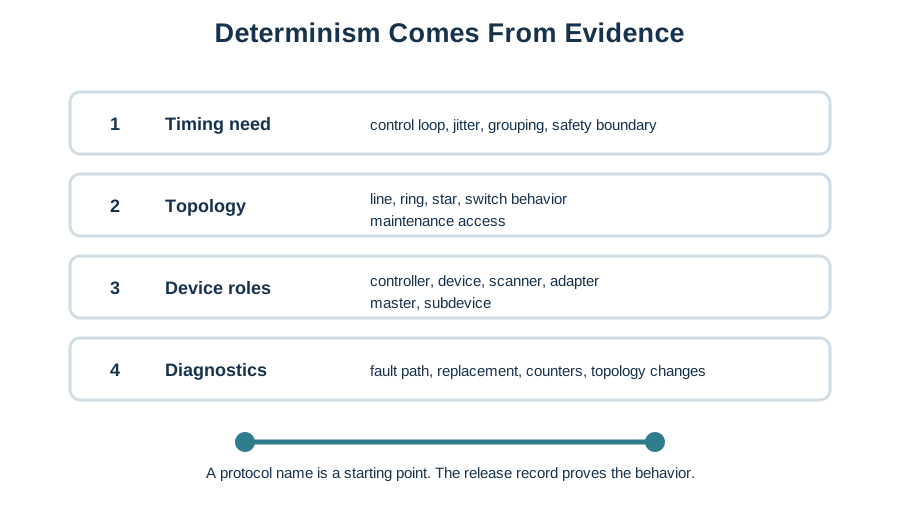
Cycle and jitter Control loops need bounded update behavior, not only high average throughput.
- A useful acceptance trace records the behavior before and after load is added.
- Topology Line, ring, star, switch path, redundancy, and maintenance access change the timing and failure surface.
- Safety requires a separate certified safety case and validation process.
Major section
Under the Hood: Determinism Is Proven, Not Implied (continued)
The test should capture normal cyclic traffic, add the planned historian or gateway traffic, force a device replacement or link change, and verify that controller timeouts and diagnostics still put the process into a known state.
- Device roles Controller, device, scanner, adapter, master, slave, and gateway roles must match the protocol family.
- Diagnostics Fault counters, topology changes, replacement behavior, and audit trails are part of the release evidence.
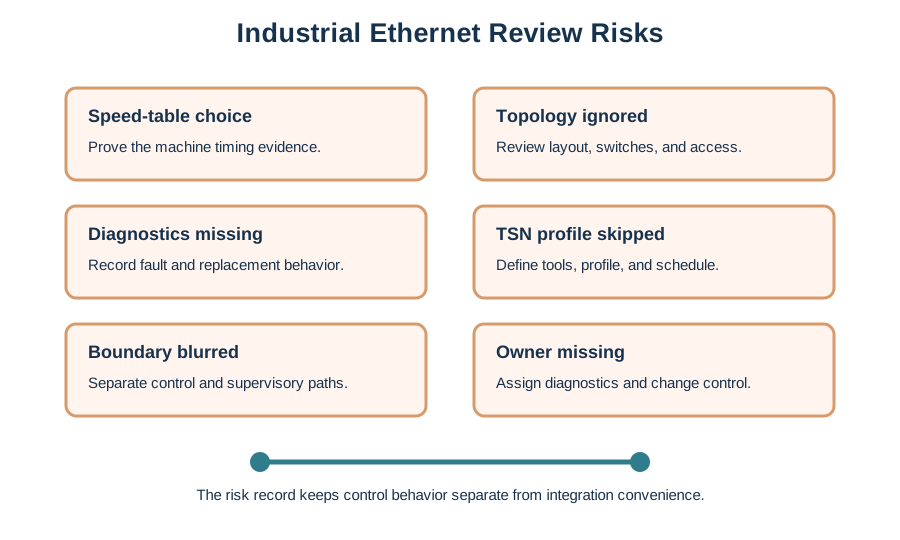
- That progression is the mechanism behind The risk record keeps control behavior separate from integration convenience and the evidence order needed for the “speed-table choice”–“prove the machine timing evidence” decision.
Major section
Interoperability Beyond Connection
The sender means air temperature in degrees Celsius at the time of the sample.
- A parsed message is not proof of shared meaning, and a shared meaning is not proof that the action is allowed.
- The shared system can coordinate and retain history, but it must not erase a local safe response.
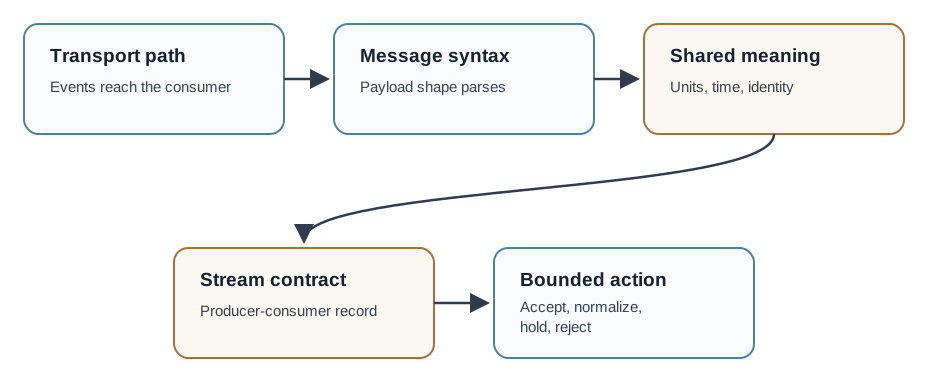
- The practical artifact is a stream contract.
Major section
Interoperability Beyond Connection (continued)
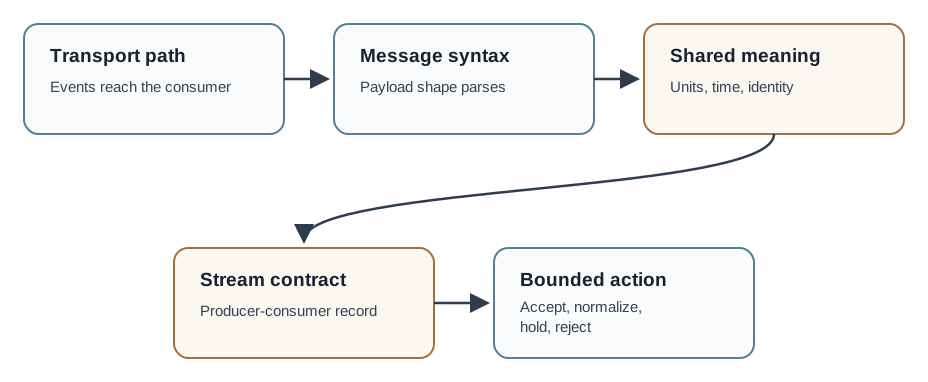
This opening does not make two whole products interchangeable.
- Under the Hood separates path, shape, meaning, policy, version change, and the evidence needed at each boundary.
- Relate it to “Payload shape parses”, then carry “Shared meaning” toward “Units, time, identity”.
- Interoperability fundamentals are about usable meaning across a boundary.
Major section
Interoperability Beyond Connection (continued)
A working connection and a parseable payload are necessary, but they do not prove that a receiver can combine, display, alert on, or automate from the event safely.
- It records source identity, event time, message shape, measurement meaning, schema version, consumer expectation, validation evidence, bounded action, and retest trigger.
- When that evidence is missing, constrain the response to the affected stream path: accept, normalize, hold, or reject based on the consumer decision.
- Interoperability is a chain of evidence: transport gets the event there, syntax makes it readable, semantics make it meaningful, and the contract proves the consumer can use it safely.
Deck summary
Key takeaways
Those two paths should not share the same proof.
- Industrial IoT protocol choices start with the machine, cell, line, or plant process being connected.
- The architecture is normal when each boundary has a clear job.
- An edge service may publish selected telemetry through MQTT/Sparkplug after the OT boundary.
- A release decision about the “prove the family in the real machine and operations context, not from one marketing claim”–“1 · control behavior” decision needs “timing, jitter, sync”, not a slogan.
Retrieval practice
Recall check 1 of 6

Gateway Gus says: answer from memory, then check your reasoning.
Q1What is the best first question when selecting an industrial IoT protocol?
Show answer
Answer: C Industrial protocol selection starts from process consequence and evidence, not from a favorite protocol name.
Retrieval practice
Recall check 2 of 6

Gateway Gus says: answer from memory, then check your reasoning.
Q2A plant wants analytics from an existing Modbus-controlled line without changing the PLC control loop. Which design is most defensible?
Show answer
Answer: B This preserves the brownfield control path while exposing selected tags through a governed gateway boundary with outage evidence.
Retrieval practice
Recall check 3 of 6

Gateway Gus says: answer from memory, then check your reasoning.
Q3Why is it not enough to say an industrial Ethernet design is deterministic because it uses a protocol with real-time features?
Show answer
Answer: C Determinism is an engineered and tested system property, not only a protocol label.
Retrieval practice
Recall check 4 of 6

Gateway Gus says: answer from memory, then check your reasoning.
Q4Two IoT event streams arrive over the expected protocol and parse as valid JSON. A dashboard still combines values incorrectly because one stream uses room air temperature and the other uses supply air temperature. Which interoperability layer needs review?
Show answer
Answer: C Interoperability review separates connection, payload syntax, shared meaning, and operational use.
Retrieval practice
Recall check 5 of 6

Gateway Gus says: answer from memory, then check your reasoning.
Q5A gateway adapter converts device payloads into a local event shape before a rule engine uses them for alerts. Which record best supports an interoperability review?
Show answer
Answer: D A practical interoperability record keeps producer, boundary, event semantics, consumer use, validation, and retest evidence visible so the team can review later changes.
Retrieval practice
Recall check 6 of 6

Gateway Gus says: answer from memory, then check your reasoning.
Q6A standards-based payload profile parses successfully, but it does not distinguish current, stale, suspect, and unavailable readings. A safety dashboard needs those states. What is the best interoperability decision?
Show answer
Answer: B Under-the-hood interoperability review keeps syntax, semantics, operational fitness, and bounded action separate.
Print reference
Answers 1 of 2
Answer key.
- C · Industrial protocol selection starts from process consequence and evidence, not from a favorite protocol name.
- B · This preserves the brownfield control path while exposing selected tags through a governed gateway boundary with outage evidence.
- C · Determinism is an engineered and tested system property, not only a protocol label.
- C · Interoperability review separates connection, payload syntax, shared meaning, and operational use.
Print reference
Answers 2 of 2
Answer key.
- D · A practical interoperability record keeps producer, boundary, event semantics, consumer use, validation, and retest evidence visible so the team can review later changes.
- B · Under-the-hood interoperability review keeps syntax, semantics, operational fitness, and bounded action separate.