Industrial IoT and Business Operations · Study deck
IIoT Operations: Legacy Risk and Evidence
A legacy PLC can keep production moving and still hide a weak integration path.
Ada is your guide for this deck.

After studying this chapter
Learning objectives
You will be able to:
- Explain: Good IIoT work respects that reality: it starts with an operational decision, places compute where the timing requires it, and adds integration without weakening existing control or safety behavior.
- Explain: A design that sends a millisecond control decision through a cloud dashboard is usually wrong, while a design that traps production context inside a PLC is also incomplete.
- Explain: Commission with evidence: Record tag mappings, sample rates, alarm thresholds, units, calibration status, and acceptance tests so maintenance and operations teams know what the new signal means.
- Explain: A sensor shows that it is shaking more than usual.
Major section
IIoT Operational Decision Contracts
A sensor shows that it is shaking more than usual.
- Someone must decide what happens next.
- The machine may keep running.
- The line may slow down.
- A safety system may stop it at once.
Major section
IIoT Operational Decision Contracts (continued)
Under the Hood examines industrial data context, trust, and why the same reading can support several decisions without giving every layer control.
- Industrial IoT connects field evidence to choices like these.
- The short name is IIoT.
- The useful part is not the label.
- Some choices must happen beside the machine.
Major section
IIoT Operational Decision Contracts (continued)
This contract chapter defines the operational boundary so IIoT evidence supports the right action without moving control into the wrong layer.
- A distant service must not delay a safety action.
- Other choices can wait.
- A weekly repair plan can use stored history.
- A business report can wait longer still.
Major section
IIoT Operational Decision Contracts (continued)
It also says what the system must never control.
- That boundary protects production and people.
- A real plant has shared machines, old equipment, work permits, and several owners.
- This page isolates the decision contract underneath those ideas: a plant signal becomes valuable only when its timing, context, owner, and safe action path are explicit.
Major section
IIoT Operational Decision Contracts (continued)
Every cross-layer exchange should retain source, time, quality, safety meaning, and the owner allowed to act.
- A sensor reading matters when it changes a maintenance work order, production schedule, safety response, quality hold, or engineering decision.
- Industry 4.0 is therefore more than a sensor retrofit.
- Security and reliability also differ from office IT defaults.
Major section
IIoT Operational Decision Contracts (continued)
The technical stack still senses, communicates, analyzes, and acts, but the cost of a wrong or late action is much higher than a missed convenience notification.
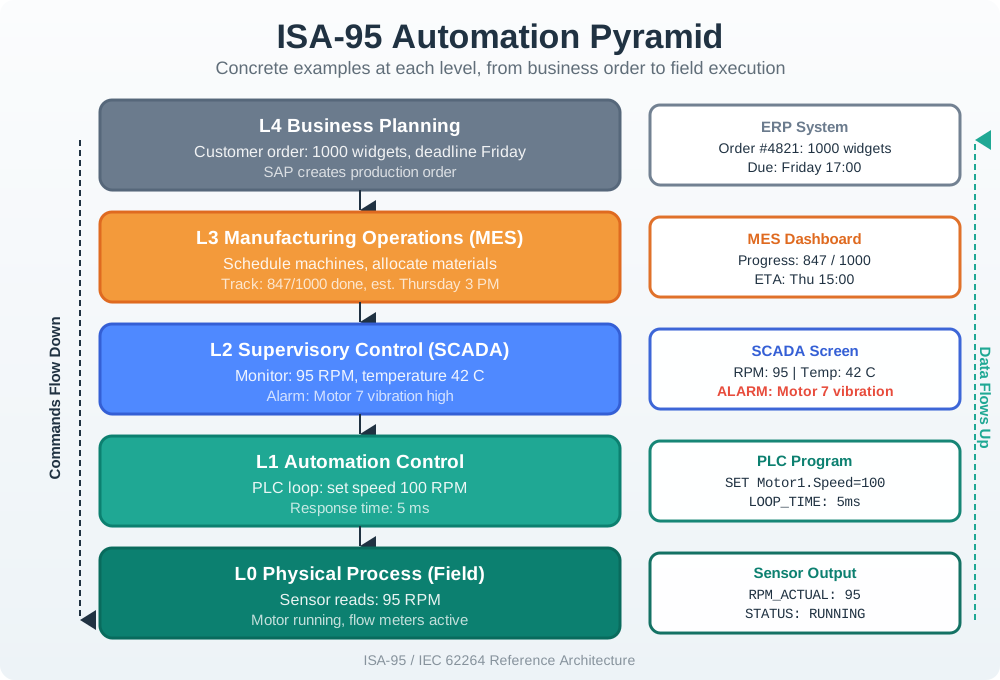
- The 1,000-widget order due Friday may change a schedule, but it should not command a one-millisecond torque loop.
- Trusted operation depends on preserving that boundary when data travels upward.
- The ISA-95 layers are a useful way to avoid vague architecture diagrams.
Major section
IIoT Operational Decision Contracts (continued)
A design that sends a millisecond control decision through a cloud dashboard is usually wrong, while a design that traps production context inside a PLC is also incomplete.
- Machines may run for decades, shutdown windows may be short, vendor equipment may be closed, and safety interlocks may already be certified.
- A useful IIoT design starts by locating the constraint before choosing a platform.
- A maintenance trend may be safe to aggregate through an edge gateway.
Major section
IIoT Operational Decision Contracts (continued)
OPC UA can expose structured equipment data to SCADA, MES, historians, or integration gateways.
- Good IIoT work respects that reality: it starts with an operational decision, places compute where the timing requires it, and adds integration without weakening existing control or safety behavior.
- A sub-second machine-control loop may belong near the PLC and should not wait for a cloud round trip.
- MQTT Sparkplug B can carry contextualized edge data toward brokers and applications.
Major section
IIoT Operational Decision Contracts (continued)
A production KPI may belong in MES or ERP after the signal has been cleaned, timestamped, and contextualized.
- The same sensor can support all three, but each consumer needs a different latency budget, failure behavior, and owner.
- REST APIs, Kafka, time-series databases, data lakes, and enterprise warehouses may support analytics and reporting after the control boundary is protected.
- Separate monitor from control: Decide whether the project observes a machine, recommends action, or directly changes equipment behavior.
Major section
IIoT Operational Decision Contracts (continued)
Monitoring can often be added through read-only paths; control changes require formal engineering review.
- Commission with evidence: Record tag mappings, sample rates, alarm thresholds, units, calibration status, and acceptance tests so maintenance and operations teams know what the new signal means.
- Industrial telemetry is useful only when the consumer knows what the signal means.
- A vibration RMS value needs asset identity, sensor mounting point, sampling window, engineering unit, timestamp, machine state, speed, load, and quality flag.
Major section
IIoT Operational Decision Contracts (continued)
A temperature reading needs probe location, calibration status, alarm thresholds, measurement range, and whether the equipment was idle, ramping, cleaning, or producing.
- Without that context, analytics may learn maintenance schedules, product recipes, or operator behavior instead of the physical failure mode.
- OPC UA information models can describe objects, methods, variables, namespaces, and data quality.
- MQTT Sparkplug B birth certificates can advertise edge nodes, devices, metrics, units, and online state to a broker.
Deck summary
Key takeaways
A sensor shows that it is shaking more than usual.
- Under the Hood examines industrial data context, trust, and why the same reading can support several decisions without giving every layer control.
- This contract chapter defines the operational boundary so IIoT evidence supports the right action without moving control into the wrong layer.
- It also says what the system must never control.
- Every cross-layer exchange should retain source, time, quality, safety meaning, and the owner allowed to act.
Retrieval practice
Recall check 1 of 6

Ada says: answer from memory, then check your reasoning.
Q1A working old controller is being connected to a new analytics gateway. What should the project check first?
Show answer
Answer: A Inventory and downtime evidence expose the real integration risk.
Retrieval practice
Recall check 2 of 6
Ada says: answer from memory, then check your reasoning.
Q2An analytics service may recommend stopping a machine. Which record lets operations audit the decision before release?
Show answer
Answer: A The record ties evidence, authority, timing, and failure response to one decision.
Retrieval practice
Recall check 3 of 6
Ada says: answer from memory, then check your reasoning.
Q3Per this chapter, why is a design that sends a millisecond control decision through a cloud dashboard usually wrong, while a design that traps all production context inside a PLC is also incomplete?
Show answer
Answer: D A design that sends a millisecond control decision through a cloud dashboard is usually wrong, while a design that traps production context inside a PLC is also incomplete.
Retrieval practice
Recall check 4 of 6
Ada says: answer from memory, then check your reasoning.
Q4In this chapter's worked decision-trace example, what path does a vibration alert take from the physical source to an operational decision?
Show answer
Answer: B see answers page
Retrieval practice
Recall check 5 of 6
Ada says: answer from memory, then check your reasoning.
Q5A plant will use vibration telemetry for maintenance advice. Which contract set is complete enough to review?
Show answer
Answer: C Meaning, delivery behavior, access, and safe action limits are all stated.
Retrieval practice
Recall check 6 of 6
Ada says: answer from memory, then check your reasoning.
Q6Why should an IIoT design separate monitoring, recommendation, and direct control before choosing where logic runs?
Show answer
Answer: C see answers page
Print reference
Answers 1 of 3
Answer key.
- A · Inventory and downtime evidence expose the real integration risk.
- A · The record ties evidence, authority, timing, and failure response to one decision.
- D · A design that sends a millisecond control decision through a cloud dashboard is usually wrong, while a design that traps production context inside a PLC is also incomplete.
Print reference
Answers 2 of 3
Answer key.
- B · The chapter states: 'a vibration alert may start at an accelerometer, pass through an IO module or edge computer, publish to a broker, land in a historian, trigger a CMMS work order, and reach a technician with enough evidence to decide whether production can continue.'.
- C · Meaning, delivery behavior, access, and safe action limits are all stated.
Print reference
Answers 3 of 3
Answer key.
- C · Monitoring, recommendation, and direct control each carry a different latency budget, safety-review requirement, failure mode, and owner -- a PLC's control loop, an edge analytics job, a SCADA/MES workflow, and a cloud dashboard are not interchangeable places to put the same logic.