Industrial IoT and Business Operations · Study deck
Real-Time ISA-95: Timing Foundations
A factory message can be correct and still arrive too late for control.
Ada is your guide for this deck.

After studying this chapter
Learning objectives
You will be able to:
- Explain: Hard real-time describes a deadline for which lateness is failure, not merely inconvenience: Jitter is cycle-to-cycle timing variation; in synchronized motion, bounded jitter can matter more than average latency.
- Explain: A servo drive, PLC task, HMI alarm, MES work order, and ERP purchase plan all matter, but they live on different time scales and carry different consequences when they arrive late.
- Explain: Safety functions may rely on certified PLCs, safety relays, safety-rated drives, PROFIsafe, CIP Safety, or IEC 61508/IEC 61511 engineering practices rather than ordinary application code.
Major section
Start With the Story
A filling line must close a valve before a bottle overflows.
- The line controller can act in a fraction of a second.
- A production system can count finished bottles over minutes, while business planning may work across days.
- Sending the fast decision upward through every layer would add delay and mix duties that need different owners.
Major section
Start With the Story (continued)
The layers are not fixed brands or a promise that every factory is arranged alike.
- The deeper sections name the formal levels, timing classes, control loops, production records, and evidence needed when information moves between fast operations and slower planning.
- A machine state may rise to planning.
- A plan may set an approved target.
Major section
Phoebe's Field Notes: Sizing the Anti-Alias Filter for a 1 kHz Motor Loop
The mathematical gist: A 4–20 mA loop across 250 ohms becomes 1.00–5.00 V, a 4.00 V ADC span.
- At the chapter's 1 ms sample period, 1 kHz sampling sets a 500 Hz Nyquist limit.
Major section
ISA-95 Timing Boundaries
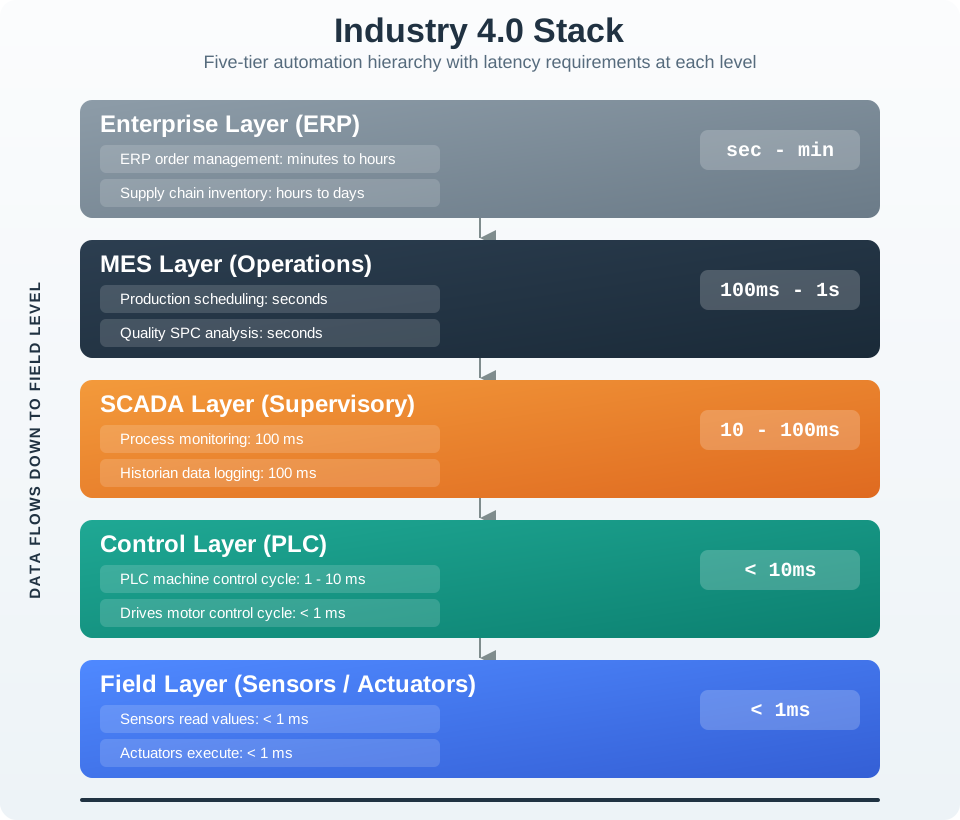
A servo drive, PLC task, HMI alarm, MES work order, and ERP purchase plan all matter, but they live on different time scales and carry different consequences when they arrive late.
- The lower levels are close to the physical process.
- Level 1 controllers run machine logic.
- The useful pattern is to separate control authority from information visibility.
Major section
ISA-95 Timing Boundaries (continued)
MES may issue a production order, but it should not bypass a PLC interlock.
- IoT designs fail when they move Level 0 or Level 1 control decisions into cloud services, dashboards, or business systems that were never built for deterministic deadlines.
- That separation also keeps industrial IoT projects honest.
- Integration technology must respect that difference.
Major section
ISA-95 Timing Boundaries (continued)
A cloud dashboard may show a motor-current trend, but it should not close a 1 ms torque loop.
- ERP may plan inventory, but it should not decide whether a robot can enter a safety zone.
- Each level can exchange data with the others, but the deadline and safety owner must stay attached to the function.
- The lower levels need deterministic response and fail-safe behavior; the upper levels need context, timestamps, ordering, reconciliation, and business meaning.
Major section
ISA-95 Timing Boundaries (continued)
A machine event may need a local trip, a SCADA alarm, a historian sample, an MES quality hold, and an ERP maintenance cost update.
- Hard real-time: Missing the deadline is a system failure, even if the answer eventually arrives.
- Soft real-time: Delay degrades usefulness, but the system can usually continue safely.
- Best effort: Correctness depends more on completeness, ordering, and reconciliation than on millisecond delivery.
Major section
Put Decisions at the Lowest Level
As timing relaxes, the architecture can move upward.
- A practical ISA-95 design starts with the fastest unsafe or economically damaging event.
- Emergency stop, light curtain, torque limit, burner management, and motion synchronization belong near certified safety controllers, drives, PLCs, or dedicated real-time hardware.
- SCADA and HMI systems can supervise lines and alarms.
Major section
Put Decisions at the Lowest Level (continued)
None of those bridges should silently become the only place where a local stop, interlock, or critical fallback is decided.
- A dashboard can display their state, but it should not be the path that makes them safe.
- Historians can sample process values for trends.
- ERP can plan demand, inventory, purchasing, and finance.
Major section
Deadlines Beyond Network Speed
A real-time guarantee includes sensing delay, input filtering, PLC scan time, task priority, network scheduling, controller execution, output update, actuator response, and mechanical settling.
- A fast Ethernet link does not fix a slow scan cycle, overloaded gateway, nondeterministic task scheduler, or cloud round trip.
- Higher levels have their own correctness rules.
- ERP integrations need reconciliation and retry.
Major section
Deadlines Beyond Network Speed (continued)
Safety functions may rely on certified PLCs, safety relays, safety-rated drives, PROFIsafe, CIP Safety, or IEC 61508/IEC 61511 engineering practices rather than ordinary application code.
- MES transactions need sequence, genealogy, batch state, operator action, and quality disposition.
- Historians need timestamp source, compression, exception/deviation rules, and data quality.
- These concerns are different from sub-millisecond determinism, but they are still part of a reliable industrial IoT architecture.
Major section
Key Concepts
Hard real-time describes a deadline for which lateness is failure, not merely inconvenience: Jitter is cycle-to-cycle timing variation; in synchronized motion, bounded jitter can matter more than average latency.
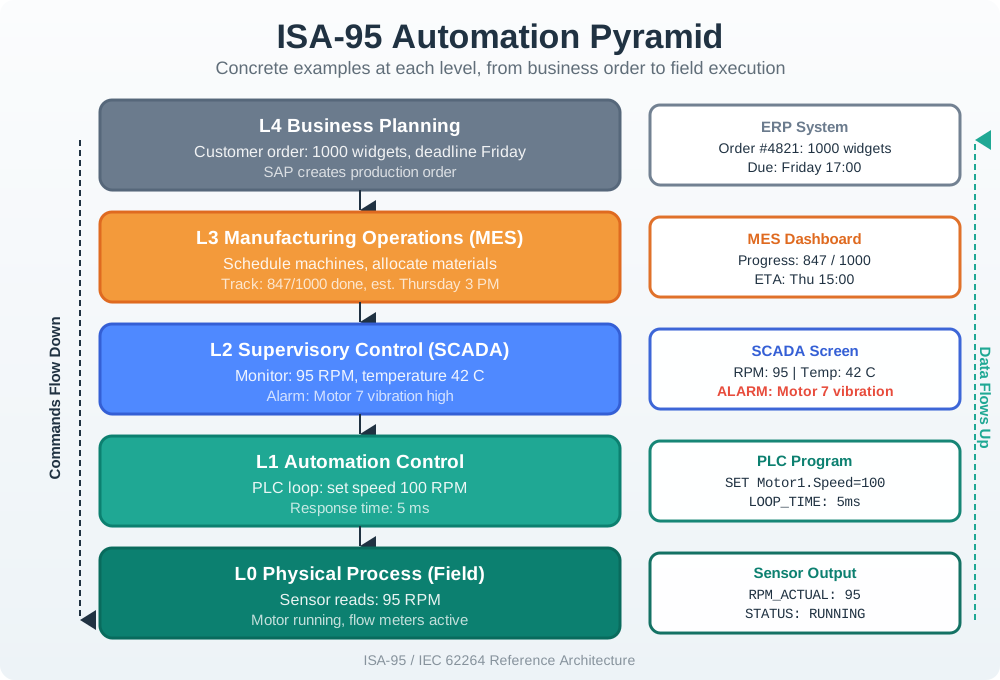
- MES schedules work and SCADA reports current values between those extremes.
- The arrows carry data, deadline, safety context, and owner; they do not make every level interchangeable.
Deck summary
Key takeaways
A filling line must close a valve before a bottle overflows.
- The layers are not fixed brands or a promise that every factory is arranged alike.
- The mathematical gist: A 4–20 mA loop across 250 ohms becomes 1.00–5.00 V, a 4.00 V ADC span.
- A servo drive, PLC task, HMI alarm, MES work order, and ERP purchase plan all matter, but they live on different time scales and carry different consequences when they arrive late.
- MES may issue a production order, but it should not bypass a PLC interlock.
Retrieval practice
Recall check

Ada says: answer from memory, then check your reasoning.
Q1A cloud dashboard displays motor-current trends. Where should the fast torque control decision remain?
Show answer
Answer: D The chapter separates upper-level visibility from deterministic machine control authority.
Q2A motor-control path has fast Ethernet but a slow PLC scan. What should the team measure to review its deadline?
Show answer
Answer: C The timing budget includes sensing, scheduling, execution, output, and mechanical response.
Print reference
Answers
Answer key.
- D · The chapter separates upper-level visibility from deterministic machine control authority.
- C · The timing budget includes sensing, scheduling, execution, output, and mechanical response.