Applications & Use Cases · Study deck

Real-Time ISA-95: System Design and Practice

An assembly line needs a local stop in milliseconds and a plant report in seconds.

Blueprint Bina is your guide for this deck.

iiotrealtime
Blueprint Bina, the module guide, in a scene from this chapter.
iotclass.org

After studying this chapter

Learning objectives

You will be able to:

  • Explain: Sub-millisecond cycle-time capability can support a 1 ms motion requirement when the drive, controller, topology, and load test all meet the timing budget.
  • Explain: Wi-Fi, private 5G, OPC-UA, MQTT, or REST can carry fleet state, dispatch, and telemetry only where bounded local safety behavior is preserved.
  • Explain: The release record should include measured cycle time, jitter, fault response, and replacement-device behavior, not only the protocol name.
  • Explain: Technology mapping: Protocol, computing platform, and network architecture choices must align with the timing requirements of each ISA-95 level.
iotclass.org

Major section

Assembly Line Design Case
All robots must be synchronized within 1 ms.

  • Quality data must be logged for 10-year traceability.
  • AGVs must avoid collisions with <100 ms response time.
  • Operators need real-time production status.
  • Enterprise ERP system needs hourly production counts.

Numbers to remember

1 msAll robots must be synchronized within 1 ms.
<100 msAGVs must avoid collisions with <100 ms response time.

Why it matters

Tight jitter control enables coordinated multi-axis motion when clocks, task scheduling, and diagnostics are validated.

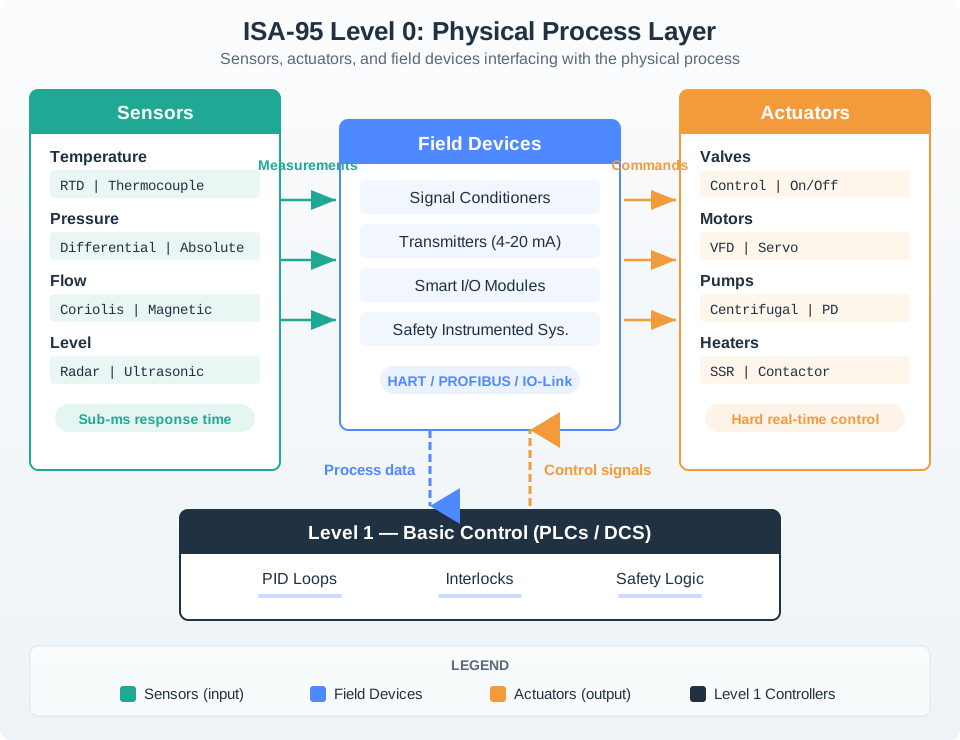
ISA-95 Level 0 physical process layer
iotclass.org

Major section

Assembly Line Design Case (continued)

Justification: 6-axis coordinated motion requires deterministic timing.

  • Vision processing and data logging can tolerate slight delays.
  • Safety-critical, must respond to obstacles deterministically.
  • Human perception doesn't require sub-second updates.
  • Sub-millisecond cycle-time capability can support a 1 ms motion requirement when the drive, controller, topology, and load test all meet the timing budget.
iotclass.org

Major section

Assembly Line Design Case (continued)

The release record should include measured cycle time, jitter, fault response, and replacement-device behavior, not only the protocol name.

  • Obstacle detection and stop behavior should remain local to the vehicle, safety scanner, controller, or certified safety system.
  • Wi-Fi, private 5G, OPC-UA, MQTT, or REST can carry fleet state, dispatch, and telemetry only where bounded local safety behavior is preserved.
  • Tight jitter control enables coordinated multi-axis motion when clocks, task scheduling, and diagnostics are validated.
iotclass.org

Major section

Map Tech to ISA-95 Levels

When designing industrial IoT systems, the biggest mistake is using the wrong technology for the wrong level.

  • This decision framework helps you match computing platforms, protocols, and architectures to automation levels.
  • Yes → Hard real-time (Levels 0-1) → Use PLC/PAC with deterministic network (EtherCAT, PROFINET IRT).
  • Yes → Soft real-time (Level 1-2) → Use PLC with standard industrial Ethernet (PROFINET IO, EtherNet/IP).
iotclass.org

Major section

Summary

Technology mapping: Protocol, computing platform, and network architecture choices must align with the timing requirements of each ISA-95 level.

  • The standard (IEC 62264) provides the definitive interface model between enterprise and control systems.
  • Choosing the wrong class can cause safety incidents (under-specifying) or wasted budget (over-specifying).
  • Cloud cannot control motors; PLCs should not run ERP.
iotclass.org

Deck summary

Key takeaways

All robots must be synchronized within 1 ms.

  • Justification: 6-axis coordinated motion requires deterministic timing.
  • The release record should include measured cycle time, jitter, fault response, and replacement-device behavior, not only the protocol name.
  • When designing industrial IoT systems, the biggest mistake is using the wrong technology for the wrong level.
  • Technology mapping: Protocol, computing platform, and network architecture choices must align with the timing requirements of each ISA-95 level.
iotclass.org

Retrieval practice

Recall check 1 of 4

Blueprint Bina says: answer from memory, then check your reasoning.

Q1Place each ISA-95 level where it lives so you can send real-time control, plant operations, and business planning to the right decision horizon.

APhysical process
BAutomation control
CSCADA supervision
DMES operations
EERP planning
Show answer

Answer: A Group the physical process and control loop, supervisory and manufacturing operations, and enterprise planning so you can avoid pushing slow business logic into safety-critical control.

iotclass.org

Retrieval practice

Recall check 2 of 4

Blueprint Bina says: answer from memory, then check your reasoning.

Q2Complete the ISA-95 route gate so upper-level consumers cannot act on stale data or write through a protected control boundary:

Aself.max_local_deadline_ms = max_local_deadline_ms
Bself.max_local_deadline_ms = None
Cself.max_local_deadline_ms = 'cloud'
Dself.max_local_deadline_ms = []
Show answer

Answer: A The gate keeps fast Level 0-1 control local, blocks upper-layer write-through paths, and holds stale or bad-quality data before publishing context upward.

iotclass.org

Retrieval practice

Recall check 3 of 4

Blueprint Bina says: answer from memory, then check your reasoning.

Q3A factory is upgrading its motor control system (ISA-95 Level 0-1) and a plant engineer suggests using MQTT over WiFi for sensor-to-PLC communication because "it works great for our dashboard data." The control loop requires 1ms cycle time with bounded jitter. Why is this proposal problematic?

AMQTT payload limits make high-rate drive telemetry and PLC status words impossible
BWiFi power draw is the main blocker even for line-powered motor cabinets
CMQTT support is rare in modern PLCs, so integration would require custom firmware
DMQTT over WiFi cannot bound latency or jitter for a 1ms hard-real-time motor loop
Show answer

Answer: D ISA-95 Level 0-1 motor control requires hard real-time determinism with guaranteed worst-case timing.

iotclass.org

Retrieval practice

Recall check 4 of 4

Blueprint Bina says: answer from memory, then check your reasoning.

Q4A multi-axis robotic welding cell requires all six axes to be synchronized within 1 microsecond. The axes are controlled by separate drives connected via industrial Ethernet. Which factor is MORE critical than absolute latency for this synchronized motion application?

ATotal network bandwidth to carry position data for all six axes simultaneously
BBounded jitter, because consistent timing between axes matters more than raw speed for coordinated motion
CThe physical cable length between drives, which must be under 10 meters
DThe processing speed of the master PLC, which must complete all calculations in under 100 nanoseconds
Show answer

Answer: B For synchronized multi-axis motion, consistent timing (low jitter) is more critical than absolute speed.

iotclass.org

Print reference

Answers 1 of 2

Answer key.

  1. A · Group the physical process and control loop, supervisory and manufacturing operations, and enterprise planning so you can avoid pushing slow business logic into safety-critical control.
  2. A · The gate keeps fast Level 0-1 control local, blocks upper-layer write-through paths, and holds stale or bad-quality data before publishing context upward.
  3. D · ISA-95 Level 0-1 motor control requires hard real-time determinism with guaranteed worst-case timing.
iotclass.org

Print reference

Answers 2 of 2

Answer key.

  1. B · For synchronized multi-axis motion, consistent timing (low jitter) is more critical than absolute speed.
iotclass.org