Industrial IoT and Business Operations · Study deck
Real-Time ISA-95: Determinism and Technology Mapping
A fast average link can still miss a control deadline when jitter spikes.
Ada is your guide for this deck.
After studying this chapter
Learning objectives
You will be able to:
- Explain: c) Hard real-time -- A printing press with a 125 microsecond cycle time and 1 microsecond maximum jitter tolerance is a classic hard real-time application.
- Explain: But if one axis varies randomly between 1 ms and 9 ms (high jitter), the axes become unsynchronized, causing mechanical stress, poor surface finish, or collisions.
- Explain: c) Level 2 -- Supervisory -- SCADA (Supervisory Control and Data Acquisition) systems operate at ISA-95 Level 2, which handles monitoring and supervision of production processes.
- Explain: A compromised Level 0-1 network could cause physical damage, equipment destruction, or endanger human life.
Major section
Determinism vs. Throughput
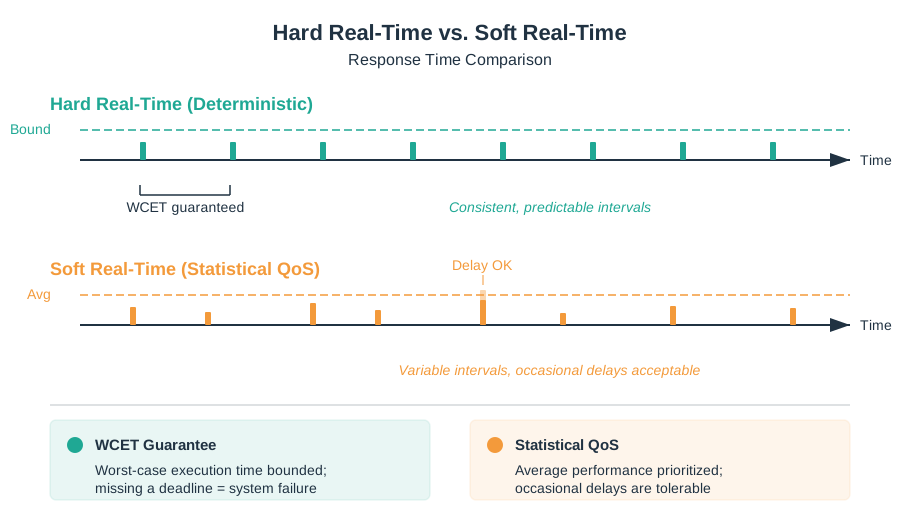
With the level timing ladder in place, the next question is what kind of promise each deadline needs.
- Missing a deadline is a system failure.
- Hard real-time: Response time is bounded and predictable.
Major section
Jitter and Synchronization
Figure: Two streams can have the same average latency shows why an average latency figure can hide a missed deadline.
- The closing line is the definition to carry forward.
- The two axes in Figure: Two streams can have the same average latency are aligned on purpose, and both streams average 20 ms.
Major section
Answer
c) Hard real-time -- A printing press with a 125 microsecond cycle time and 1 microsecond maximum jitter tolerance is a classic hard real-time application.
- Missing a deadline would cause visible print defects (color misregistration, smearing).
- Hard real-time requires guaranteed worst-case execution time (WCET) and minimal jitter, typically implemented with specialized hardware like EtherCAT with distributed clocks.
- c) Level 2 -- Supervisory -- SCADA (Supervisory Control and Data Acquisition) systems operate at ISA-95 Level 2, which handles monitoring and supervision of production processes.
Major section
Answer
If one axis is consistently 5 ms late but all axes have the same 5 ms delay, the motion is perfectly coordinated.
- But if one axis varies randomly between 1 ms and 9 ms (high jitter), the axes become unsynchronized, causing mechanical stress, poor surface finish, or collisions.
- These networks must be physically isolated from IT networks to prevent cyberattacks from reaching PLCs, safety controllers, and field devices.
- A compromised Level 0-1 network could cause physical damage, equipment destruction, or endanger human life.
Deck summary
Key takeaways
With the level timing ladder in place, the next question is what kind of promise each deadline needs.
- Figure: Two streams can have the same average latency shows why an average latency figure can hide a missed deadline.
- c) Hard real-time -- A printing press with a 125 microsecond cycle time and 1 microsecond maximum jitter tolerance is a classic hard real-time application.
- If one axis is consistently 5 ms late but all axes have the same 5 ms delay, the motion is perfectly coordinated.
Retrieval practice
Recall check 1 of 4

Ada says: answer from memory, then check your reasoning.
Q1A factory floor has three subsystems: (1) a servo motor requiring 250-microsecond cycle time, (2) a SCADA HMI refreshing every 500ms, and (3) a cloud dashboard updating every 30 seconds. Which protocol stack correctly matches each subsystem to the appropriate ISA-95 level?
Show answer
Answer: B EtherCAT can be engineered for sub-millisecond servo control at Level 0-1, PROFINET can support supervisory factory traffic, and MQTT fits best-effort dashboard publishing when the control boundary is protected.
Retrieval practice
Recall check 2 of 4

Ada says: answer from memory, then check your reasoning.
Q2A printing press requires a cycle time of 125 microseconds with maximum jitter of 1 microsecond. Which type of real-time guarantee does this require?
Show answer
Answer: Review the source
Q3At which ISA-95 level would you place a SCADA system that displays alarm conditions to plant operators?
Show answer
Answer: Review the source
Retrieval practice
Recall check 3 of 4

Ada says: answer from memory, then check your reasoning.
Q4Why is jitter often more critical than absolute latency for synchronized motion control?
Show answer
Answer: Review the source
Q5An engineer needs to connect 100 PLCs to a Manufacturing Execution System (MES) for production scheduling. Which protocol and ISA-95 level boundary does this cross?
Show answer
Answer: Review the source
Retrieval practice
Recall check 4 of 4

Ada says: answer from memory, then check your reasoning.
Q6A factory floor network uses air-gapped segmentation. Which ISA-95 level does this practice primarily protect?
Show answer
Answer: Review the source
Print reference
Answers
Answer key.
- B · EtherCAT can be engineered for sub-millisecond servo control at Level 0-1, PROFINET can support supervisory factory traffic, and MQTT fits best-effort dashboard publishing when the control boundary is protected.
- Review the source
- Review the source
- Review the source
- Review the source
- Review the source