Applications & Use Cases · Study deck
Predictive Maintenance: Signals and Vibration
This first route connects maintenance strategy and business evidence to a signal pipeline, then develops vibration features into reviewable fault evidence.
Blueprint Bina is your guide for this deck.

After studying this chapter
Learning objectives
You will be able to:
- Explain: The gateway may compute FFT features locally, forward time-series data through OPC UA or MQTT, and store results in a historian, AVEVA PI System, InfluxDB, TimescaleDB, or cloud data lake.
- Explain: The first proof is whether the system can distinguish normal load changes from a developing bearing defect, then raise an alert early enough for a planned inspection.
- Explain: A feature such as vibration RMS or envelope energy should carry the source sensor, asset id, timestamp, window size, filter settings, firmware version, and operating state.
- Explain: Condition data needs a traceable path from sensor to action.
Major section
Start With the Story
Heat, sound, current, and vibration may give early clues.
- A change during heavy work may be normal; the same change at light work may matter.
- The simple story has a limit.
- A pattern can show that something changed; it may not prove why.
- Safe action still needs physical checks and maintenance judgment.
Major section
PdM Turns Signals into Work
Predictive maintenance is valuable when a signal changes a maintenance action before the asset fails.
- The goal is not to collect every possible waveform.
- The goal is to detect a developing fault early enough to order parts, schedule labor, protect safety, and avoid unplanned downtime.
- A useful deployment starts with one named asset and one named fault.
Major section
PdM Turns Signals into Work (continued)
The strongest candidates are assets with expensive failure modes and measurable degradation patterns: motors, pumps, compressors, fans, gearboxes, spindles, conveyors, chillers, turbines, and critical bearings.
- The signal may come from vibration, temperature, acoustic emission, motor current, pressure, oil debris, lubricant analysis, cycle counts, or control-system operating context.
- The decision in pdm turns signals into work must preserve that labelled boundary.
- The business case should also include what will not be predicted.
Major section
PdM Turns Signals into Work (continued)
For example, a drive-end bearing on a cooling pump might use a triaxial accelerometer, motor current, and discharge pressure.
- The first proof is whether the system can distinguish normal load changes from a developing bearing defect, then raise an alert early enough for a planned inspection.
- If the alert cannot become a work order with parts, labor, and safe access, the analytics result has not yet created maintenance value.
- Some faults arrive too suddenly, some assets lack repeatable operating cycles, and some failures are cheaper to repair after failure than to instrument continuously.
Major section
Design the Signal Chain First
Process equipment may use pressure differential, flow, valve position, energy use, startup time, or compressor discharge temperature.
- A practical PdM pilot starts with failure modes and effects analysis, asset history, and maintenance records.
- A poorly mounted accelerometer can produce clean-looking data that is useless for diagnosis.
- Useful features depend on the asset.
Major section
PdM Needs Physics and Workflow
Condition data needs a traceable path from sensor to action.
- An IEPE accelerometer, MEMS sensor, current transformer, oil particle counter, or temperature probe may connect to an edge DAQ, PLC, or gateway.
- Sampling choices change what faults can be seen.
- Model operations are part of the design.
Major section
PdM Needs Physics and Workflow (continued)
The gateway may compute FFT features locally, forward time-series data through OPC UA or MQTT, and store results in a historian, AVEVA PI System, InfluxDB, TimescaleDB, or cloud data lake.
- Nyquist limits, anti-alias filtering, window length, spectral resolution, tachometer references, sensor orientation, mounting stiffness, and unit conversion all affect the signal.
- Downsampling a 10 kHz vibration waveform to a 1 Hz dashboard trend can erase the bearing information that maintenance needed.
- Alerts need severity, confidence, asset id, feature values, baseline comparison, recent maintenance state, and recommended inspection.
- A PdM system that cannot learn from technician outcomes becomes an expensive alarm list.
Major section
PdM Needs Physics and Workflow (continued)
Teams must handle false positives, false negatives, seasonal operation, new product mixes, replaced parts, firmware changes, sensor drift, and concept drift.
- The data model should keep raw windows, derived features, and maintenance events connected.
- A feature such as vibration RMS or envelope energy should carry the source sensor, asset id, timestamp, window size, filter settings, firmware version, and operating state.
- The work-order outcome should then link back to the same feature window.
Major section
Sammy Listens to Machines
The repair took 3 days because nobody knew it was about to break.
- Temperature Terry has a new job at a candy factory!
- Sammy's Solution: Be a Machine Doctor!
- Monday: Sammy notices the mixer is shaking a tiny bit more than usual.
- Monday: The mixer is back to making chocolate perfectly!
Major section
Key Concepts
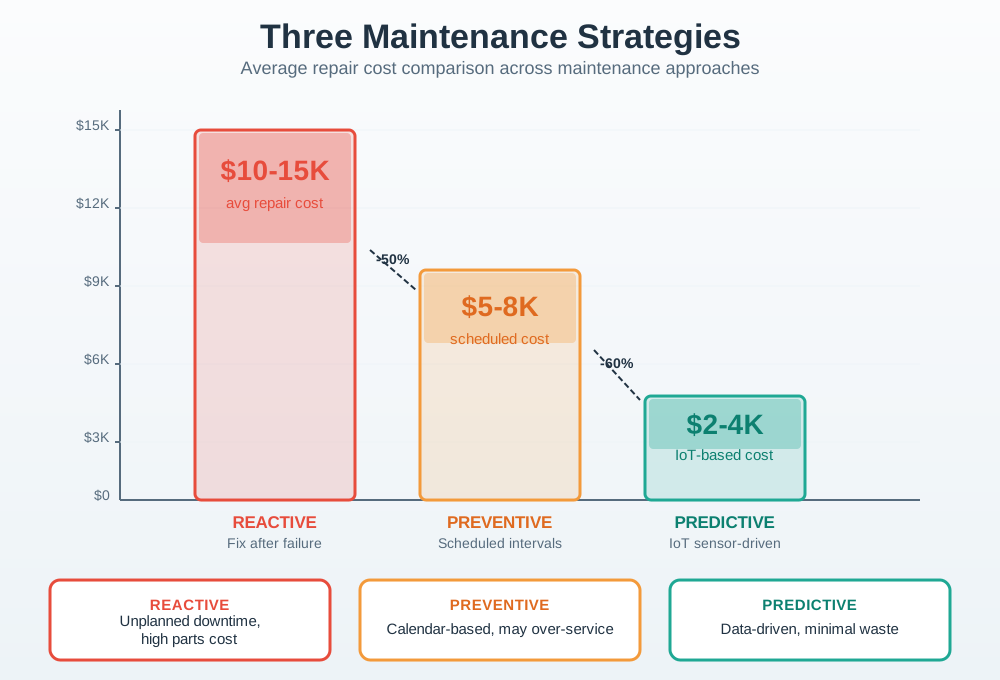
Asset Criticality: Ranking equipment by production impact, safety consequence, repair cost, spare-part lead time, and whether failure stops a constrained process.
- Remaining Useful Life (RUL): An estimate of time or cycles until a failure threshold is likely, valid only for the modeled fault mode and operating context.
- The decision in key concepts must preserve that labelled boundary.
Major section
Key Concepts (continued)
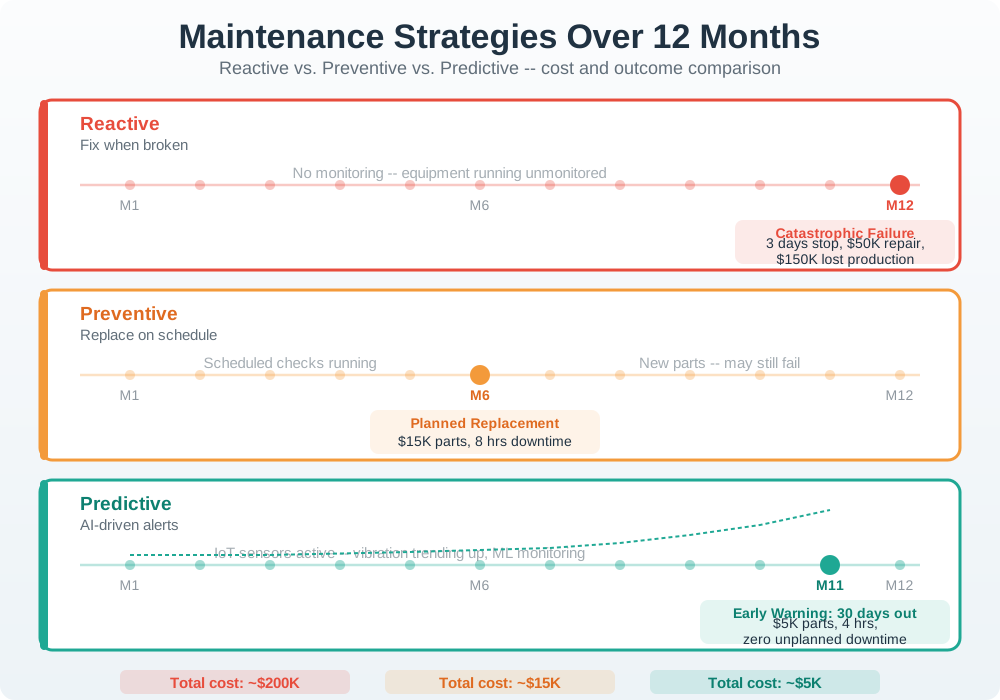
This scenario timeline contrasts how the same equipment can behave under three maintenance regimes.
- CMMS/EAM Integration: Routing alerts into maintenance systems so inspection, parts, labor, and technician disposition are captured.
- The dollar values are illustrative inputs, not universal benchmarks.
- The decision in equipment lifecycle comparison must preserve that labelled boundary.
Major section
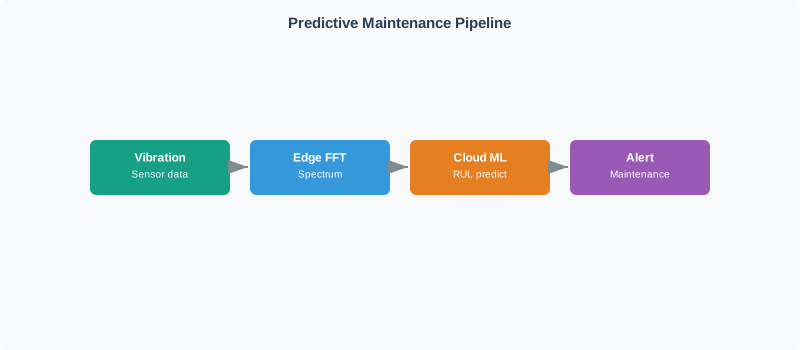
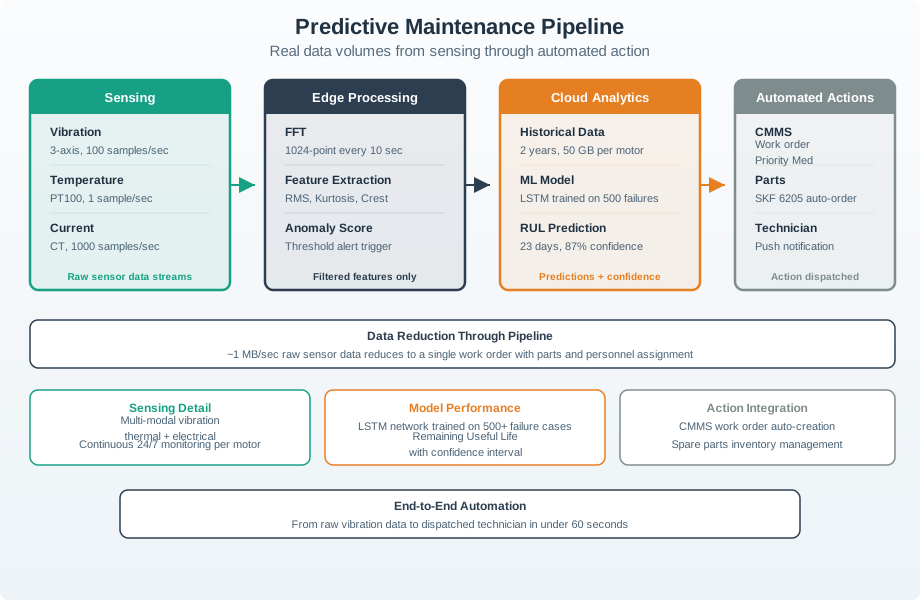
Predictive Maintenance Pipeline
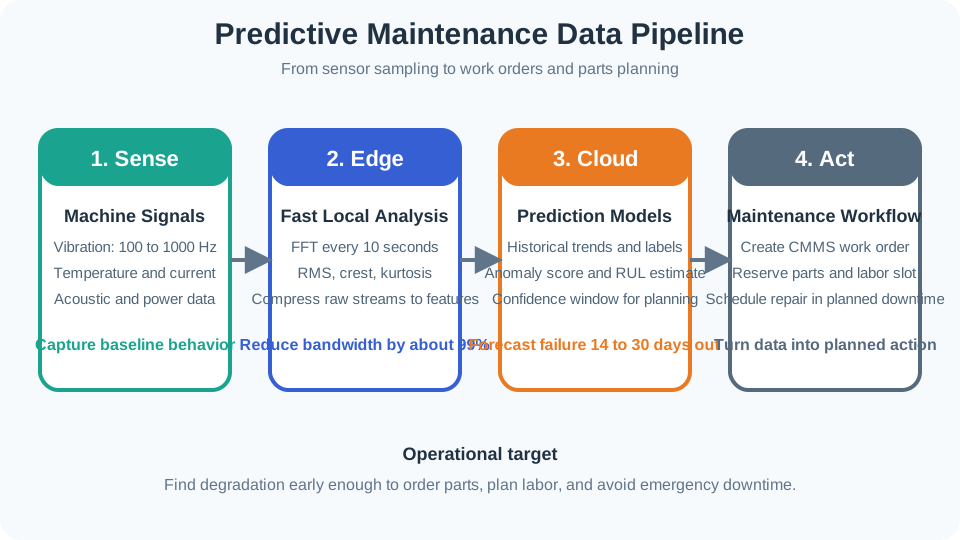
The next question is how that evidence travels from a physical asset to a maintenance decision without losing context.
- Carry: Predictive Maintenance Data Pipeline into predictive maintenance pipeline; use 1.
- This diagram uses concrete example values to show where data volume changes.
- That sequence keeps alternative view: example data flow tied to what is visibly labelled.
Major section
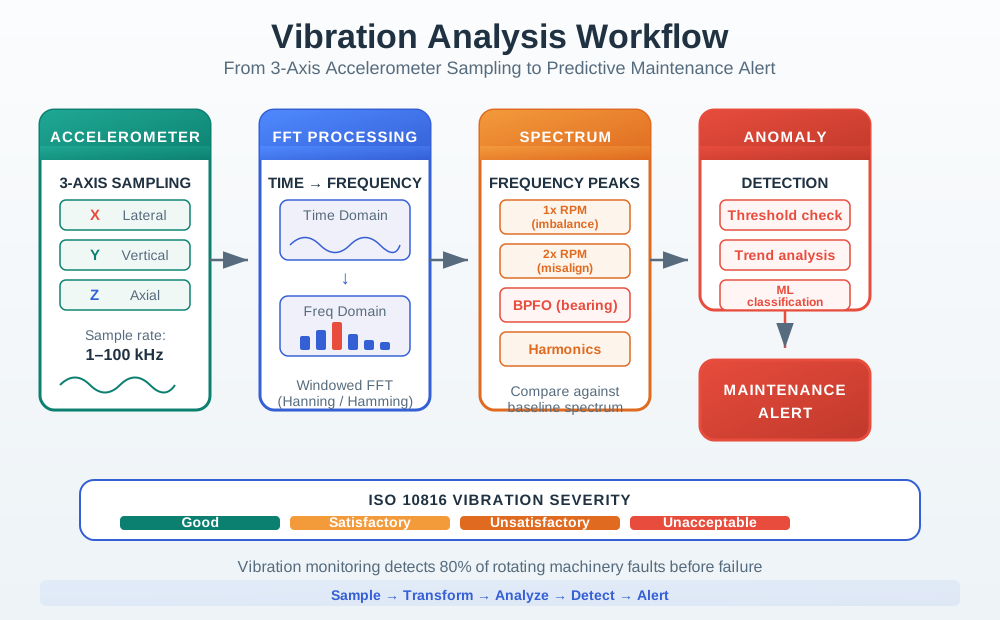
Vibration Analysis
That sequence keeps vibration analysis tied to what is visibly labelled.
- FFT: Fast Fourier Transform identifies specific defect frequencies.
- Spectral trending: Monitors changes in specific frequency bands over time.
- Cepstrum analysis: Detects periodic patterns in spectrum (gear families).
- For detection timeline, the useful result is the reasoning chain: observed condition, governing constraint, calculation or classification, and operational consequence.
Deck summary
Key takeaways
Heat, sound, current, and vibration may give early clues.
- Predictive maintenance is valuable when a signal changes a maintenance action before the asset fails.
- The strongest candidates are assets with expensive failure modes and measurable degradation patterns: motors, pumps, compressors, fans, gearboxes, spindles, conveyors, chillers, turbines, and critical bearings.
- For example, a drive-end bearing on a cooling pump might use a triaxial accelerometer, motor current, and discharge pressure.
- Process equipment may use pressure differential, flow, valve position, energy use, startup time, or compressor discharge temperature.
Retrieval practice
Recall check

Blueprint Bina says: answer from memory, then check your reasoning.
Q1A maintenance engineer notices a pump motor showing vibration at exactly 2x the shaft rotational frequency, with significant amplitude in both axial and radial directions. What is the most likely defect?
Show answer
Answer: B Correct!
Print reference
Answers
Answer key.
- B · Correct!