Industrial IoT and Business Operations · Study deck

Predictive Maintenance: Models and Rollout

A vibration model can flag a bearing pattern, but some failures appear first as heat and every alert must still become a planned job.

Ada is your guide for this deck.

iiotpredictivemaintenance
Ada, the module guide, in a scene from this chapter.
iotclass.org

After studying this chapter

Learning objectives

You will be able to:

  • combine thermal and vibration evidence for maintenance decisions
  • select a machine-learning model with stated operating limits
  • connect alerts to work orders, ROI evidence, and staged rollout
  • Explain: The screen sits above the grip, so a reading is checked at the asset rather than back at a desk.
iotclass.org

Major section

Thermal Imaging

The screen sits above the grip, so a reading is checked at the asset rather than back at a desk.

  • The lens at the front sets the field of view, which decides how close an inspector must stand to a live panel.
  • Nothing here records a route on its own.
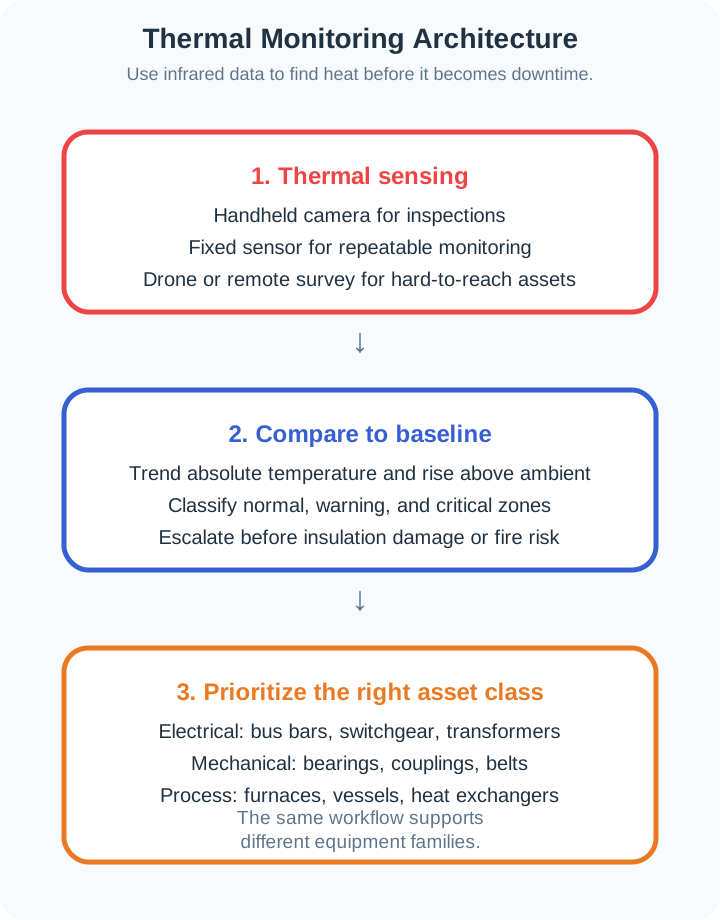
  • the Thermal monitoring system architecture from sensing to alerts diagram answers what the camera alone cannot: how a hot reading turns into an action.

Why it matters

The middle band is where a temperature becomes evidence, because a reading only means something next to a baseline and the rise above ambient.

A handheld thermal camera turns infrared radiation into a temperature image, letting an inspector compare bearings, electrical joints, and process equipment against a healthy thermal baseline. Photo: Asurnipal, CC BY-SA 4.0
iotclass.org

Major section

Thermal Imaging (continued)

Figure: Thermal monitoring system architecture from sensing to alerts answers what the camera alone cannot: how a hot reading turns into an action.

  • The top band is sensing, and it already forces a choice: a handheld camera suits an inspection route, a fixed sensor suits repeatable trending, and a drone survey suits assets nobody can reach safely.
  • The same three steps serve all three families, so the workflow is reusable even when the failure physics differ.
  • The middle band is where a temperature becomes evidence, because a reading only means something next to a baseline and the rise above ambient.
Thermal monitoring system architecture from sensing to alerts
iotclass.org

Major section

Machine Learning Models

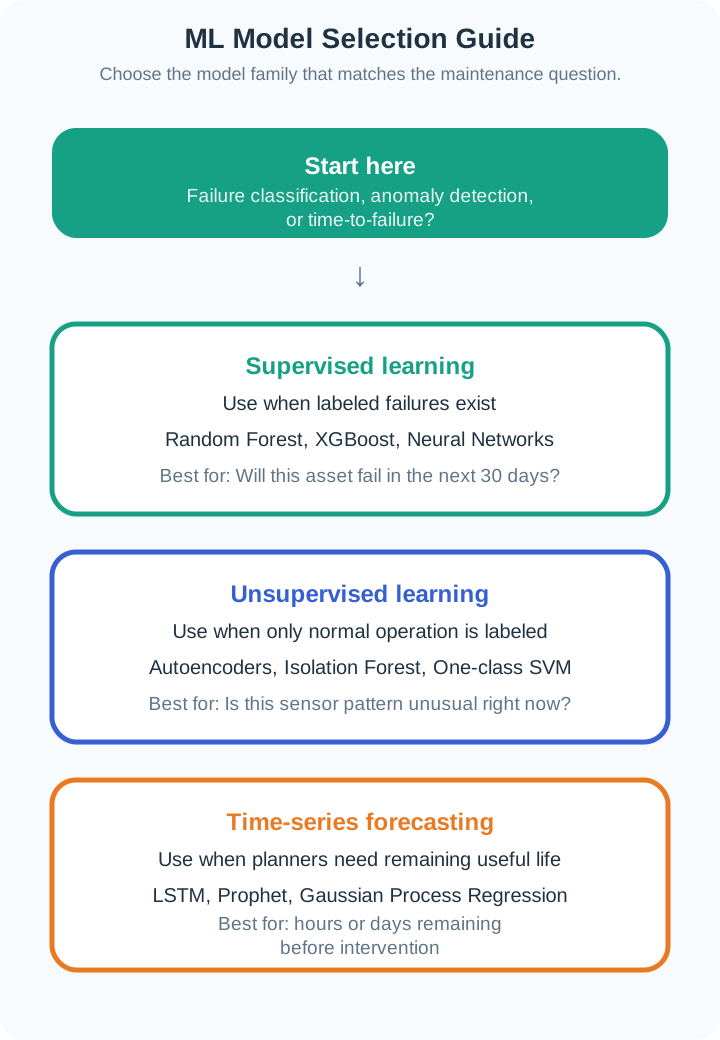
Modern predictive maintenance uses ML to learn normal behavior and detect anomalies.

  • The three branches below answer it in the order of evidence you can supply.
  • Unsupervised learning needs only a record of normal running, so it suits a plant with clean history and few recorded faults.
  • Isolation Forests (detects outliers).

Why it matters

Forecasting sits last because it needs runs that were followed all the way to failure, the hardest data of all.

ML model selection decision tree for predictive maintenance
iotclass.org

Major section

Alert to Work Order

An automotive smart-factory maintenance program usually succeeds or fails at the handoff between analytics and maintenance execution.

  • The useful case-study pattern is not "AI predicted a fault" by itself; it is a closed loop from condition evidence to work order, inspection, repair, and model feedback.
  • The workflow must leave an auditable trail.
  • Critical conveyors, robots, compressors, pumps, spindles, and drives are ranked by failure impact.
  • The band underneath lists what each pass must leave behind.

Why it matters

The third stage decides whether the system is trusted, because an engineer can reject a bad alert before it costs a shift.

Predictive maintenance workflow from condition evidence to planned repair and feedback.
iotclass.org

Major section

Alert to Work Order (continued)

Vibration, current, temperature, cycle-count, and controller-state data are captured with asset id, speed/load context, and maintenance history.

  • The dashed return is why this is drawn as a loop rather than a line: technician outcomes go back into thresholds and models.
  • Each alert should identify the asset, feature values, baseline comparison, severity, recommended inspection, technician disposition, replaced part, and return-to-service result.
  • Lesson learned: Success requires maintenance adoption, not just analytics.
iotclass.org

Major section

Automated Electronics Plant Pattern

Production equipment emits process values, alarms, cycle counts, and quality results.

  • Asset health features are tied to product, recipe, shift, maintenance event, and environmental context.
  • Digital twin or simulation work is used for what-if planning, not as a replacement for measured condition data.
  • Better root-cause records for repeat failures.
iotclass.org

Major section

Implementation Roadmap

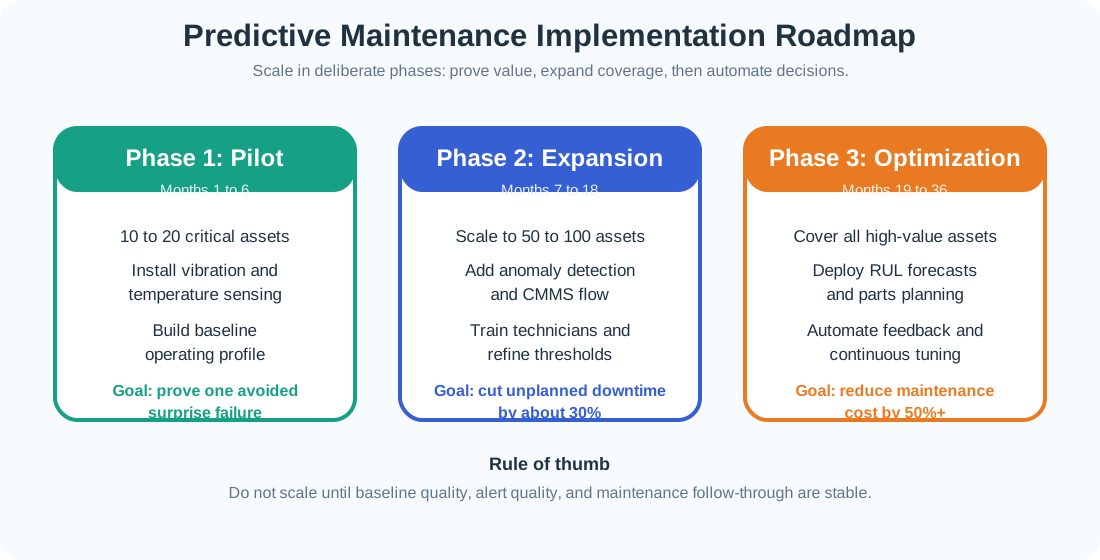
The pilot installs basic sensing, builds normal baselines, and must catch one previously unseen issue.

  • Expansion to 50–100 assets adds anomaly models, CMMS work orders, and technician training; success is a measured drop in emergency work on those asset classes.
  • Coverage grows after alert quality and maintenance follow-through are stable, not simply when the model emits more warnings.
  • Implementation timeline showing three phases: Pilot (months 1-6) focuses on critical asset selection and baseline establishment, Expansion (months 7-18) scales coverage and adds ML capabilities, and Optimization (months 19-36) achieves full facility coverage with automated workflows.
Phased implementation roadmap for predictive maintenance
iotclass.org

Major section

Baseline Data Before Sensors

After 2 weeks, they get zero alerts and assume the system is broken -- or worse, they tune sensitivity so high that false alarms overwhelm maintenance.

  • Without baseline data, the model has no reference.
  • Instead, they got alerts on pumps that had run the same way for 10 years.
  • The "anomalies" were just normal operating characteristics the model hadn't seen yet.
  • Technicians who ignore 10 false alarms will ignore the 11th real one.
iotclass.org

Deck summary

Key takeaways

The screen sits above the grip, so a reading is checked at the asset rather than back at a desk.

  • Figure: Thermal monitoring system architecture from sensing to alerts answers what the camera alone cannot: how a hot reading turns into an action.
  • Modern predictive maintenance uses ML to learn normal behavior and detect anomalies.
  • An automotive smart-factory maintenance program usually succeeds or fails at the handoff between analytics and maintenance execution.
  • Vibration, current, temperature, cycle-count, and controller-state data are captured with asset id, speed/load context, and maintenance history.
iotclass.org

Retrieval practice

Recall check 1 of 5

Ada says: answer from memory, then check your reasoning.

Q1During a quarterly thermal survey, a bus-bar connection has a 55°C rise above ambient. The connection is stable with no arcing or other urgent fault sign, and this plant's thermal planning rubric labels 40-70°C as Warning with a 1-4 week planned-repair window. What action matches that rubric, subject to the site's electrical safety review?

ASchedule repair within normal maintenance cycle (3-6 months)
BImmediate shutdown and emergency repair
CContinue monitoring - this is within normal operating range
DSchedule repair within 1-4 weeks during planned downtime
Show answer

Answer: D Correct for the stated rubric and stable condition.

iotclass.org

Retrieval practice

Recall check 2 of 5

Ada says: answer from memory, then check your reasoning.

Q2A plant has clean normal-running data but few labeled failures. Which model path fits its evidence?

AUse a supervised failure classifier as if labels exist
BStart with anomaly detection and state its false-alert limits
CClaim an exact remaining life for each asset
DSkip validation because normal history is clean
Show answer

Answer: B Anomaly detection can use normal data, with operating limits checked.

iotclass.org

Retrieval practice

Recall check 3 of 5

Ada says: answer from memory, then check your reasoning.

Q3A factory has 500 motors and a limited predictive-maintenance pilot budget. In this plant, the 50 largest motors also carry the highest downtime cost, have comparable failure likelihood and monitoring cost, and cannot be bypassed easily. Which pilot focus best targets the stated return?

AMonitor all 500 motors with low-cost vibration sensors
BStart with the newest motors since they have better documentation
CMonitor motors with the highest runtime hours first
DFocus pilot on the 50 largest, costliest motors.
Show answer

Answer: D Correct for these stated plant conditions.

iotclass.org

Retrieval practice

Recall check 4 of 5

Ada says: answer from memory, then check your reasoning.

Q4A manufacturing plant is starting a predictive maintenance pilot program. They have 500 motors, pumps, and compressors. What is the recommended approach for asset selection in Phase 1?

ASelect 10-20 high-criticality assets where failure causes significant production impact
BSelect the 10-20 oldest pieces of equipment since they're most likely to fail
CRandomly sample 10-20 assets across the facility for representative coverage
DSelect the 10-20 newest assets since they have better documentation
Show answer

Answer: A Select high-criticality assets whose failures cause material production impact, then verify that detectable warning and feasible maintenance action make the pilot valuable.

iotclass.org

Retrieval practice

Recall check 5 of 5

Ada says: answer from memory, then check your reasoning.

Q5What converts condition features into a reviewable maintenance estimate rather than a completed repair?

ACondition sensing
BEdge feature extraction
CMaintenance workflow
DPrediction model
Show answer

Answer: D It converts features into a reviewable estimate rather than a completed repair.

Q6Complete the predictive-maintenance alert gate so bad-quality data is held, local feature thresholds are checked, and reviewable alerts carry asset context:

Areturn {'action': 'hold', 'reason': 'bad_quality'}
Breturn {'action': 'dispatch', 'reason': 'ignore_quality'}
Creturn {'action': 'retrain', 'reason': 'missing_label'}
Dreturn {'action': 'close', 'reason': 'no_fault'}
Show answer

Answer: A The gate holds bad data, compares a feature to the asset baseline, and creates a reviewable work-order record instead of treating an anomaly score as the maintenance outcome.

iotclass.org

Print reference

Answers 1 of 2

Answer key.

  1. D · Correct for the stated rubric and stable condition.
  2. B · Anomaly detection can use normal data, with operating limits checked.
  3. D · Correct for these stated plant conditions.
  4. A · Select high-criticality assets whose failures cause material production impact, then verify that detectable warning and feasible maintenance action make the pilot valuable.
  5. D · It converts features into a reviewable estimate rather than a completed repair.
iotclass.org

Print reference

Answers 2 of 2

Answer key.

  1. A · The gate holds bad data, compares a feature to the asset baseline, and creates a reviewable work-order record instead of treating an anomaly score as the maintenance outcome.
iotclass.org