Applications & Use Cases · Study deck
OPC UA: Architecture, Models, and Security
This first route builds the OPC UA architecture from information models and communication patterns through a reviewable security baseline.
Blueprint Bina is your guide for this deck.

After studying this chapter
Learning objectives
You will be able to:
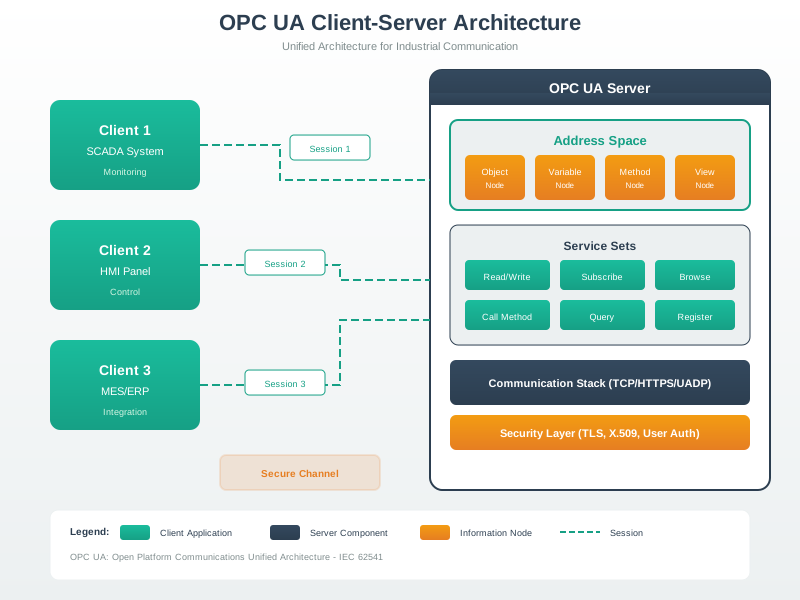
- Explain: The visual's third anchor,: OPC UA Server, completes opc-ua servers expose address-space nodes and service sets through secured sessions so scada, hmi, mes, and erp clients can browse, read, subscribe,.
- Explain: Neither pattern removes the need for data-quality handling: clients still need source timestamps, server timestamps, status codes, stale-data detection, and explicit behavior when a gateway restarts or a subscription queue overflows.
- Explain: A client can browse a server, find an asset, read variables, inspect units and data types, and discover methods without relying on a spreadsheet of vendor-specific register numbers.
Major section
Start With the Story
One means motor turns per minute.
- The other means belt metres per second.
- Joining the raw tags would create a quiet but dangerous error.
- OPC Unified Architecture (OPC UA) gives industrial data shared names, types, units, quality, time, and links.
- A protocol is an agreed set of rules for how systems exchange data.
Major section
Start With the Story (continued)
OPC UA becomes useful when the story is semantic interoperability: expose state, commands, alarms, and metadata in a way that another system can trust and maintain.
- Transmission Control Protocol (TCP) provides an ordered byte stream between two endpoints.
- OPC UA can share meaning.
- They do not make two unlike tags mean the same thing.
Major section
For Beginners: OPC-UA Standard
OPC-UA is like a universal translator for factory machines.
- In most factories, different machines from different manufacturers speak their own "languages" and cannot talk to each other.
- OPC-UA gives them a common language so a robot arm, a temperature sensor, and a cloud computer can all share information securely.
- If you have ever used a USB cable that works with many different devices, OPC-UA does the same thing but for industrial communication.
Major section
OPC UA Shared Meaning
For learners, the important shift is from tag collection to information modeling.
- OPC Unified Architecture, standardized as IEC 62541, is not just another wire protocol.
- Its main value is that it lets a machine describe what its data means.
- A raw register list might say that register 40017 is a number.
Major section
OPC UA Shared Meaning (continued)
A client can browse a server, find an asset, read variables, inspect units and data types, and discover methods without relying on a spreadsheet of vendor-specific register numbers.
- That makes OPC UA especially useful when a factory needs data to survive vendor changes, PLC upgrades, and multiple generations of analytics tools.
- That matters in plants where equipment comes from many vendors and must connect to SCADA, HMI, historian, MES, CMMS, analytics, and cloud systems.
- A conveyor drive, robot cell, chiller, or packaging machine can expose a structured address space instead of forcing every integration team to reverse-engineer tags from scratch.
Major section
Model Before Wiring Tags
A practical OPC UA project starts by deciding which objects the client should see.
- Model assets such as Line 3, Filler 2, Motor M101, TemperatureSensor A, or BatchRecipe as meaningful objects, then attach variables and methods that operators, engineers, and applications can interpret.
- The integration choice depends on the consumer.
- Practitioners also need an operating model.
Major section
Model Before Wiring Tags (continued)
For brownfield systems, use gateways deliberately.
- A SCADA display may use client-server subscriptions to monitor selected nodes at a defined sampling interval.
- A plant historian may collect normalized values with engineering units and quality flags.
- A Modbus, PROFIBUS, PROFINET, EtherNet/IP, or vendor-driver gateway should not simply relay every register as a flat tag.
Major section
OPC UA Reads Semantics
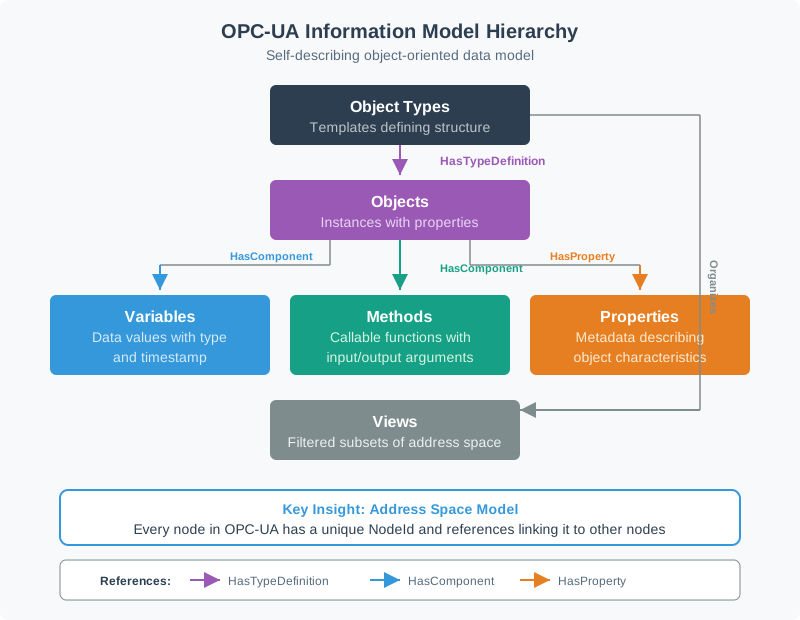
Inside an OPC UA server, each node has a NodeId, BrowseName, DisplayName, NodeClass, attributes, and references to other nodes.
- A variable can carry a DataType, ValueRank, engineering unit, quality status, timestamp, and access level.
- References such as HasComponent, HasProperty, Organizes, and HasTypeDefinition make the model navigable instead of flat.
- OPC UA communication choices change the failure mode.
Major section
OPC UA Reads Semantics (continued)
Namespaces keep vendor, standard, and site-specific definitions separate, which is why careless NodeId churn can break historians, dashboards, and analytics jobs after a PLC or server update.
- The secure channel is also part of the design, not a later wrapper.
- Security Policy None is acceptable for a classroom lab but is not a production baseline for plant or pharmaceutical systems.
- Client-server subscriptions maintain monitored items, queues, publishing intervals, keep-alives, and sequence numbers.
Major section
OPC UA Reads Semantics (continued)
PubSub decouples publishers from subscribers and may use UADP or JSON mappings over UDP, MQTT, or other transports depending on the deployment.
- Neither pattern removes the need for data-quality handling: clients still need source timestamps, server timestamps, status codes, stale-data detection, and explicit behavior when a gateway restarts or a subscription queue overflows.
- Implementation choices are concrete.
- The difficult work is making the published model stable, secure, and useful across the equipment lifecycle.
Major section
OPC UA Reads Semantics (continued)
Model stability:: Version namespaces and NodeIds deliberately so dashboards and historians do not break after every PLC or server update.
- A reviewer should be able to trace one value from PLC or gateway source, through OPC UA namespace, secure session or PubSub route, historian or SCADA consumer, and final operational decision.
- If that trace loses units, quality, ownership, or write authorization, the deployment is only connected, not integrated.
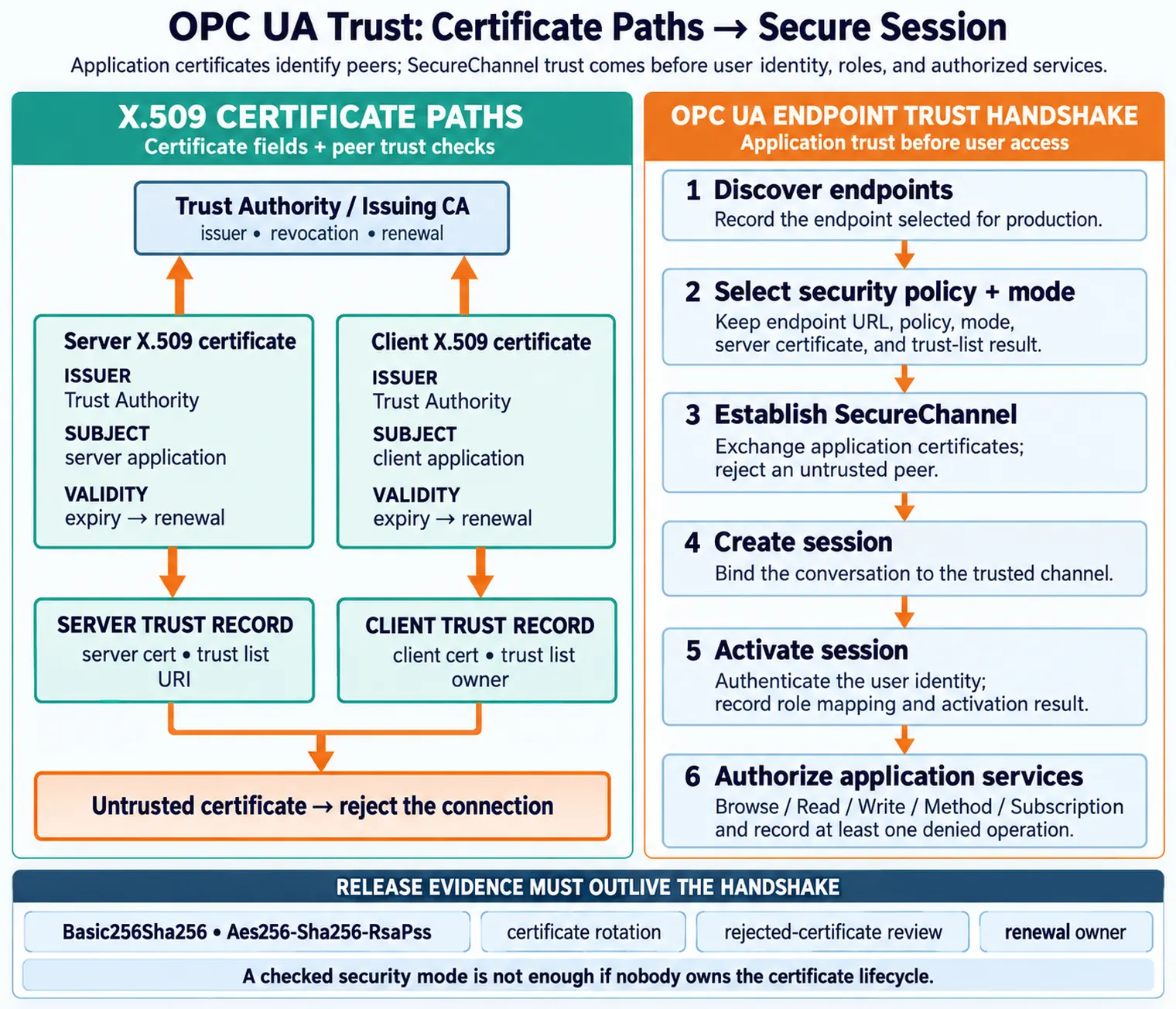
- Production servers need certificate rotation, trust-list management, user-role mapping, time synchronization, and clear rules for writable nodes because a write to the wrong setpoint can affect real equipment.
Major section
OPC-UA Architecture
The visual's third anchor,: OPC UA Server, completes opc-ua servers expose address-space nodes and service sets through secured sessions so scada, hmi, mes, and erp clients can browse, read, subscribe,.
- Carry: OPC UA Client-Server Architecture into opc-ua architecture; use: OPC UA Server as its limiting condition.
Major section
Information Model
The decision in information model must preserve that labelled boundary.
- This self-describing model means clients can discover capabilities without prior knowledge of the device.
Major section
Communication Patterns
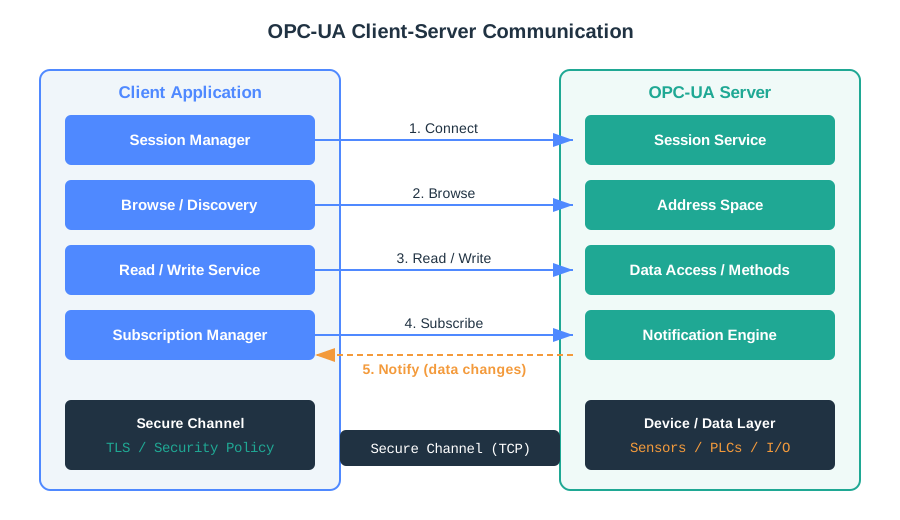
OPC-UA Client-Server Communication supplies one named condition;: Client Application supplies the necessary comparison for client-server communication separates discovery, read/write access, subscriptions, notifications, and secure-channel handling.
- That labelled check bounds client-server communication separates discovery, read/write access, subscriptions, notifications, and secure-channel handling.
- Monitor: Server sends notifications when subscribed values change.
Major section
Security Features
Together those labels make opc-ua security needs certificate ownership, trust-list management, user identity, authorization roles, and endpoint policy evidence, not only a testable.
- OPC-UA security operates in layered defense: transport encryption protects the channel, application certificates authenticate endpoints, user tokens authorize access, and audit logging records all activity.
Deck summary
Key takeaways
One means motor turns per minute.
- OPC UA becomes useful when the story is semantic interoperability: expose state, commands, alarms, and metadata in a way that another system can trust and maintain.
- OPC-UA is like a universal translator for factory machines.
- For learners, the important shift is from tag collection to information modeling.
- A client can browse a server, find an asset, read variables, inspect units and data types, and discover methods without relying on a spreadsheet of vendor-specific register numbers.
Retrieval practice
Recall check

Blueprint Bina says: answer from memory, then check your reasoning.
Q1An engineer is configuring OPC-UA security for a regulated batch-control system. Which policy and authentication combination is most appropriate?
Show answer
Answer: C This combines a strong endpoint policy, application identity, named user identity, and audit evidence, which is the right design direction for a regulated control environment.
Print reference
Answers
Answer key.
- C · This combines a strong endpoint policy, application identity, named user identity, and audit evidence, which is the right design direction for a regulated control environment.