Application Protocols · Study deck
Modern HTTP: HTTP/2, HTTP/3, and Selection
Modern HTTP is the web stack learning to move many IoT conversations without reopening the road for every request.
Broker Bex is your guide for this deck.

After studying this chapter
Learning objectives
You will be able to:
- Explain HTTP/2 Multiplexing: Describe how binary framing, stream multiplexing, and HPACK header compression reduce IoT gateway overhead by up to 76%
- Evaluate HTTP/3 vs HTTP/2: Compare QUIC transport benefits against TCP-based HTTP/2 for mobile and cellular IoT deployments, justifying the choice based on network conditions
- Select the Appropriate Protocol: Distinguish between HTTP/1.1, HTTP/2, and HTTP/3 based on device RAM constraints, network stability, and firewall policies
- Configure Modern HTTP: Implement HTTP/2 and HTTP/3 settings for IoT gateways and cloud backends, including keep-alive tuning and QUIC server configuration
Major section
In 60 Seconds
Telemetry is a time-linked record from a device.
- Hypertext Transfer Protocol (HTTP) is a request-and-response method.
- Transmission Control Protocol (TCP) is a delivery method that keeps an ordered byte stream.
- User Datagram Protocol (UDP) sends separate units without that built-in stream.
- Latency is the time data takes to arrive.
Major section
In 60 Seconds (continued)
Constrained Application Protocol (CoAP) is a compact web-style method for small devices.
- Message Queuing Telemetry Transport (MQTT) is a lightweight publish-and-subscribe method.
- A gateway is a device or service that joins different system parts.
- A newer version is not always a better fit.
- This makes the trade clear before the team adds more features.
Major section
Concurrent Data Transfers with HTTP/2 and HTTP/3
That's what HTTP/2 does - it's like a multi-lane highway!".
- Meet the Sensor Squad!: Temperature Terry needs to send LOTS of messages to the Cloud Castle, but the old road is SO SLOW!
- But the old road only has ONE lane!
- Nobody has to wait!".
Major section
Concurrent Data Transfers with HTTP/2 and HTTP/3 (continued)
The Problem: Sammy and 49 other sensors all want to send their readings to the Cloud Castle using HTTP/1.1.
- "We have to wait in line FOREVER!" complains Sammy. "By the time my message arrives, the temperature has already changed!".
- But what about when the road has potholes?".
- Max explains HTTP/3: "HTTP/3 uses magic flying cars (QUIC)!
Major section
HTTP/2: Multiplexing and Header Compression
The HTTP/2 side assigns telemetry, configuration, and firmware to separate logical streams whose frames share one secure connection.
- That removes application-level queueing between requests, but the final note preserves an important limit: all frames still travel through one ordered TCP byte stream.
Major section
HTTP/2: Multiplexing and Header Compression (continued)
The repeated authorization and representation fields below can outweigh a tiny sensor value.
- A later request can name indexed fields instead, reducing the example to roughly 15–30 bytes.
- The saving therefore depends on connection reuse and repeated headers, linking HPACK’s benefit to the session choices in this chapter rather than to every isolated request.
- HTTP/1.1 repeats the example fields on every request; the first HTTP/2 request still sends them because both endpoints must establish matching table state.
Major section
Phoebe's Field Notes: Where the Battery-Life Number Behind the Calculator Comes From
The mathematical gist.: A 2000 mAh, 3.7 V battery carries 7.40 Wh by nameplate.
- Separately, 2% monthly self-discharge leaves about 1570 mAh after a year.
- Under HTTP/3, QUIC keeps those application streams independent, allowing telemetry to progress while the firmware stream waits.
Major section
Protocol Selection Guide
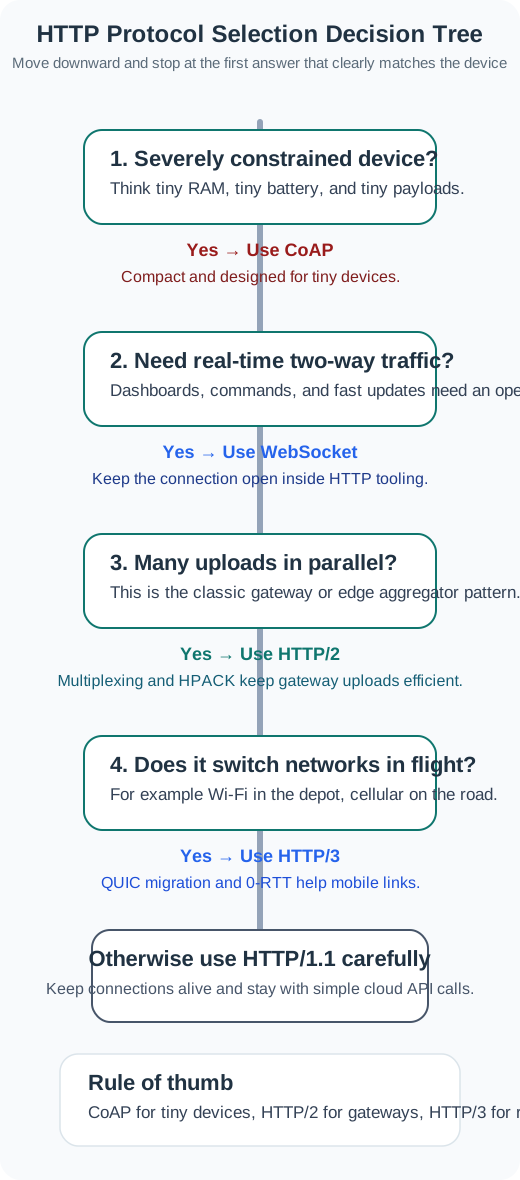
The following decision flowchart helps you select the appropriate HTTP version (or alternative protocol) based on your IoT device constraints and network environment.
- For an HTTP workload, many parallel exchanges favor HTTP/2 multiplexing; a client that changes networks in flight creates a specific case for HTTP/3 connection migration.
- Existing HTTP/REST infrastructure must be preserved.
Major section
Protocol Selection Guide (continued)
The remaining stable, simple path can use HTTP/1.1 with keep-alive.
- Devices have sufficient memory (32KB+ RAM for TLS+HTTP/2 stack).
- Connection reuse is possible (persistent connection to backend).
- Simple request-response suffices (use CoAP instead).
- UDP is blocked by network (enterprise firewalls).
Deck summary
Key takeaways
Telemetry is a time-linked record from a device.
- Constrained Application Protocol (CoAP) is a compact web-style method for small devices.
- That's what HTTP/2 does - it's like a multi-lane highway!".
- The Problem: Sammy and 49 other sensors all want to send their readings to the Cloud Castle using HTTP/1.1.
- The HTTP/2 side assigns telemetry, configuration, and firmware to separate logical streams whose frames share one secure connection.
Retrieval practice
Recall check

Broker Bex says: answer from memory, then check your reasoning.
Q1A sensor sends repeated headers over a reused HTTP/2 connection. Why can later requests have smaller headers?
Show answer
Answer: C HPACK establishes table state and later reuses indexed fields.
Q2A gateway loses a firmware packet while sending telemetry on another HTTP/3 stream. What behavior does the chapter predict?
Show answer
Answer: B QUIC keeps the application streams independent when one stream waits for missing data.
Print reference
Answers
Answer key.
- C · HPACK establishes table state and later reuses indexed fields.
- B · QUIC keeps the application streams independent when one stream waits for missing data.