Reference Architectures · Study deck
Power and Interfaces: Supply Draw and Bus Choice
The active portion often dominates even when it is brief.
Blueprint Bina is your guide for this deck.

After studying this chapter
Learning objectives
You will be able to:
- Explain: External pull-ups, sensors, radios, converters, drivers, service cables, and protection components can change current draw or pin state during boot, sleep, fault, and update.
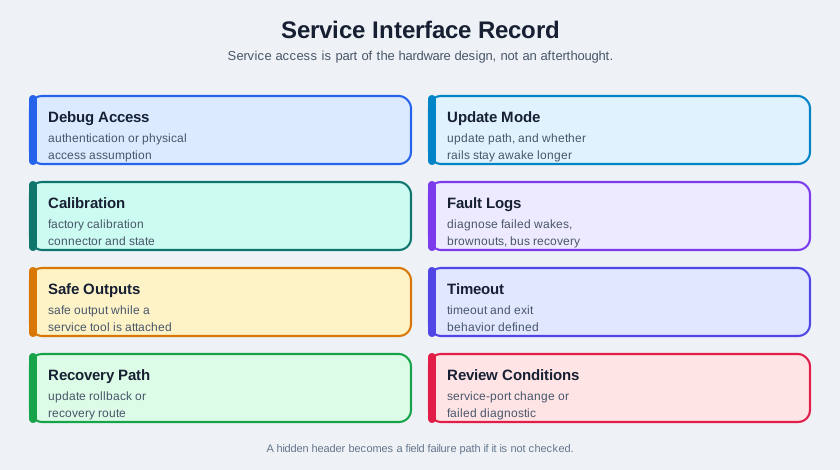
- Explain: A hidden debug header, boot console, firmware update pin, or factory calibration connector can become a field failure path if it is not checked.
- Explain: Wake source:: A timer, pin, watchdog, radio event, service action, or external signal that can move the device out of a lower-power state.
- Explain: Estimates are useful early, but approval should depend on measured draw for the modes the device will actually use.
Major section
Supply Draw Ledger
Supply draw is a measured state ledger.
- Estimates are useful early, but approval should depend on measured draw for the modes the device will actually use.
- The active portion often dominates even when it is brief.
- A radio join, actuator burst, sensor warm-up, flash write, or display refresh can outweigh long sleep intervals.
Major section
Choosing a Bus
Interface selection should follow the signal need.
- The physical value is analog and the required resolution survives sensor tolerance, noise, input range, and reference behavior.
- The output can be controlled by a duty pattern through a proper driver.
- Multiple low-rate board-level devices share a short bus.
- The device needs faster synchronous transfers or deterministic chip-select ownership.
Major section
Service and Update Interfaces
Service access is part of the hardware design.
- A hidden debug header, boot console, firmware update pin, or factory calibration connector can become a field failure path if it is not checked.
- This supports service and update interfaces.
Major section
Key Concepts
External pull-ups, sensors, radios, converters, drivers, service cables, and protection components can change current draw or pin state during boot, sleep, fault, and update.
- Wake source:: A timer, pin, watchdog, radio event, service action, or external signal that can move the device out of a lower-power state.
- Retained state:: Data or hardware context preserved while the rest of the device is paused or unpowered.
- Level shifter:: A circuit that makes logic signals compatible across different voltage domains.
Deck summary
Key takeaways
Supply draw is a measured state ledger.
- Interface selection should follow the signal need.
- Service access is part of the hardware design.
- External pull-ups, sensors, radios, converters, drivers, service cables, and protection components can change current draw or pin state during boot, sleep, fault, and update.
Retrieval practice
Recall check 1 of 2

Blueprint Bina says: answer from memory, then check your reasoning.
Q1A remote valve node sleeps between reports but must close the valve as soon as a leak sensor trips. Which proof is most important before approving the sleep state?
Show answer
Answer: B Sleep approval must prove the retained wake path, defined input level, wake trigger, retained state, and safe output behavior.
Retrieval practice
Recall check 2 of 2

Blueprint Bina says: answer from memory, then check your reasoning.
Q2A remote valve node sleeps most of the time, wakes on a leak sensor, closes a valve, and exposes a service UART. Which record best proves the power and interface design is ready?
Show answer
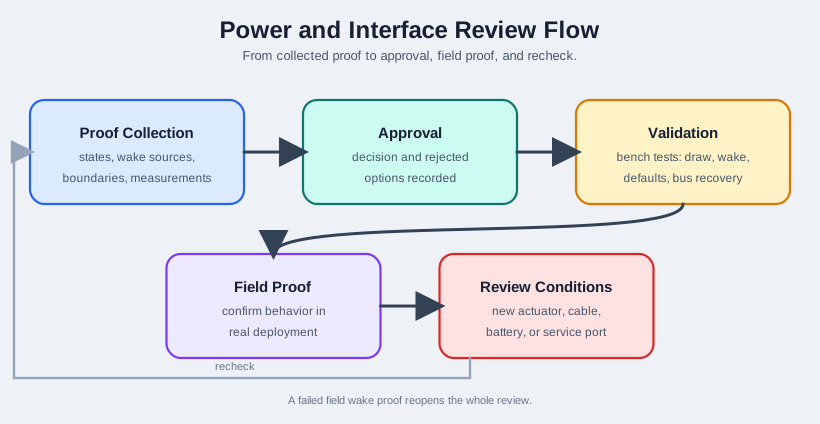
Answer: B The proof connects power states, signal ownership, boundary protection, service behavior, measurements, and the conditions that would restart the review.
Print reference
Answers
Answer key.
- B · Sleep approval must prove the retained wake path, defined input level, wake trigger, retained state, and safe output behavior.
- B · The proof connects power states, signal ownership, boundary protection, service behavior, measurements, and the conditions that would restart the review.