Reference Architectures · Study deck

IoT SoC Architecture: Accelerators and Security

The main data path is mapped, but fixed hardware can change performance, power, and trust boundaries.

Blueprint Bina is your guide for this deck.

hardwarechar
Blueprint Bina, the module guide, in a scene from this chapter.
iotclass.org

After studying this chapter

Learning objectives

You will be able to:

  • Explain: For the chosen SoC, record the DMA-capable sensor path, bounded local processing, protected boot and update path, retained fault record, radio wake behavior, and enough memory to hold the update image alongside working buffers.
  • Explain: These confidentiality modes do not authenticate the message, so a production protocol should use an approved authenticated-encryption construction when available rather than inventing a separate integrity scheme.
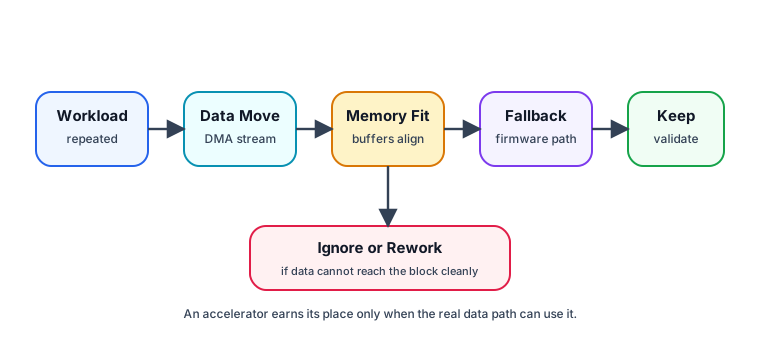
  • Explain: Hardware accelerators are useful when they match a repeated workload that would otherwise keep the main core active or increase memory movement.
  • Explain: A SAM4L-style AES block makes the pattern concrete.
iotclass.org

Major section

Hardware Accelerators

The selection record should name the workload, input size, rate, memory buffer, expected duty pattern, fallback behavior, and test method.

  • If the accelerator cannot access the required memory region or peripheral stream, it may not help the real design.
  • An accelerator is a peripheral with a command protocol expressed through memory-mapped registers.
  • The timeout is part of correctness.

Key terms

Hardware accelerators
Hardware accelerators are useful when they match a repeated workload that would otherwise keep the main core active or increase memory movement.
CFB and OFB
CFB and OFB are feedback modes with their own IV and state-update rules.
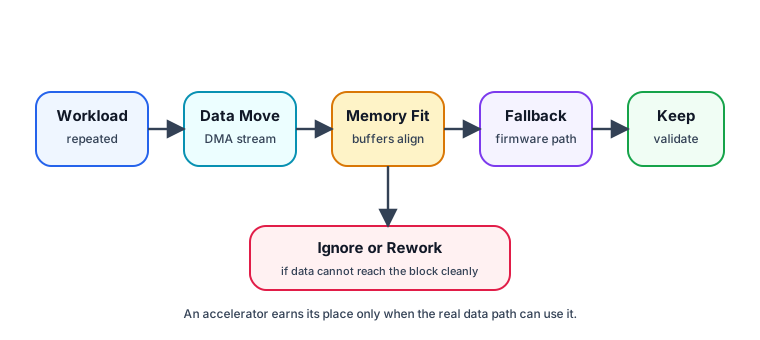
Hardware accelerator decision route from repeated workload and data movement through DMA access, memory fit, fallback behavior, validation, and final keep-or-ignore decision.
iotclass.org

Major section

Hardware Accelerators (continued)

A SAM4L-style AES block makes the pattern concrete.

  • The exact bit positions must come from the selected device manual, but the register roles show the complete transaction.
  • CFB and OFB are feedback modes with their own IV and state-update rules.
  • An unbounded spin loop can turn a clock-gating mistake into a fleet hang.
iotclass.org

Major section

Hardware Accelerators (continued)

An IV or nonce must satisfy the selected mode's uniqueness/unpredictability requirement; it is not an optional decoration.

  • These confidentiality modes do not authenticate the message, so a production protocol should use an approved authenticated-encryption construction when available rather than inventing a separate integrity scheme.
  • The interrupt path needs the same completion and error checks as polling, and DMA adds cache/coherency and buffer-lifetime proof.
  • Hardware accelerators are useful when they match a repeated workload that would otherwise keep the main core active or increase memory movement.
iotclass.org

Major section

Memory and Security Boundaries

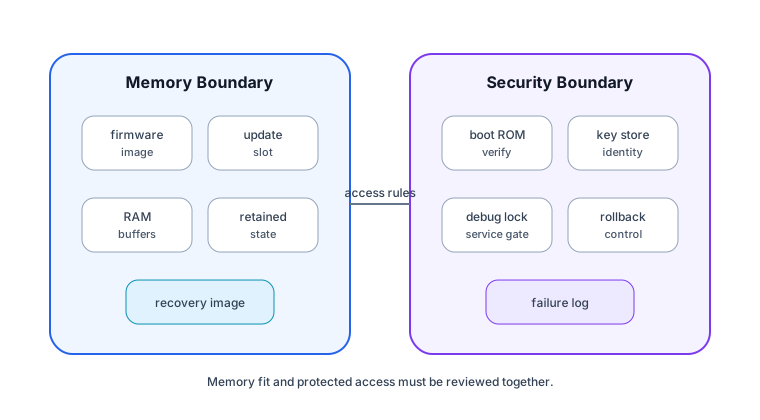
Memory architecture drives what the device can do at the same time.

  • Security architecture drives what the device is allowed to expose when something goes wrong.
SoC memory and security boundary map showing boot ROM, firmware image, update slot, RAM buffers, retained state, key store, debug lock, and recovery path.
iotclass.org

Major section

Radio Integration

Integrated radio simplifies the board but adds RF, antenna, coexistence, certification, and layout obligations.

  • External radio modules can isolate some RF design work but add board space, interface ownership, and supply sequencing.
SoC radio boundary map comparing integrated radio and external radio module paths across packet buffer, baseband, antenna interface, coexistence pins, wake behavior, and validation proof.
iotclass.org

Major section

Walkthrough: Vibration Monitor SoC

The selection should reopen if the sample rate, radio protocol, retained proof, update image size, enclosure, or service access changes.

  • It samples an accelerometer, extracts a compact vibration signature, stores fault proof, and reports summaries to a gateway.
  • A faster core alone is not enough proof.
  • If the radio cannot join, identify who receives the retained fault.

Key terms

If DMA
If DMA is unavailable, prove whether CPU polling still meets the alarm deadline.
iotclass.org

Major section

Under the Hood: Shared-Block Coupling

Pin conflicts: radio, crystal, service, or debug functions may need the same package pins as a listed peripheral.

  • A single SoC choice can tie together pin multiplexing, memory regions, DMA access, radio layout, power domains, debug exposure, and update recovery.
  • The evidence therefore needs pin and bus checks, memory-access checks, power-state checks, and security-state checks.
  • Memory visibility:: DMA or accelerators may not reach protected, cached, retained, or external regions.

Why it matters

Integration reduces board parts, but it increases coupling.

iotclass.org

Major section

Selection Record

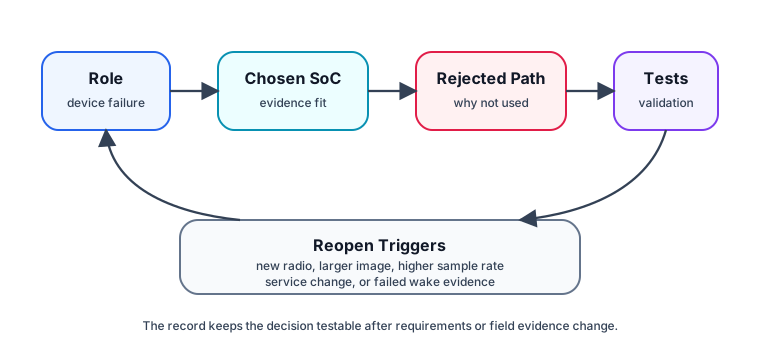
For the chosen SoC, record the DMA-capable sensor path, bounded local processing, protected boot and update path, retained fault record, radio wake behavior, and enough memory to hold the update image alongside working buffers.

  • Validation must follow those claims.
  • At selection record, Role makes the architecture testable.
SoC selection record linking device role, chosen architecture proof, rejected path, validation tests, and reopen triggers.
iotclass.org

Deck summary

Key takeaways

The selection record should name the workload, input size, rate, memory buffer, expected duty pattern, fallback behavior, and test method.

  • A SAM4L-style AES block makes the pattern concrete.
  • An IV or nonce must satisfy the selected mode's uniqueness/unpredictability requirement; it is not an optional decoration.
  • Memory architecture drives what the device can do at the same time.
  • Integrated radio simplifies the board but adds RF, antenna, coexistence, certification, and layout obligations.
iotclass.org

Retrieval practice

Recall check 1 of 2

Blueprint Bina says: answer from memory, then check your reasoning.

Q1A vibration-monitor SoC lists SPI, DMA, DSP acceleration, integrated radio, and secure boot. Which record best proves the SoC fits the device?

AA path record for data, radio, update, and power behavior.
BThe vendor feature table, because listing SPI, DMA, radio, and secure boot proves they can all be used together.
COnly the processor clock speed, because a faster core removes the need to check DMA, accelerators, and power islands.
DOnly the antenna layout note, because radio integration is the only SoC risk for an IoT device.
Show answer

Answer: A The SoC is proven by connected paths and state behavior, not by the feature list alone.

iotclass.org

Retrieval practice

Recall check 2 of 2

Blueprint Bina says: answer from memory, then check your reasoning.

Q2A vibration monitor has an SoC with an application core, SPI, DMA, and a DSP accelerator. Which proof best shows the accelerator is useful for the real design?

AThe accelerator appears in the SoC table, so the workload is approved without a data-path test.
BDMA reaches accelerator memory and meets timing and memory budgets.
CThe main core clock is high, so acceleration does not need timing or power proof.
DThe radio can report processed results, so the accelerator path can be assumed to work.
Show answer

Answer: B Hardware acceleration is approved only when the real workload reaches the block through a valid data path, fits memory limits, meets timing, and has a fallback.

iotclass.org

Print reference

Answers

Answer key.

  1. A · The SoC is proven by connected paths and state behavior, not by the feature list alone.
  2. B · Hardware acceleration is approved only when the real workload reaches the block through a valid data path, fits memory limits, meets timing, and has a fallback.
iotclass.org