Capstone & Resources · Study deck
IoT Glossary: Q-R
This first reference route covers Q and R terms and keeps their definitions, examples, and cross-references together.
Test Tessa is your guide for this deck.

After studying this chapter
Learning objectives
You will be able to:
- Define key IoT terms from Q to Z with technical precision.
- Evaluate quality of service levels and their trade-offs for different IoT scenarios.
- Select appropriate database technologies for time-series IoT data based on write rate, retention, aggregation, and query patterns.
- define Q-Z IoT glossary terms
Major section
Overview · In 60 Seconds
If a word cannot say who acts and what happens on failure, it is not yet ready for a runbook.
- This first reference route covers Q and R terms and keeps their definitions, examples, and cross-references together.
- A useful term should open a test, not end the talk.
- This opening does not replace the detailed entries below.
Major section
Start With The Runtime Promise · Q-Z Terms Name Run-Time Promises
Wireless terms need the same discipline.
- Q-Z terms often sound like guarantees, so start by naming the promise they really make.
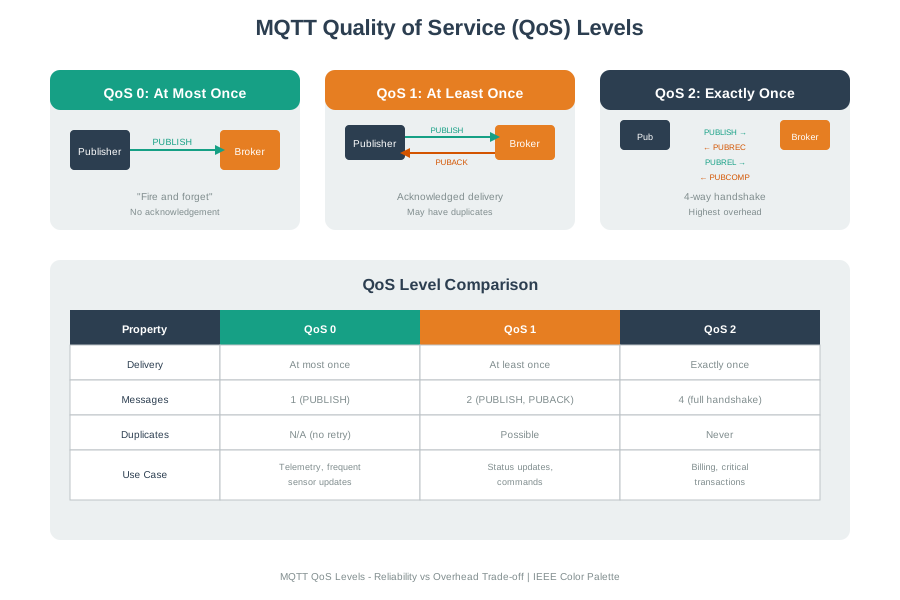
- QoS describes broker delivery behavior, not whether an actuator command is safe to repeat.
- The term is a starting point, not a field result.
Major section
Turn Terms Into Runbook Checks · Guarantees Stop At Layer Boundaries
Wireless terms need deployment evidence rather than generic protocol descriptions.
- A QoS claim should say which MQTT QoS level is used, why that level fits the data or command, what duplicate behavior was tested, and where idempotency is enforced.
- Security terms need observable negative tests.
- Each choice changes ordering and incident reconstruction.
Major section
Deep Dive: Q-Z Terms Define Operational Boundaries
Terms from Q through Z describe what happens after a device starts operating: delivery semantics, retry behavior, routing, sampling, schema evolution, serialization, telemetry, security, time-series storage, wireless behavior, and low-power IP networking.
- Real-time may mean an alert deadline, a control-loop budget, or dashboard freshness.
- Secure may mean TLS certificate validation, token scope, key storage, or message authorization.
Major section
Deep Dive: Q-Z Terms Define Operational Boundaries (continued)
Low power may mean radio duty cycle, sleepy end-device behavior, sampling interval, routing role, or retransmission cost.
- QoS is not a universal reliability switch; timestamps still control ordering and retention, while wireless choices still carry topology, channel, power, certification, gateway, and regional constraints.
- A QoS 1 duplicate can be harmless telemetry with timestamp-and-sequence deduplication and dangerous for a non-idempotent actuator command.
- Many Q-Z terms are operational contracts.
Major section
Deep Dive: Q-Z Terms Define Operational Boundaries (continued)
The same stop-sign logic applies to the other Q-Z terms: each names one owned promise and leaves downstream checks visible.
- QoS should point to MQTT packet flow, duplicate handling, and command idempotency.
- Schema should point to JSON Schema, Protobuf, Avro, or database migrations.
- Sampling rate changes what a sensor can represent.
Major section
Deep Dive: Q-Z Terms Define Operational Boundaries (continued)
For TLS and Token, record certificate chain validation, hostname behavior, clock tolerance, key rotation, scope, expiry, and where authorization is enforced.
- TLS should point to certificate validation, cipher policy, and token handling.
- For wireless and storage terms, record the constraint that changes the design.
- Schema changes what a downstream service can trust.
Major section
Deep Dive: Q-Z Terms Define Operational Boundaries (continued)
A telemetry row should show sensor id, units, timestamp source, schema version, quality flag, and retention class.
- For a capstone explanation, avoid saying that a system is "real time," "secure," "reliable," or "low power" without the Q-Z term that makes the claim inspectable.
- Z-Wave uses sub-GHz regional bands and certification constraints.
- For data terms, keep the evidence tied to the field contract.
Major section
Deep Dive: Q-Z Terms Define Operational Boundaries (continued)
Downsampling changes which anomalies survive long-term storage.
- Zigbee, Thread, and Wi-Fi share the 2.4 GHz band in many deployments but use different channel plans and mesh/star behavior.
- TSDB selection depends on write rate, retention, downsampling, compression, query shape, and operational familiarity.
- The hidden technical detail is usually state ownership.
Major section
Deep Dive: Q-Z Terms Define Operational Boundaries (continued)
A TSDB or TimescaleDB decision should include write rate, cardinality, compression/downsampling plan, query windows, backup/restore expectations, and the team that can operate the database.
- A Thread or Zigbee statement should include channel, PAN or fabric identity as appropriate, router/end-device role, gateway or border-router dependency, link-quality evidence, and interference assumptions.
- A 6LoWPAN statement should include the adaptation boundary: IPv6 header compression, fragmentation risk, MTU, routing interaction, and what happens when a fragment is lost.
- MQTT QoS 1 can redeliver a message, so consumers still need deduplication or idempotent state changes.
Major section
Deep Dive: Q-Z Terms Define Operational Boundaries (continued)
QoS 2 narrows one MQTT duplicate-delivery path, but it does not make a physical actuator command safe by itself.
- TLS protects transport only when certificates, hostnames, time, keys, and trust stores are correct.
- Retention policy changes what an incident review can reconstruct.
- Raising MQTT QoS can increase radio wake time and duplicate-handling requirements.
- Extending TSDB retention can increase storage cost while still losing high-frequency anomalies if downsampling is too aggressive.
Major section
How It Works: Use Q-Z Terms in a Review · Key Concepts
The important terms are Zigbee, routing, telemetry, TLS, schema, sampling, aggregation, and retention.
- Beginner Example: A room sensor publishes temperature to floor/3/room/12/temperature with QoS 0, includes an ISO 8601 timestamp, and stores readings in a TSDB.
- The important terms are topic, QoS, timestamp, time series, and TSDB.
- The important question is which layer owns delivery, identity, replay protection, fragmentation, and historical evidence.
Major section
Reference Use Metric · Q
where R is resolved lookups and T is total lookups.
- Worked example: If learners perform 220 glossary lookups and 198 are resolved without leaving the section, usability is 198/220=90%.
- Improving cross-references and examples should push this ratio higher.
- In simple terms: Delivery choices - like choosing between regular mail, tracked delivery, or registered mail depending on how important your package is and what extra handling you can afford.
Deck summary
Key takeaways
If a word cannot say who acts and what happens on failure, it is not yet ready for a runbook.
- Wireless terms need the same discipline.
- Wireless terms need deployment evidence rather than generic protocol descriptions.
- Terms from Q through Z describe what happens after a device starts operating: delivery semantics, retry behavior, routing, sampling, schema evolution, serialization, telemetry, security, time-series storage, wireless behavior, and low-power IP networking.
- Low power may mean radio duty cycle, sleepy end-device behavior, sampling interval, routing role, or retransmission cost.
Retrieval practice
Recall check
Test Tessa says: answer from memory, then check your reasoning.
Q1An actuator receives a command through MQTT QoS. What remains outside that delivery promise?
Show answer
Answer: D The chapter distinguishes broker delivery from database and actuator behavior.
Q2A project claims its TLS connection is trustworthy. Which test would challenge that claim?
Show answer
Answer: A The chapter asks for observable negative tests including hostname and credential failures.
Print reference
Answers
Answer key.
- D · The chapter distinguishes broker delivery from database and actuator behavior.
- A · The chapter asks for observable negative tests including hostname and credential failures.