Capstone & Resources · Study deck
IoT Glossary: G-H
This first reference route covers G and H terms and keeps gateway, hardware, web, and hybrid-system definitions together.
Sammy is your guide for this deck.

After studying this chapter
Learning objectives
You will be able to:
- Explain: HTTP status codes can confirm that an API accepted a request, but they do not prove that downstream analytics, alerting, or dashboard refresh completed unless those states are separately inspected.
- Explain: An MQTT publisher can send at QoS 0, QoS 1, or QoS 2, but the broker's acknowledgement is not the same as a database write or operator action.
- Explain: A platform may manage device registry, command routing, OTA update state, and analytics, but the glossary term "platform" should be tied to the actual service boundary in the project.
Major section
Overview · In 60 Seconds
This first reference route covers G and H terms and keeps gateway, hardware, web, and hybrid-system definitions together.
- The fault may sit in the device, the local link, or the service that reads the message.
- A glossary helps only when each word points to a real handoff.
- Firmware means software stored on a device.
Major section
Start With The Handoff · G-P Terms Name Handoffs
The term is only trustworthy when the report shows the trace across that handoff.
- A platform hands a prototype to the people who operate, support, and improve it after the demo.
- A gateway can translate a field incorrectly.
- A topic can route to the wrong subscriber.
Major section
Prove The Handoff With Traces
In a project review, do not write "the gateway sends data to the platform" without evidence.
- For I2C, that may include the device address, bus speed, pull-up arrangement, and an error or clock-stretching observation.
- For GPIO, it may include pin mode, voltage level, debounce choice, and board-specific boot pin constraints.
- A payload sample should name fields, units, null behavior, schema version, and what metadata is outside the payload.
Major section
Prove The Handoff With Traces (continued)
JSON is readable and easy to debug, but it does not enforce a schema by itself.
- Protobuf is compact and strongly described by a.proto contract, but it requires schema version discipline and tooling.
- MTU, packet, latency, and jitter claims should point to a capture, log, or timing sample rather than a single average number.
- For OAuth, record scopes, token lifetime, refresh flow, and which API enforces the token.
Major section
Prove The Handoff With Traces (continued)
For MQTT, record broker address, client id, topic, QoS, retained flag, session behavior, Last Will and Testament if used, subscriber filter, and ACL.
- For OPC UA or Modbus integration, record the address/register/node mapping and the translation rule that preserves meaning.
- AWS IoT Core, Azure IoT Hub, ThingsBoard, Eclipse Ditto, InfluxDB, TimescaleDB, Grafana, Node-RED, and custom microservices can all appear in IoT designs, but each owns different states.
- A platform claim should say whether the service owns device registry, command queue, digital twin or shadow state, storage retention, alert routing, dashboard rendering, analytics jobs, OTA update state, audit logging, or support workflows.
Major section
Similar Words Carry Different Guarantees
A packet is a network-layer or link-layer unit with headers and size limits.
- A payload is the application data carried inside an envelope.
- A message may include payload plus headers, topic, properties, and broker state.
- A router forwards packets between networks.
- Middleware may transform messages or coordinate services without owning the whole device lifecycle.
Major section
Similar Words Carry Different Guarantees (continued)
A gateway may translate protocols, buffer offline telemetry, map local identities to cloud identities, normalize timestamps, run rules, and manage credentials.
- A platform may own registry, policy, storage, analytics, command routing, and operational workflows.
- One physical box or cloud product can contain several roles, so the report should name the role being tested rather than only the product name.
- A retained message may be useful for last-known state and dangerous when old state looks current.
Major section
Similar Words Carry Different Guarantees (continued)
LoRaWAN delivery depends on spreading factor, channel plan, regional duty-cycle constraints, gateway placement, join state, receive windows, network-server routing, and backhaul.
- An MQTT publisher can send at QoS 0, QoS 1, or QoS 2, but the broker's acknowledgement is not the same as a database write or operator action.
- Wildcard topic filters make subscribers powerful and risky.
- The technical term is complete only when the implementation guarantee and its limit are both named.
Major section
Similar Words Carry Different Guarantees (continued)
HTTP status codes can confirm that an API accepted a request, but they do not prove that downstream analytics, alerting, or dashboard refresh completed unless those states are separately inspected.
- NB-IoT and LTE-M use licensed cellular networks with different mobility, latency, power, and deployment assumptions from unlicensed LPWANs.
- Latency averages can hide jitter; jitter can break control loops or ordering assumptions even when average delay looks acceptable.
- MTU and packet-size limits can turn a neat payload design into fragmentation, truncation, or failed uplinks.
Major section
Deep Dive: G-P Terms Mark Integration Boundaries
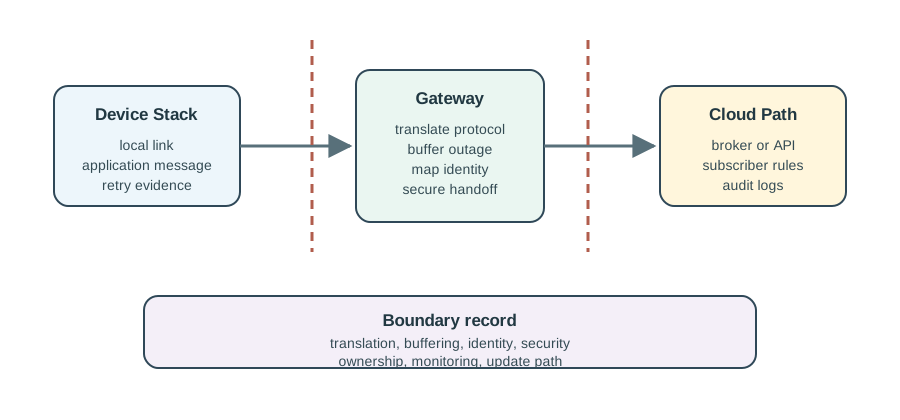
The gateway changes the wire rules and may hold data while the next link is down.
- Each handoff can change identity, rules, or ownership.
- A GPIO pin is not an I2C bus.
- LoRa is not the LoRaWAN join and route process.
- I2C depends on bus pull-ups, address conflicts, bus capacitance, and clock speed.
Major section
Deep Dive: G-P Terms Mark Integration Boundaries (continued)
MTU depends on the link and headers.
- MQTT publishers, brokers, topics, data, and subscribers also have distinct jobs, even when one demo script hides them.
- The cloud side separates broker or API receipt from registry, subscriber, dashboard, database, and audit outcomes.
- Protocol terms also carry hidden contracts.
Major section
Deep Dive: G-P Terms Mark Integration Boundaries (continued)
Each handoff changes what “message,” “payload,” “publisher,” “platform,” and “gateway” mean, so the trace must name the boundary being claimed.
- Gateway is broader than router when it translates, buffers, validates, maps identity, or survives an outage.
- LoRa is the radio modulation; LoRaWAN adds MAC behavior, join procedure, network server routing, device classes, regional parameters, and security.
- Gateway should connect to a protocol-translation rule, buffering policy, route table, or local queue.
Major section
Deep Dive: G-P Terms Mark Integration Boundaries (continued)
HTTP request-response does not behave like MQTT publish-subscribe.
- MQTT is not a database or dashboard; it is a broker-mediated publish-subscribe protocol whose topic and payload choices still need storage, schema, and access-control decisions.
- MQTT should connect to a broker address, client id, topic name, QoS setting, retained-message policy, Last Will and Testament, or session-expiry setting.
- OAuth authorization does not prove device identity by itself.
Major section
Deep Dive: G-P Terms Mark Integration Boundaries (continued)
A publisher sends to a topic, but it does not know which subscribers will match the filter.
- OAuth should connect to scopes, token lifetime, refresh behavior, and the API that checks the token.
- JSON, CBOR, and Protobuf change payload size, schema enforcement, debugging, and binary-data handling.
- A broker routes messages, but it is not automatically the long-term system of record.
Major section
Deep Dive: G-P Terms Mark Integration Boundaries (continued)
On the gateway side, record translation rules, buffer size, offline retention, credential mapping, topic or endpoint construction, and the rule that decides whether bad data is dropped, quarantined, or forwarded with a quality flag.
- A platform may manage device registry, command routing, OTA update state, and analytics, but the glossary term "platform" should be tied to the actual service boundary in the project.
- LoRa airtime and LoRaWAN duty-cycle limits do not behave like Wi-Fi throughput.
- Underneath the wording, each G-P term is a contract with a failure mode.
Major section
How It Works: Turn G-P Terms Into Design Decisions · Key Concepts
Beginner Example: An ESP32 room sensor reads an I2C temperature sensor, formats a JSON payload, and publishes it to building/room-12/temperature over MQTT.
- The key terms are I2C, JSON, payload, publisher, MQTT, and broker.
- Intermediate Example: A LoRaWAN soil sensor sends a small uplink through a gateway to a network server.
- The key question is which component owns translation, authorization, retry, schema evolution, and operator visibility.
Major section
Reference Use Metric · G
where R is resolved lookups and T is total lookups.
- Worked example: If learners perform 220 glossary lookups and 198 are resolved without leaving the section, usability is 198/220=90%.
- Improving cross-references and examples should push this ratio higher.
- Definition: A device that connects networks using different protocols, translating between them and enabling communication between IoT devices and external networks or cloud services.
Deck summary
Key takeaways
This first reference route covers G and H terms and keeps gateway, hardware, web, and hybrid-system definitions together.
- The term is only trustworthy when the report shows the trace across that handoff.
- In a project review, do not write "the gateway sends data to the platform" without evidence.
- JSON is readable and easy to debug, but it does not enforce a schema by itself.
- For MQTT, record broker address, client id, topic, QoS, retained flag, session behavior, Last Will and Testament if used, subscriber filter, and ACL.
Retrieval practice
Recall check

Test Tessa says: answer from memory, then check your reasoning.
Q1A design names MQTT as its solution for safe commands. What should the reviewer still require?
Show answer
Answer: B The chapter says MQTT routing does not define command safety, scope, or dashboard freshness.
Q2A gateway sends JSON telemetry to a platform. What should a payload sample explain?
Show answer
Answer: B The chapter notes that readable JSON does not enforce a schema by itself.
Print reference
Answers
Answer key.
- B · The chapter says MQTT routing does not define command safety, scope, or dashboard freshness.
- B · The chapter notes that readable JSON does not enforce a schema by itself.