Capstone & Resources · Study deck
IoT Glossary: A
This first reference route keeps the substantial A-term family together, from access control and ADCs through architecture and authentication.
Sammy is your guide for this deck.

After studying this chapter
Learning objectives
You will be able to:
- Define key IoT terms from A to F with technical precision.
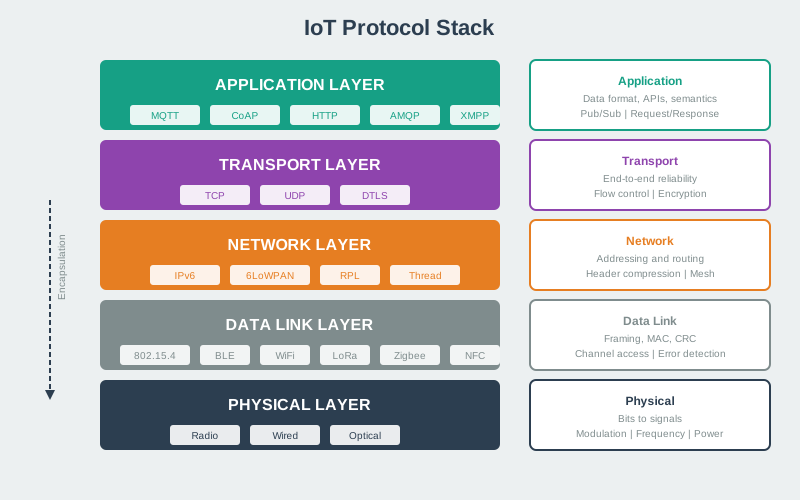
- Apply appropriate terminology when discussing IoT protocols, architectures, hardware interfaces, data formats, and security.
- Use cross-references to move from a quick definition to deeper system-level understanding.
- define A-F IoT terms precisely
Major section
Overview · In 60 Seconds
This first reference route keeps the substantial A-term family together, from access control and ADCs through architecture and authentication.
- Every word may be correct, yet the sentence does not say which boundary each one controls or what proof the team should inspect.
- A protocol is an agreed set of message and timing rules.
- An application programming interface is a named way for software to ask another system for data or action; it is often shortened to API.
Major section
Start With The Boundary · A-F Terms Name Boundaries
Authentication sits at the boundary between an unknown actor and a known identity.
- Authorization sits at the boundary between identity and permission.
- A frame sits at a local link boundary, while an API call sits at an application boundary.
- This habit keeps glossary lookup practical.
Major section
Attach Every Term To An Artifact · Words Hide Protocol Scope
A report that only says "the ACK was received" has not yet named the contract.
- For CoAP, inspect the method, confirmable or non-confirmable message type, response code, token, retransmission behavior, and whether DTLS is required.
- Data terms need a different artifact trail.
- The implementation scope is what separates them.
Major section
Deep Dive: A-F Terms Mark System Boundaries
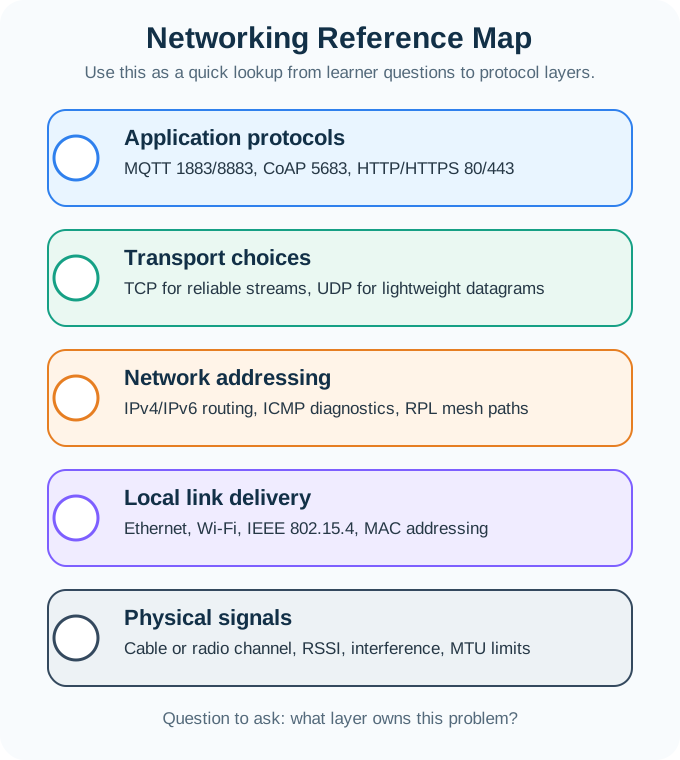
A glossary entry is useful when it helps you name the right boundary.
- That order keeps a glossary lookup tied to the component that can actually fix a fault.
- A certificate supports identity and trust, but it does not automatically prove an account has the right permission.
- At-most-once can lose messages.
Major section
Deep Dive: A-F Terms Mark System Boundaries (continued)
For authorization, show the ACL, IAM policy, OAuth scope, topic permission, or role mapping that limits action.
- Cloud, edge, and fog name placement and operational ownership, not just where code happens to run.
- The term becomes useful when it helps explain what the artifact is doing.
- The artifact is the object being inspected.
Major section
Deep Dive: A-F Terms Mark System Boundaries (continued)
The boundary says what the term promises and what it does not.
- If a term changes who owns a fault, who validates data, or where state is stored, treat it as a design boundary.
- At-least-once can duplicate messages and needs idempotent handling.
- The same is true for protocol semantics.
Major section
Deep Dive: A-F Terms Mark System Boundaries (continued)
Exactly-once usually depends on coordination, deduplication, transactions, or stream-processing semantics, and the contract often applies only inside a defined boundary.
- For CoAP, show whether the message is confirmable, what method and response code appear, and whether DTLS is used.
- The next check sends the learner to the chapter, standard, datasheet, packet capture, or bench test that can settle the claim.
- Data terms have the same hidden scope.
Major section
Deep Dive: A-F Terms Mark System Boundaries (continued)
Confusing authentication with authorization can produce accounts that prove identity but receive the wrong permissions.
- Confusing encryption with certificate validation can protect data in transit while still accepting the wrong endpoint.
- Confusing aggregation with raw telemetry can hide outliers that a device-health workflow needs.
- MQTT QoS 1, AMQP acknowledgements, CoAP confirmable messages, and stream-processing exactly-once claims do not all mean the same thing.
Major section
Deep Dive: A-F Terms Mark System Boundaries (continued)
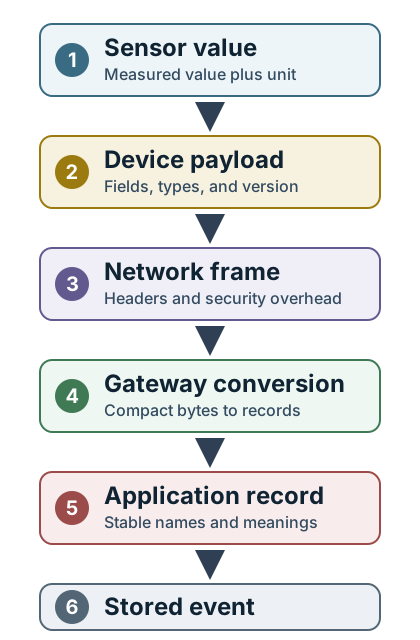
Underneath the vocabulary, every term is tied to a state transition or contract.
- An ACK may confirm that a TCP segment arrived, that a CoAP confirmable message was received, that an AMQP broker accepted a delivery, or that application code processed a command.
- Encryption may protect bytes on the wire, while certificate validation decides whether the endpoint is trusted.
- A firewall may filter at an address, port, or protocol boundary, while an application authorization rule may decide whether a device can write to a specific topic or API route.
Major section
Key Concepts · How It Works: Turn a Term into a Design Choice
API (Application Programming Interface): A defined contract that lets software components communicate.
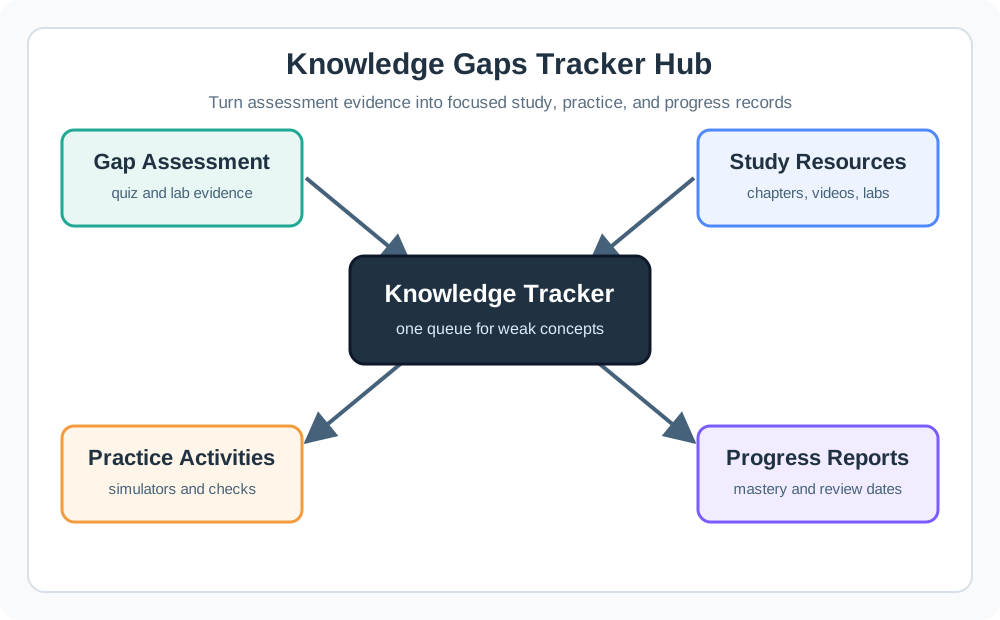
- A glossary lookup should end with a better design choice, not just a remembered definition.
- This placement prevents one broad term from hiding several owners.
- The walk-through clarifies which header, trace, or configuration should carry the evidence.
Major section
A
Definition: A security mechanism that specifies which users, devices, or systems are granted or denied access to particular resources, and what operations they can perform.
- In simple terms: A list that says who can do what - like a VIP list for a club that specifies which guests can enter which rooms.
- Definition: A signal or message sent by a receiving device to confirm successful receipt of data, enabling the sender to know transmission was successful.
- In simple terms: A "message received" confirmation - like texting "got it" when someone sends you important information.
Major section
A (continued)
In simple terms: The "muscles" of an IoT system - while sensors are the eyes and ears, actuators are the hands that actually do things like turn on lights or open valves.
- Definition: An electronic circuit that converts continuous analog signals (like voltage from a sensor) into discrete digital values that can be processed by a microcontroller.
- In simple terms: A translator that converts real-world measurements (like temperature as voltage) into numbers a computer can understand.
- In simple terms: A sophisticated postal system for software - it ensures messages get delivered reliably with options for different delivery patterns and confirmations.
Major section
A (continued)
Definition: A set of defined rules, protocols, and tools that specify how software components should interact, enabling different applications to communicate and share data.
- In simple terms: A menu at a restaurant - it tells you what you can order (available functions) and how to order it (required format), without needing to know how the kitchen works.
- Definition: A message delivery contract where the sender retries until an acknowledgement boundary is reached, reducing loss within that boundary but potentially causing duplicates that receivers must handle.
- In simple terms: "Fire and forget" delivery - send the message once and hope it arrives, like shouting across a noisy room.
Major section
A (continued)
In simple terms: "Better safe than sorry" delivery - the system keeps trying until it's sure you got the message, even if that means sending it twice.
- Definition: A message delivery contract where messages are sent zero or one time, providing best-effort delivery without retries, which may result in message loss.
- Definition: The process of determining what actions or resources an authenticated entity is permitted to access, enforcing access policies after identity is verified.
- In simple terms: Deciding what you're allowed to do - after the security guard confirms who you are, they check if you have permission to enter specific areas.
Deck summary
Key takeaways
This first reference route keeps the substantial A-term family together, from access control and ADCs through architecture and authentication.
- Authentication sits at the boundary between an unknown actor and a known identity.
- A report that only says "the ACK was received" has not yet named the contract.
- A glossary entry is useful when it helps you name the right boundary.
- For authorization, show the ACL, IAM policy, OAuth scope, topic permission, or role mapping that limits action.
Retrieval practice
Recall check

Test Tessa says: answer from memory, then check your reasoning.
Q1A device authenticates successfully but tries to publish to a restricted topic. Which separate boundary should decide permission?
Show answer
Answer: B Authentication establishes identity; authorization limits which actions that identity may perform.
Q2A report says a gateway aggregates readings. Which artifact would make the claim reviewable?
Show answer
Answer: C The chapter asks which outliers disappear and whether alerting uses raw or aggregated data.
Print reference
Answers
Answer key.
- B · Authentication establishes identity; authorization limits which actions that identity may perform.
- C · The chapter asks which outliers disappear and whether alerting uses raw or aggregated data.