Edge & Fog Computing · Study deck
Fog Energy-Latency Tradeoffs
Imagine a road camera that must warn a local sign in one second and also help a team study traffic each month.
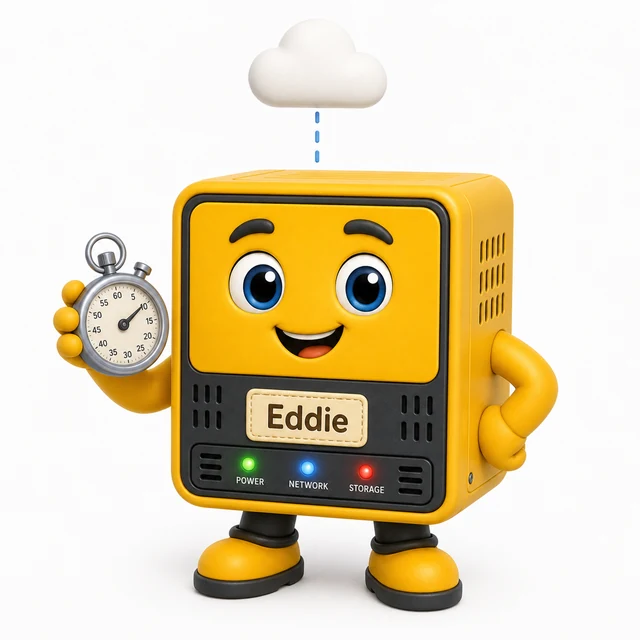
Edge Eddie is your guide for this deck.

After studying this chapter
Learning objectives
You will be able to:
- Build an energy-latency budget for a fog workload using measured components.
- Compare edge, fog, and cloud placement without relying on fixed universal latency or energy numbers.
- Explain when duty cycling, batching, compression, filtering, and local aggregation help or hurt.
- Identify queueing, wake-up, retry, thermal, and contention effects that make a design miss its response budget.
Major section
In 60 Seconds · Start Simple
Fog energy and latency optimization is not the claim that fog is always faster, cheaper, or lower power.
- The quick warning and the long study do not need to run in the same place.
- A gateway is the unit that links local devices to another network or service.
- Retest when the load, radio, code, or site changes.
Major section
Minimum Viable Understanding · Most Valuable Understanding
Latency is a budget, not a slogan.: Break it into sensing, transmission, queueing, processing, return, and actuation time.
- Energy is a duty-cycle record, not one active-power number.: Measure active, radio, idle, sleep, wake, retry, and management states.
- Fog is useful when local coordination changes the budget.: Good fog work filters, aggregates, buffers, prioritizes, or decides locally rather than forwarding raw work unchanged.
- The answer must be rechecked.: A placement that works at one load, battery level, temperature, or network condition can fail after contention, updates, weather, or site growth.
Major section
Why This Chapter Exists · The Stable Tradeoff Model
Energy-latency examples are easy to overstate.
- A single wireless-energy comparison, round-trip latency number, or battery-life calculation can look precise while hiding the site conditions that make it true.
- "Is the fog node overloaded?": Include queueing delay, thermal throttling, shared workload priority, and fallback behavior in the latency budget.
Major section
Build the Budget
A fog energy-latency review starts with two budgets and one set of measurements.
- The point is not to make the equation perfect.
- The point is to stop hidden costs from disappearing.
- A design that ignores sleep leakage, wake time, retransmissions, or queueing can pass a small demo and fail in the field.
Major section
Interactive Quiz: Sequence the Review · Placement Patterns
The action must continue without any gateway, broker, WAN, or remote service.
- The local algorithm consumes less energy than waking the radio, negotiating a connection, and sending the payload.
- The fog node can prioritize safety, alarm, or control work ahead of batch reporting during contention.
- The work is analytical, historical, or model-lifecycle oriented rather than an immediate local action.
Try it: Interactive Quiz: Sequence the Review · Placement Patterns in the chapter
Major section
Duty Cycling Without Magic Numbers
"Deep sleep is always better because active power is high.".
- Duty cycling can produce large energy savings, but only when the application can tolerate the sleep interval and wake penalty.
- "What is the longest quiet period we can allow before the next measurement or response?".
- "What event can wake the system early, and what is the measured wake-to-action time?".
Major section
Compute, Transmit, and DVFS Break-Even · Phoebe's Field Notes: From Millijoules to Months of Battery
That comparison is only the first gate.
- A lower-energy offload still fails if queueing, round-trip time, protocol overhead, or fallback behavior misses the response budget.
- Leakage current and the task deadline set the floor; slowing a task indefinitely does not make energy approach zero.
Major section
Worked Example: Greenhouse Irrigation Gateway · Label the Optimization Record
Sensors timestamp readings, reject impossible values, and preserve a last-known-safe reporting mode.
- A greenhouse uses soil sensors, valve controllers, and a local gateway.
- The cloud dashboard helps with seasonal planning, but the irrigation decision must continue during a WAN outage.
- The important result is not a universal saving percentage.
Major section
Code Challenge · Common Mistakes
A fog node that is fast when empty can miss deadlines when it shares CPU, GPU, disk, or network with other workloads.
- Sleep saves energy only if wake time, wake energy, and missed-event behavior fit the response budget.
- A design can save sensor energy while making the gateway, network, or operations burden unacceptable.
- Poor wireless links, reconnect storms, and replay after outage can dominate both latency and energy.
Major section
Review Checklist · Reference Notes
Datasheet values are useful for estimates, but acceptance should come from measured deployment-like behavior.
- Connection setup, listening windows, retries, acknowledgements, and roaming can matter as much as payload bytes.
- Transmission time alone does not include queueing, wake-up, processing, result return, actuation, or acknowledgement.
- The goal is not to crown one tier, but to assign the work each tier can prove.
Major section
Debate: Edge vs. Cloud Processing Placement · Summary
This scenario is drawn from a manufacturing predictive-maintenance deployment and is meant to be worked through as a design-decision exercise.
- Its audit history may travel later, but the urgent action cannot wait for an uncertain path.
- Bandwidth means how much data a path can carry in a given time.
- The prompt below asks which responsibilities belong near the device and which can move upstream.
- Fog energy and latency optimization is a measurement practice.
Deck summary
Key takeaways
Fog energy and latency optimization is not the claim that fog is always faster, cheaper, or lower power.
- Latency is a budget, not a slogan.: Break it into sensing, transmission, queueing, processing, return, and actuation time.
- Energy-latency examples are easy to overstate.
- A fog energy-latency review starts with two budgets and one set of measurements.
- The action must continue without any gateway, broker, WAN, or remote service.
Retrieval practice
Recall check 1 of 6

Edge Eddie says: answer from memory, then check your reasoning.
Q1Why does this chapter say fog computing is not automatically faster, cheaper, or lower power?
Show answer
Answer: C Fog is not automatically better; each responsibility is placed at the lowest tier that meets measured response, energy, and fallback constraints.
Retrieval practice
Recall check 2 of 6

Edge Eddie says: answer from memory, then check your reasoning.
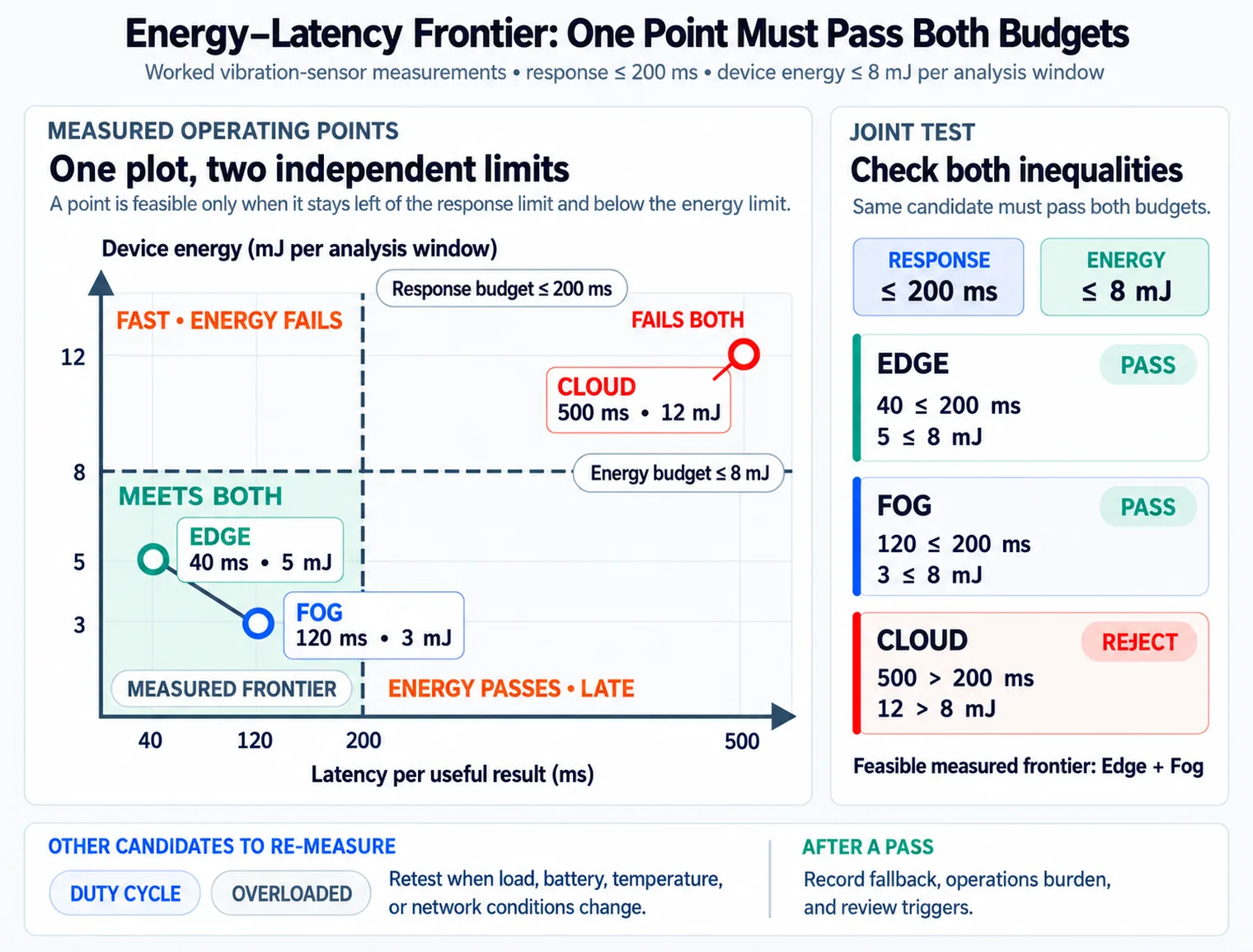
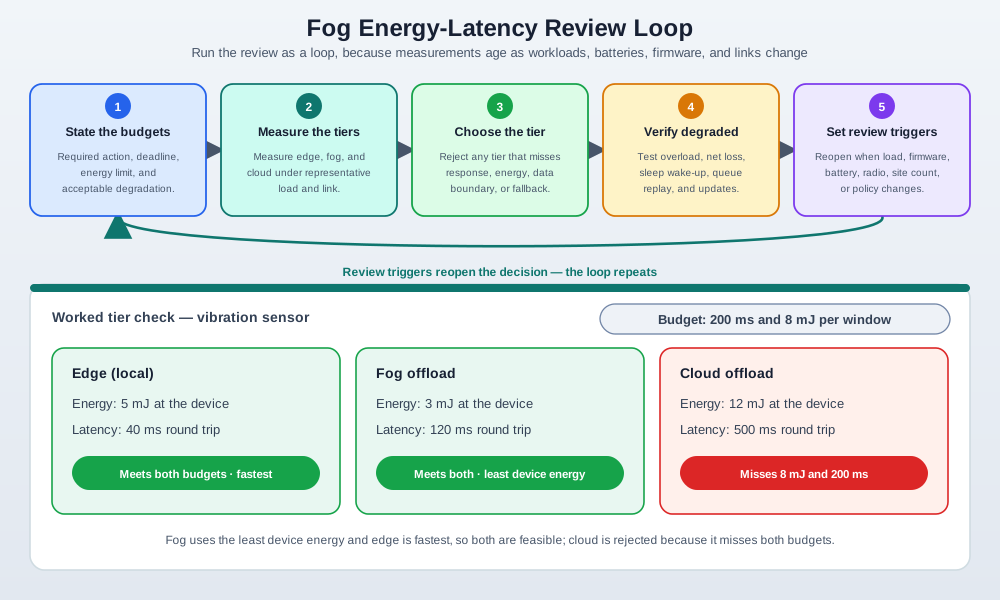
Q2A vibration sensor has a response budget of 200 ms and an energy budget of 8 mJ per analysis window. Bench measurements show edge local processing uses 5 mJ and returns in 40 ms. Fog offload uses 3 mJ at the device and returns in 120 ms. Cloud offload uses 12 mJ at the device and returns in 500 ms. Which statement is the best engineering conclusion?
Show answer
Answer: B A defensible placement compares measured operating points against explicit budgets.
Retrieval practice
Recall check 3 of 6

Edge Eddie says: answer from memory, then check your reasoning.
Q3Which statement is the strongest energy-latency claim for the greenhouse gateway design?
Show answer
Answer: B A good energy-latency claim is specific, measured, and tied to the local obligation.
Retrieval practice
Recall check 4 of 6

Edge Eddie says: answer from memory, then check your reasoning.
Q4Place each energy-latency decision element where it lives so you can choose a feasible tier and defend the fallback when conditions change.
Show answer
Answer: A Separate budgets, measured tier selection, and operational proof so you can reject placements that miss either the response or energy constraint.
Retrieval practice
Recall check 5 of 6

Edge Eddie says: answer from memory, then check your reasoning.
Q5This chapter's manufacturing scenario lists reasons an engineer might argue for edge processing (Position A). Which of the following is one of them?
Show answer
Answer: A The chapter lists three reasons for Position A (edge): lower latency for real-time alerts, bandwidth savings, and working during network outages -- distinct from Position B's cloud-side reasons (more powerful models, centralized updates, cross-plant pattern detection).
Retrieval practice
Recall check 6 of 6

Edge Eddie says: answer from memory, then check your reasoning.
Q6In this chapter's scenario, what monitoring scale and sampling rate is driving the edge-vs-cloud inference placement decision?
Show answer
Answer: A The chapter's scenario is explicit: 1,000 machines, vibration sensors sampled at 1 kHz, with the goal of predicting failures before they happen -- this scale is what makes the edge-vs-cloud inference placement decision consequential.
Print reference
Answers 1 of 2
Answer key.
- C · Fog is not automatically better; each responsibility is placed at the lowest tier that meets measured response, energy, and fallback constraints.
- B · A defensible placement compares measured operating points against explicit budgets.
- B · A good energy-latency claim is specific, measured, and tied to the local obligation.
- A · Separate budgets, measured tier selection, and operational proof so you can reject placements that miss either the response or energy constraint.
Print reference
Answers 2 of 2
Answer key.
- A · The chapter lists three reasons for Position A (edge): lower latency for real-time alerts, bandwidth savings, and working during network outages -- distinct from Position B's cloud-side reasons (more powerful models, centralized updates, cross-plant pattern detection).
- A · The chapter's scenario is explicit: 1,000 machines, vibration sensors sampled at 1 kHz, with the goal of predicting failures before they happen -- this scale is what makes the edge-vs-cloud inference placement decision consequential.