Edge & Fog Computing · Study deck
Cloudlets: Local Compute Pools
Picture a repair headset that needs a large vision model.
Edge Eddie is your guide for this deck.

After studying this chapter
Learning objectives
You will be able to:
- Explain how cloudlets differ from remote cloud services, general fog nodes, and simple edge gateways.
- Describe a cloudlet session lifecycle from discovery through cleanup.
- Evaluate when a workload should run on the device, cloudlet, fog node, or cloud.
- Explain why VM synthesis, container layering, and model pre-positioning all solve the same startup problem.
Major section
In 60 Seconds · Start Simple
Borrow Nearby Compute, Keep State Clear: Picture a repair headset that needs a large vision model.
- The headset cannot carry enough compute, and a distant service may answer too slowly.
- A small computer pool at the site can run the hard task nearby.
- A cloudlet is that nearby pool.
- It accepts short work sessions for local devices.
Major section
Cloudlets: Local Compute Pools · How Cloudlets Differ
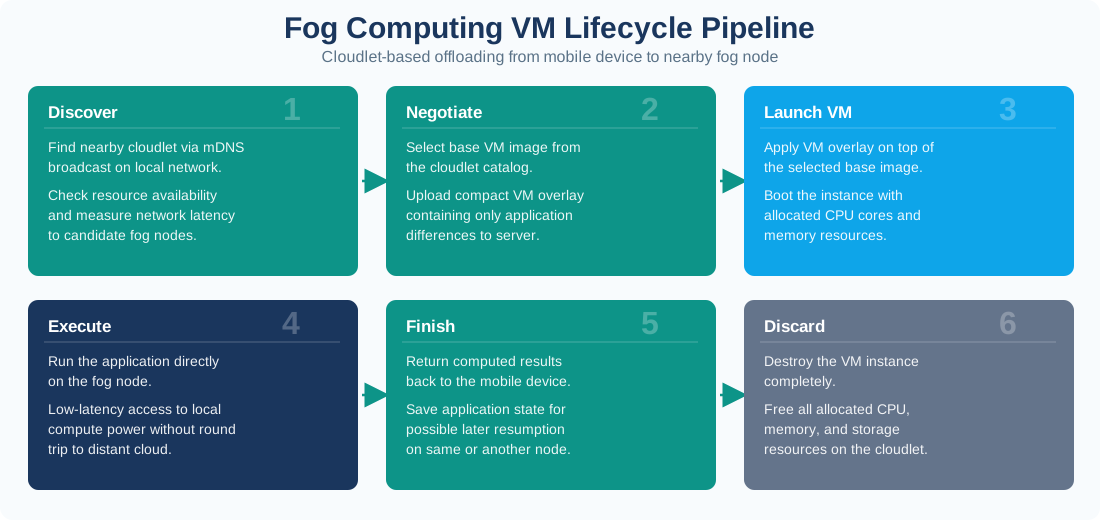
Cloudlets were introduced to make powerful computation available one local network hop from mobile users.
- The Negotiate step selects a base VM and uploads the compact overlay, after which The Launch VM step applies it with assigned CPU and memory.
- Captures data, provides the user interface, and keeps a minimum local mode.
Major section
Cloudlet Session Architecture · Do Not Treat Proximity as Trust
A production cloudlet architecture needs more than a server placed near users.
- It needs a session contract.
- The cloudlet admits a session only if it has capacity, compatible runtime layers, current policy, and a trusted identity path.
- The session runs in a VM, container, sandbox, or other isolated environment.
Major section
VM Synthesis, Containers, and Pre-Positioned Layers
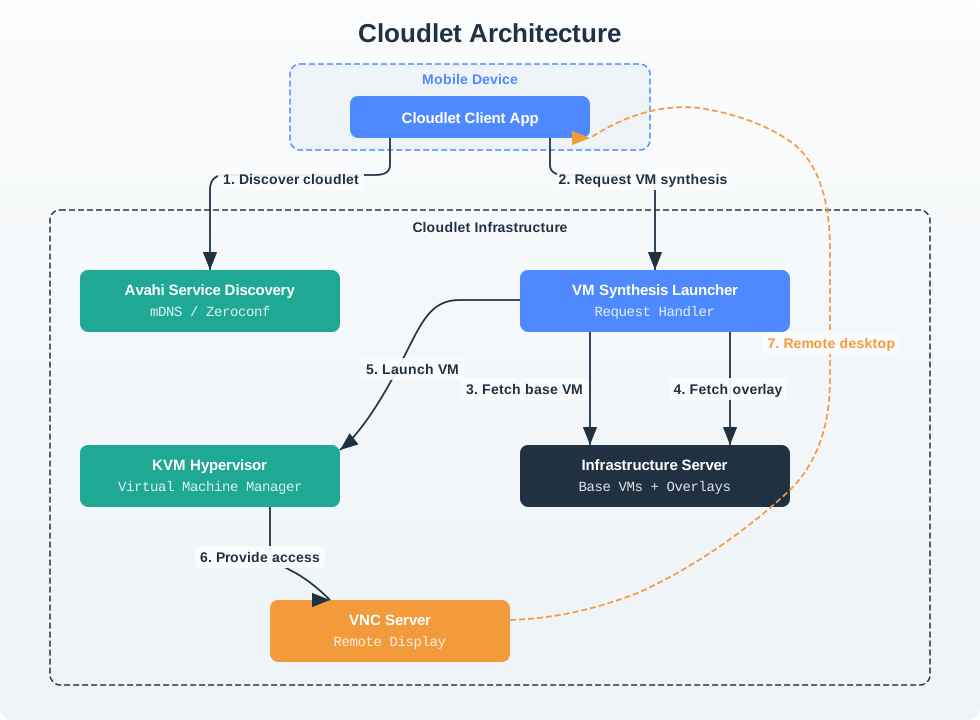
Classic cloudlet literature emphasized VM synthesis: a cloudlet keeps a base VM image locally, and the client or management system supplies a smaller overlay that personalizes the runtime.
- Many modern implementations use container layers, application bundles, model caches, or sandbox snapshots instead.
- Destroy or reset the session after use.
Major section
VM Synthesis, Containers, and Pre-Positioned Layers (continued)
Its request reaches the VM Synthesis Launcher, whose handler fetches a Base VM and then an overlay from the Infrastructure Server; KVM Hypervisor launches the combined instance.
- Those labelled steps identify what must be pre-positioned, what crosses the local network, and where launch-time evidence should be collected.
- Discover a candidate cloudlet.: The device or local controller finds an approved nearby cloudlet and learns which runtimes, models, policies, and services are available.
- Large common layers should already be cached.
Major section
Workload Fit
Cloudlets are most valuable when the workload has a local reason to exist.
- A cloudlet is rarely justified by fashion alone.
- Augmented reality, cognitive assistance, inspection guidance, room-scale collaboration, and local video interpretation often need nearby results while raw streams remain local.
- Emergency response kits, mobile labs, field operations, and temporary venues may need useful compute even when the WAN is weak or unavailable.
Major section
Worked Example: Mixed-Reality Maintenance Room
A university engineering lab uses smart glasses to guide students through equipment maintenance.
- The room has a local cloudlet with approved models, safety policy, and a mixed-reality runtime.
- The campus cloud keeps student accounts, lab records, and model release history.
- Room-scale recognition and overlays need nearby response, and raw camera views should stay in the lab network.
Major section
Worked Example: GigaSight Privacy-Preserving Video Analytics
Proximity is not only a speed argument.
- A campus or neighborhood runs video cameras, motion sensors, thermal sensors, and utility meters that stream continuously.
- puts a cloudlet at the first point of contact for that raw data, so the cloud only ever sees what the cloudlet decides to release.
- The same proximity keeps interactive latency low and gives the site a fallback service if the cloud path fails or is attacked.
Major section
Label the Cloudlet Path · Common Anti-Patterns
Temporary session VMs become the only place where important records live.
- When cleanup, failure, or replacement happens, the records disappear or leak.
- Every nearby client is accepted until CPU, memory, storage, network, or accelerator capacity collapses.
- Good designs reject, queue, or degrade before overload.
- A minimum local path should be part of the product behavior.
Major section
Latency Budget and Handoff Trace
The reason to pay for a cloudlet is not "nearby" as a slogan.
- The cloud GPU kernel may be fast, but the WAN round trip and jitter arrive before every interactive result.
- The local GPU may be smaller, but the one-hop network path leaves more of the budget for inference and rendering.
- A cloud GPU that runs a kernel in 12 ms is still a poor fit for a tight interaction loop if the network path adds 80 ms or more before inference starts.
Major section
Summary · Concept Relationships
Cloudlets are specialized fog resources for nearby, session-oriented compute.
- Their strength is not merely low distance from the user; it is the combination of local placement, pre-positioned runtime layers, isolated temporary sessions, explicit state ownership, and reliable cleanup.
- The principle that local session state can be removed and rebuilt.
- Durable state must have a named owner elsewhere.
Deck summary
Key takeaways
Borrow Nearby Compute, Keep State Clear: Picture a repair headset that needs a large vision model.
- Cloudlets were introduced to make powerful computation available one local network hop from mobile users.
- A production cloudlet architecture needs more than a server placed near users.
- Classic cloudlet literature emphasized VM synthesis: a cloudlet keeps a base VM image locally, and the client or management system supplies a smaller overlay that personalizes the runtime.
- Its request reaches the VM Synthesis Launcher, whose handler fetches a Base VM and then an overlay from the Infrastructure Server; KVM Hypervisor launches the combined instance.
Retrieval practice
Recall check 1 of 6

Edge Eddie says: answer from memory, then check your reasoning.
Q1What best describes a cloudlet in edge and fog architecture?
Show answer
Answer: C A cloudlet is a small trusted compute pool near devices, running short-lived sessions while durable state is synced elsewhere.
Retrieval practice
Recall check 2 of 6

Edge Eddie says: answer from memory, then check your reasoning.
Q2A museum wants visitors' smart glasses to recognize exhibits, overlay directions, and keep raw camera frames inside the building. Which placement is the best fit for the recognition task?
Show answer
Answer: A The task benefits from nearby compute, local data handling, and a short-lived session.
Retrieval practice
Recall check 3 of 6

Edge Eddie says: answer from memory, then check your reasoning.
Q3A worker finishes an inspection session that used a cloudlet-hosted mixed-reality runtime. Which behavior best matches the cloudlet soft-state model?
Show answer
Answer: B Cloudlet session state is disposable.
Retrieval practice
Recall check 4 of 6

Edge Eddie says: answer from memory, then check your reasoning.
Q4Place each cloudlet-session responsibility where it lives so you can offload nearby without losing fallback, isolation, or durable evidence.
Show answer
Answer: A Separate device fallback, admitted cloudlet work, and durable cloud records so you can prove an offload session is safe from entry through cleanup.
Retrieval practice
Recall check 5 of 6

Edge Eddie says: answer from memory, then check your reasoning.
Q5A trace shows a cloud GPU kernel takes 12 ms, but the WAN path adds 80-120 ms before inference starts. A nearby cloudlet GPU takes 18 ms and adds 4 ms of local network delay. What does the trace prove?
Show answer
Answer: B The trace proves that full-path latency matters more than isolated accelerator speed.
Retrieval practice
Recall check 6 of 6

Edge Eddie says: answer from memory, then check your reasoning.
Q6Which statement best describes a production-quality cloudlet design?
Show answer
Answer: B This captures the core cloudlet responsibilities: pre-positioning, admission, state ownership, and cleanup.
Print reference
Answers 1 of 2
Answer key.
- C · A cloudlet is a small trusted compute pool near devices, running short-lived sessions while durable state is synced elsewhere.
- A · The task benefits from nearby compute, local data handling, and a short-lived session.
- B · Cloudlet session state is disposable.
- A · Separate device fallback, admitted cloudlet work, and durable cloud records so you can prove an offload session is safe from entry through cleanup.
- B · The trace proves that full-path latency matters more than isolated accelerator speed.
Print reference
Answers 2 of 2
Answer key.
- B · This captures the core cloudlet responsibilities: pre-positioning, admission, state ownership, and cleanup.