Wireless and Optical Sensing for IoT · Study deck
FMCW mmWave Radar: Range, Doppler, and Angle
Radio Remi is checking a loading bay where dust hides painted floor marks.
Radio Remi is your guide for this deck.
After studying this chapter
Learning objectives
You will be able to:
- Relate chirp slope and beat frequency to target range.
- Explain how repeated chirps and antenna phase support Doppler and angle estimates.
- Connect bandwidth, timing, aperture, SNR, resolution, and ambiguity to an IoT claim.
- Explain: Radio Remi is checking a loading bay where dust hides painted floor marks.
Major section
Start With the Story
Radio Remi is checking a loading bay where dust hides painted floor marks.
- A camera loses contrast, but a radar return still needs careful reading.
- Remi sends a rising chirp, mixes the delayed echo with the current transmit signal, and finds a beat tone.
- Repeating the chirp adds motion evidence.
Major section
Chirp, delay, and beat frequency
Ignoring target motion for this first step, beat frequency is slope times delay, so range is c times beat frequency divided by twice the slope.
- The approximation is useful only within the radar's sampling, calibration, and propagation assumptions.
- The mixer removes most of the carrier frequency and leaves a slower beat signal that an analogue-to-digital converter can sample.
- Leakage between transmitter and receiver can occupy near-range bins and mask a weak reflector.
Major section
Walk through the radar cube
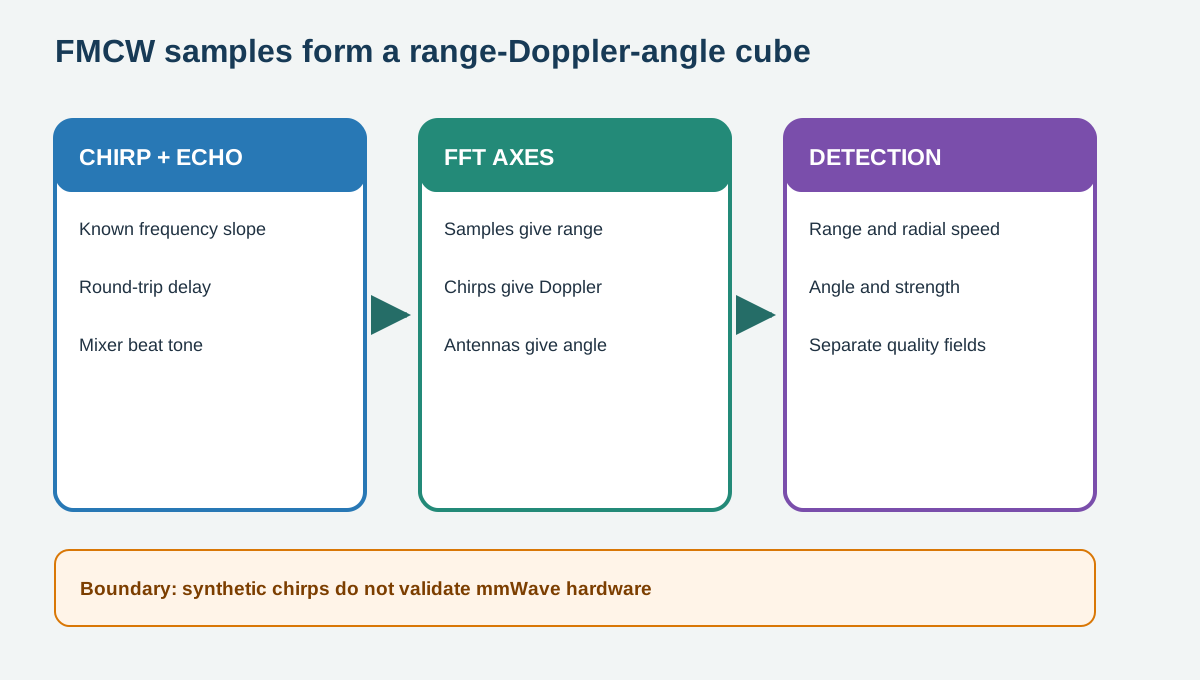
The output is a detection with range, radial velocity, angle, strength, and uncertainty—not a camera-like object record.
- The arrows show processing order, not proof that the final output is correct in every setting.
Major section
Resolution and ambiguity
Ideal range resolution is approximately c divided by twice the swept bandwidth, so more bandwidth separates closer reflectors.
- Doppler resolution improves with a longer coherent observation, while frame rate and target change limit how long samples remain comparable.
- Sampling rate bounds beat frequency and unambiguous range.
- Pulse timing bounds unambiguous velocity.
Deck summary
Key takeaways
Radio Remi is checking a loading bay where dust hides painted floor marks.
- Ignoring target motion for this first step, beat frequency is slope times delay, so range is c times beat frequency divided by twice the slope.
- The output is a detection with range, radial velocity, angle, strength, and uncertainty—not a camera-like object record.
- Ideal range resolution is approximately c divided by twice the swept bandwidth, so more bandwidth separates closer reflectors.
Retrieval practice
Recall check

Radio Remi says: answer from memory, then check your reasoning.
Q1What mainly improves ideal FMCW range resolution?
Show answer
Answer: A Increasing swept bandwidth.
Q2Which sample dimension supplies Doppler evidence?
Show answer
Answer: A Phase or frequency change across repeated chirps.
Print reference
Answers
Answer key.
- A · Increasing swept bandwidth.
- A · Phase or frequency change across repeated chirps.