Connected Health and Wearables · Study deck
Fall Detection: Alert Reliability
The backend should model the alert as a state machine rather than a single push notification.
Ada is your guide for this deck.

After studying this chapter
Learning objectives
You will be able to:
- Test reliability needs event context with a concrete scenario and pass criteria.
- Validate alert fatigue analysis with a concrete scenario and pass criteria.
- Explain: Candidate fall, wearer prompt, self-cancelled, caregiver notified, caregiver acknowledged, monitoring-center escalated, emergency dispatched, resolved, and device-offline are separate states.
- Explain: Firmware samples an IMU at a known rate, applies filters, detects impact and orientation changes, stores a short pre/post-event window, and records battery, firmware, clock, connectivity, worn-state, and location quality.
Major section
Reliability Needs Event Context
Candidate fall, wearer prompt, self-cancelled, caregiver notified, caregiver acknowledged, monitoring-center escalated, emergency dispatched, resolved, and device-offline are separate states.
- The event pipeline starts on the device.
- The backend should model the alert as a state machine rather than a single push notification.
- Privacy controls are part of reliability.
Major section
Reliability Needs Event Context (continued)
Firmware samples an IMU at a known rate, applies filters, detects impact and orientation changes, stores a short pre/post-event window, and records battery, firmware, clock, connectivity, worn-state, and location quality.
- Edge inference can reduce cloud dependency and protect privacy, but it also needs safe fallback behavior when memory, power, GPS, Wi-Fi, BLE, LTE, or the gateway link is degraded.
- Each transition needs a timestamp, actor, channel, confidence score, location quality, retry policy, and logged reason.
- That state model makes audits, incident review, reimbursement evidence, and threshold tuning possible without relying on vague notification logs.
Major section
Reliability Needs Event Context (continued)
A fall event may need a device identifier, user profile, consent version, sensor summary, confidence score, pre-event motion window, post-event inactivity, location estimate, acknowledgement trail, and resolution note.
- If the system integrates with clinical software, standards such as HL7 FHIR Observations, Device resources, or CarePlan context may be useful, but only when the deployment has a real clinical workflow that will consume them.
- A caregiver dashboard, clinical integration, or monitoring-center queue should not expose continuous life patterns unless the care plan requires them.
- Care state: Track care scenario, emergency contacts, preferred response path, accessibility needs, monitoring schedule, and device-support responsibilities.
Major section
Fall Detection System Architecture
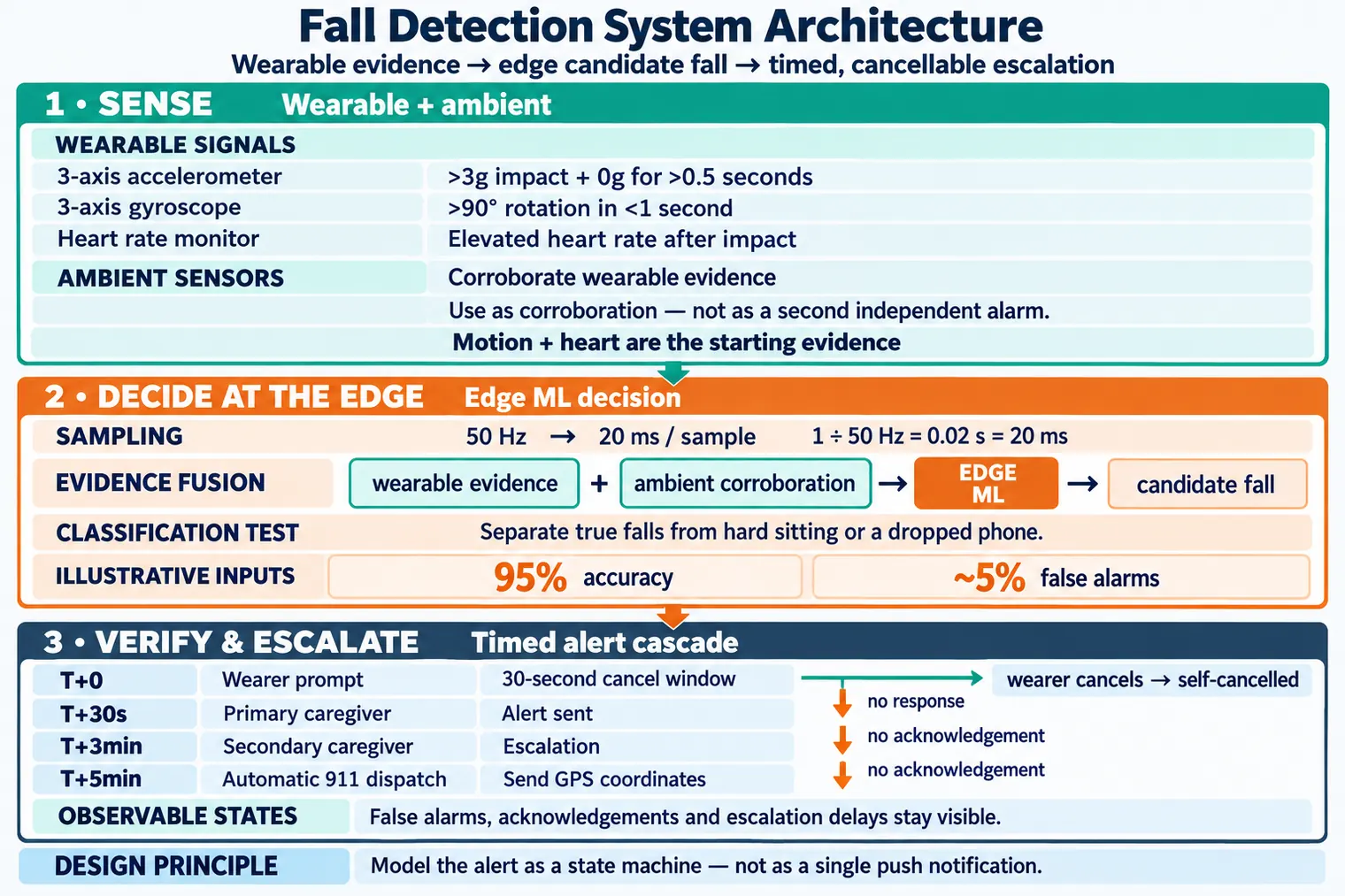
The edge model samples acceleration and rotation at 50 Hz, which means one sample every 1 ÷ 50 s = 20 ms, and separates falls from hard sitting or a dropped phone.
- A candidate fall opens a 30-second wearer-cancel window before caregivers and, later, emergency services are contacted.
Major section
Fall Detection Design Mistakes
Mistake 2: Fixed thresholds instead of personalized baselines: A frail 85-year-old has very different gait dynamics than an active 68-year-old.
- Caregivers can become desensitized, so test the alert cascade and wearer self-cancel step before rollout.
- Mistake 4: No post-fall monitoring: Detecting the fall is only step one.
- Nobody has been alerted yet.
Major section
Fall Detection Design Mistakes (continued)
After a fall, the system should continue monitoring heart rate, movement, and orientation to detect secondary events (loss of consciousness, seizure) and provide this data to EMS responders.
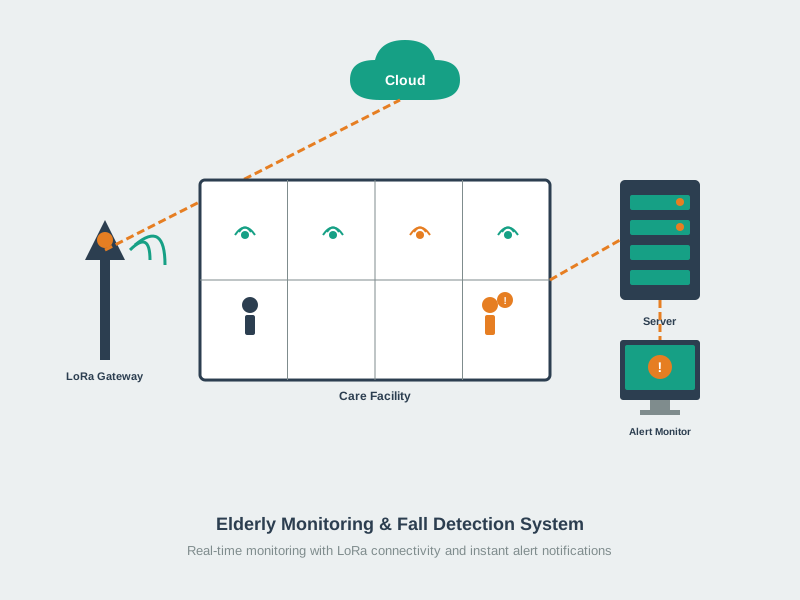
- The right half is a timed cascade, and the clock beside each step is the answer to alert fatigue.
- The self-cancel step sits deliberately ahead of any human, so a dropped phone or a heavy sit-down never reaches a responder.
- Escalation stops as soon as someone answers, which keeps the remaining alerts believable.
Major section
Fall Alert Latency Budget
Scenario: A home healthcare provider is deploying IoT fall detection wearables for 500 elderly patients living independently.
- Allocate detection latency: Fall event duration is 0.5-2 seconds.
- Edge ML inference requires 50-100 ms.
- Key Insight: Healthcare IoT systems should make latency budgets explicit, using the response target and escalation assumptions for the specific service.
Deck summary
Key takeaways
Candidate fall, wearer prompt, self-cancelled, caregiver notified, caregiver acknowledged, monitoring-center escalated, emergency dispatched, resolved, and device-offline are separate states.
- Firmware samples an IMU at a known rate, applies filters, detects impact and orientation changes, stores a short pre/post-event window, and records battery, firmware, clock, connectivity, worn-state, and location quality.
- A fall event may need a device identifier, user profile, consent version, sensor summary, confidence score, pre-event motion window, post-event inactivity, location estimate, acknowledgement trail, and resolution note.
- Scenario: A home healthcare provider is deploying IoT fall detection wearables for 500 elderly patients living independently.
Retrieval practice
Recall check 1 of 2

Ada says: answer from memory, then check your reasoning.
Q1A fall detector sends many alerts after harmless hard sits. Which test addresses alert fatigue?
Show answer
Answer: B A cancellable cascade can filter false candidates and preserve urgent escalation.
Retrieval practice
Recall check 2 of 2
Ada says: answer from memory, then check your reasoning.
Q2A home healthcare provider deploys fall detection wearables for elderly patients. The scenario response target is EMS arrival within 15 minutes of a fall. If EMS response averages 8 minutes and the detection-to-notification chain takes 7 seconds, how much time remains for caregiver intervention before auto-escalating to 911?
Show answer
Answer: C Work backward from the 15-minute target: 15 minutes − 8 minutes EMS travel − 7 seconds detection/notification = 6 minutes 53 seconds for patient cancellation and caregiver stages together.
Print reference
Answers
Answer key.
- B · A cancellable cascade can filter false candidates and preserve urgent escalation.
- C · Work backward from the 15-minute target: 15 minutes − 8 minutes EMS travel − 7 seconds detection/notification = 6 minutes 53 seconds for patient cancellation and caregiver stages together.