Energy & Power · Study deck

Energy Sources for IoT Devices

A solar field node can have a full-looking battery voltage and still reset when its radio draws a pulse.

Battery Bruno is your guide for this deck.

awaresources
Battery Bruno, the module guide, in a scene from this chapter.
iotclass.org

After studying this chapter

Learning objectives

You will be able to:

  • compare battery, harvester, and storage families as a system rather than a single nominal spec
  • build a source-selection ledger covering usable capacity, derating, and validation evidence
  • explain why nominal battery or harvester energy disappears in the field (temperature, pulse current, self-discharge)
  • identify the source-system issue when a harvested node fails to recover after a low-harvest period
iotclass.org

Major section

Match Stored Energy to the Worst Radio Pulse
A rechargeable source adds charge control and cycle life.

  • Harvesting adds variability and storage.
  • Figure: Self-discharge slowly reduces stored charge separates two different losses.
  • If the device cutoff is 3.45 V, nominal stored energy cannot prevent that reset.
  • The planning capacity is (2{,}400\times0.65=1{,}560\ \mathrm{mAh}).

Numbers to remember

120 mAA 120 mA radio pulse causes (V=IR=0.120\ \mathrm{A}\times1.5\ \Omega=0.18\ \mathrm{V}) of sag
3.45 VIf the device cutoff is 3.45 V

Why it matters

Self-discharge reduces stored charge over long time.

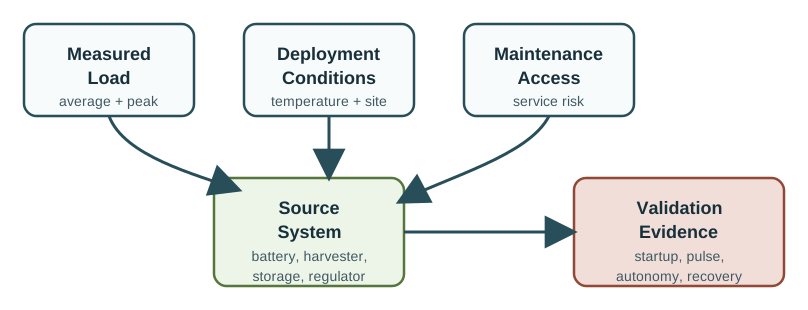
Source selection is a system decision: load evidence, field conditions, and service access shape the source path, then validation proves it can survive startup, peak current, autonomy gaps, and recovery.
iotclass.org

Major section

Match Stored Energy to the Worst Radio Pulse (continued)

A 120 mA radio pulse causes (V=IR=0.120\ \mathrm{A}\times1.5\ \Omega=0.18\ \mathrm{V}) of sag, leaving about 3.42 V before regulator and wiring effects.

  • At a measured average load of 0.20 mA, the simple service estimate is (1{,}560/0.20=7{,}800) hours, about 325 days, before self-discharge and seasonal effects.
  • A solar source needs an energy balance over the worst credible period, not the annual average.
  • A source that works in summer can fail through several dark winter days even when its yearly harvested energy exceeds yearly use.
iotclass.org

Major section

Match Stored Energy to the Worst Radio Pulse (continued)

Self-discharge reduces stored charge over long time.

  • For harvesting, remove input for the autonomy interval and verify the node follows its low-energy policy before storage reaches the cutoff.
  • Cell capacity, internal resistance, converters, harvest, and temperature vary.
  • The source must either complete the required message or enter a defined low-energy state without corrupting stored data.
iotclass.org

Major section

Start With the Source as a Constraint

On a cold morning, the radio starts and the voltage falls far enough to reset the device.

  • The stored energy looked sufficient, but the source could not support the short peak when it mattered.
  • Firmware is the code stored on the device.
  • No desk test can promise a field lifetime.
  • Parts vary and sources age.
iotclass.org

Major section

Start With the Source as a Constraint (continued)

For the source, record usable amount, voltage range, peak current, age, temperature, recharge or harvest pattern, and any buffer that supports a burst.

  • The deeper sections explain capacity, power, loss, storage, and field checks so the estimate carries a range and a retest trigger rather than a perfect date.
  • An IoT power source is not a perfect fuel tank.
  • The source sets the shape of the design as much as the firmware does.
iotclass.org

Major section

Phoebe's Field Notes: What Is Actually Inside That 65% Usable Fraction

The mathematical gist.: At 1% annual self-discharge, 98.01% of stored charge remains after two years, so shelf loss explains only 2.00 of the chapter's 35 derating percentage points.

  • The unexplained part of the 65% usable-capacity assumption cannot be assigned to one loss mechanism.

Numbers to remember

98.01%98.01% of stored charge remains after two years

Why it matters

One panel reduces stored charge slowly; the other can end service during a transient even while charge remains.

Self-discharge slowly reduces stored charge, while a radio pulse can temporarily pull terminal voltage below the device cutoff even when substantial charge remains.
iotclass.org

Major section

The Source Is A System

For the source is a system, a result at Load is incomplete without average + peak.

  • It supplies the evidence hand-off for the source is a system.
Source selection is a system decision: load evidence, field conditions, and service access shape the source path, then validation proves it can survive startup, peak current, autonomy gaps, and recovery.
iotclass.org

Deck summary

Key takeaways

A rechargeable source adds charge control and cycle life.

  • A 120 mA radio pulse causes (V=IR=0.120\ \mathrm{A}\times1.5\ \Omega=0.18\ \mathrm{V}) of sag, leaving about 3.42 V before regulator and wiring effects.
  • Self-discharge reduces stored charge over long time.
  • On a cold morning, the radio starts and the voltage falls far enough to reset the device.
  • For the source, record usable amount, voltage range, peak current, age, temperature, recharge or harvest pattern, and any buffer that supports a burst.
iotclass.org

Retrieval practice

Recall check 1 of 3

Battery Bruno says: answer from memory, then check your reasoning.

Q1What is the strongest starting point for selecting an IoT energy source?

AThe cell with the largest printed mAh rating that fits the enclosure.
BA solar panel product rating without a site energy survey.
CA measured load budget plus deployment conditions such as temperature, service access.
DThe cheapest source option, before checking peak current or maintenance risk.
Show answer

Answer: C Source selection should begin with measured demand and field conditions, then add storage, conversion, protection, and validation evidence.

iotclass.org

Retrieval practice

Recall check 2 of 3

Battery Bruno says: answer from memory, then check your reasoning.

Q2A sensor node's average-current estimate fits a battery label, but the design has not tested radio pulses at low temperature or near end-of-life voltage. What should the review require before accepting the source?

AAcceptance based on the capacity margin in the average-current calculation.
BPulse-load and usable-capacity testing at cold and end-of-life conditions.
CSpace for a larger battery to increase the stored-charge reserve.
DA dashboard screenshot showing the node has transmitted once.
Show answer

Answer: B The source must hold voltage during peak events under deployment conditions, not only satisfy a nominal capacity calculation.

iotclass.org

Retrieval practice

Recall check 3 of 3

Battery Bruno says: answer from memory, then check your reasoning.

Q3A harvested IoT node works on bright days but dies after several low-harvest days and does not recover automatically. Which source-system issue should be investigated first?

AThe harvesting balance, storage buffer, low-energy behavior, and recovery path after source gaps.
BOnly the dashboard color palette, because recovery is a presentation problem.
CThe battery's nominal capacity and bright-day charge rate, to check daily energy balance.
DThe bright-day radio link, since missed reports can look like a dead node.
Show answer

Answer: A The symptom points to source intermittency, buffer autonomy, and recovery, not only the nominal harvester rating.

iotclass.org

Print reference

Answers

Answer key.

  1. C · Source selection should begin with measured demand and field conditions, then add storage, conversion, protection, and validation evidence.
  2. B · The source must hold voltage during peak events under deployment conditions, not only satisfy a nominal capacity calculation.
  3. A · The symptom points to source intermittency, buffer autonomy, and recovery, not only the nominal harvester rating.
iotclass.org