Energy & Power · Study deck
Power Consumption Analysis
A battery sensor appears idle most of the day, yet short radio bursts and long waiting states decide whether it lasts months or years.
Battery Bruno is your guide for this deck.

After studying this chapter
Learning objectives
You will be able to:
- build a state-by-state power ledger (sleep, active, radio) instead of relying on one current reading
- calculate average current from measured per-state charge and duty cycle
- diagnose which device state is the dominant energy drain from a power ledger
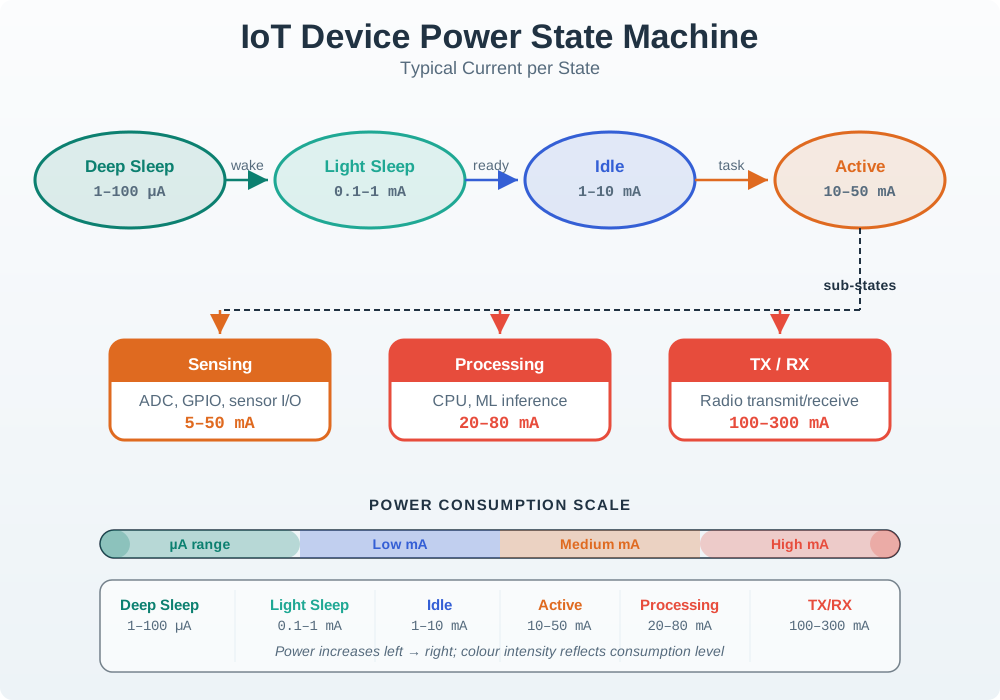
- Explain: The arrows expose transition time that a table of steady states can miss.
Major section
Integrate One Complete Sensor Cycle
The arrows expose transition time that a table of steady states can miss.
- A failed transmission may loop through radio states and change the cycle substantially.
- Total cycle charge is about 0.1994 mAh.
- The average current is (0.1994 mAh/1 h=0.1994 mA).
- Separate coulomb use from energy when voltage changes.
Major section
Integrate One Complete Sensor Cycle (continued)
Charge is current multiplied by time: sleep uses (0.02×3,590/3,600=0.0199 mAh); sensing uses 0.0028 mAh; processing uses 0.0100 mAh; radio uses 0.1667 mAh.
- A nominal 2,400 mAh battery would suggest (2{,}400/0.1994=12{,}036) hours, or about 501 days.
- The trace should cover startup and faults as well as a quiet successful hour.
- Weight every observed cycle by how often it occurs.
Major section
Integrate One Complete Sensor Cycle (continued)
If one retry adds another 5 s at 120 mA, it costs 0.1667 mAh—almost the same as the original radio event.
- Integrate the measured current over the same cycle used in the calculation, and state whether the instrument includes regulator input, device rail, or only one component.
- Force a retry and expect approximately 0.1667 mAh extra under the simplified states.
- Battery capacity and device current vary with cell, temperature, age, hardware, firmware, and network conditions.
- Validate the state budget over representative field cycles and keep margin instead of publishing the 501-day arithmetic as a guarantee.
Major section
Integrate One Complete Sensor Cycle (continued)
Usable capacity, self-discharge, temperature, regulator loss, pulse capability, battery ageing, retries, and safety reserve reduce the field result.
- Charge in mAh helps compare a battery cycle, while energy in mWh multiplies current by voltage and time.
- A converter can draw a different battery current while keeping the device rail stable.
- A one-hour fixture that omits the once-per-day radio exchange will overstate projected life.
Major section
Phoebe's Field Notes: The Voltage This Chapter's mA-s Ledger Assumes Away
The mathematical gist: The chapter's 599-second sleep, 0.7-second sensor state, and 0.3-second radio state carry 55.99 mC and average 93.3 microamps.
- At 15 ohms, the same requested burst would lose 1.80 V and cross the 2.4 V cutoff.
Major section
A Ten-Year Battery Budget
Processor throughput can improve quickly while stored energy improves slowly.
- That mismatch changes the design question.
- A faster processor may finish a burst sooner, but it does not grant the node a larger lifetime charge budget.
- Those trends are technology-era observations, not a forecast for a chosen cell.
Deck summary
Key takeaways
The arrows expose transition time that a table of steady states can miss.
- Charge is current multiplied by time: sleep uses (0.02×3,590/3,600=0.0199 mAh); sensing uses 0.0028 mAh; processing uses 0.0100 mAh; radio uses 0.1667 mAh.
- If one retry adds another 5 s at 120 mA, it costs 0.1667 mAh—almost the same as the original radio event.
- Usable capacity, self-discharge, temperature, regulator loss, pulse capability, battery ageing, retries, and safety reserve reduce the field result.
- Processor throughput can improve quickly while stored energy improves slowly.
Retrieval practice
Recall check 1 of 3

Battery Bruno says: answer from memory, then check your reasoning.
Q1Why is one active-current reading not enough to estimate battery life for a duty-cycled IoT device?
Show answer
Answer: D Average current is built from current multiplied by duration for every relevant state: sleep, wake, sensing, processing, communication, shutdown, and margin.
Retrieval practice
Recall check 2 of 3
Battery Bruno says: answer from memory, then check your reasoning.
Q2A power ledger shows the radio session has the largest charge per cycle. What should the team do next?
Show answer
Answer: D The largest measured contributor should guide the next optimization and the next trace.
Retrieval practice
Recall check 3 of 3
Battery Bruno says: answer from memory, then check your reasoning.
Q3Why should a power analysis record measurement scope and battery-capacity assumptions?
Show answer
Answer: D The trust boundary includes measurement scope, usable capacity, reserve, and field conditions.
Print reference
Answers
Answer key.
- D · Average current is built from current multiplied by duration for every relevant state: sleep, wake, sensing, processing, communication, shutdown, and margin.
- D · The largest measured contributor should guide the next optimization and the next trace.
- D · The trust boundary includes measurement scope, usable capacity, reserve, and field conditions.