Energy & Power · Study deck

Energy Cost of Common Operations

Picture a device whose small message triggers a long wake, connection wait, retry, and receive window.

Battery Bruno is your guide for this deck.

awareoperationcosts
Battery Bruno, the module guide, in a scene from this chapter.
iotclass.org

After studying this chapter

Learning objectives

You will be able to:

  • rank CPU, memory, sensing, storage, and radio operations by measured energy cost rather than assumption
  • build an operation-cost ledger that connects a design change to the dominant energy drain
  • identify break-even points where local compute stops saving energy against radio transfer
  • Explain: Counting only the send time hides most of the cost.
iotclass.org

Major section

Start With One Expensive Radio Burst
Counting only the send time hides most of the cost.

  • Firmware means the software stored on a device that controls its hardware.
  • Tie its version to the exact sleep, wake, sense, compute, store, send, wait, retry, and return sequence.
  • That one burst can dominate the whole budget.
Capacitor voltage rising in four discrete steps with a summed 22.2 nJ loss compared with an 84.5 nJ single jump.
iotclass.org

Major section

Bounded Scenario: Remote LoRa Station Cluster

The existing vineyard case already teaches that sensing can create operational value.

  • Repeating its water-saving story would add little.
  • The power budget must come from measured normal, retry, join, fault, and cold-temperature traces.
Capacitor voltage rising in four discrete steps with a summed 22.2 nJ loss compared with an 84.5 nJ single jump.
iotclass.org

Major section

Arithmetic, Memory, and Radio Energy Hierarchy

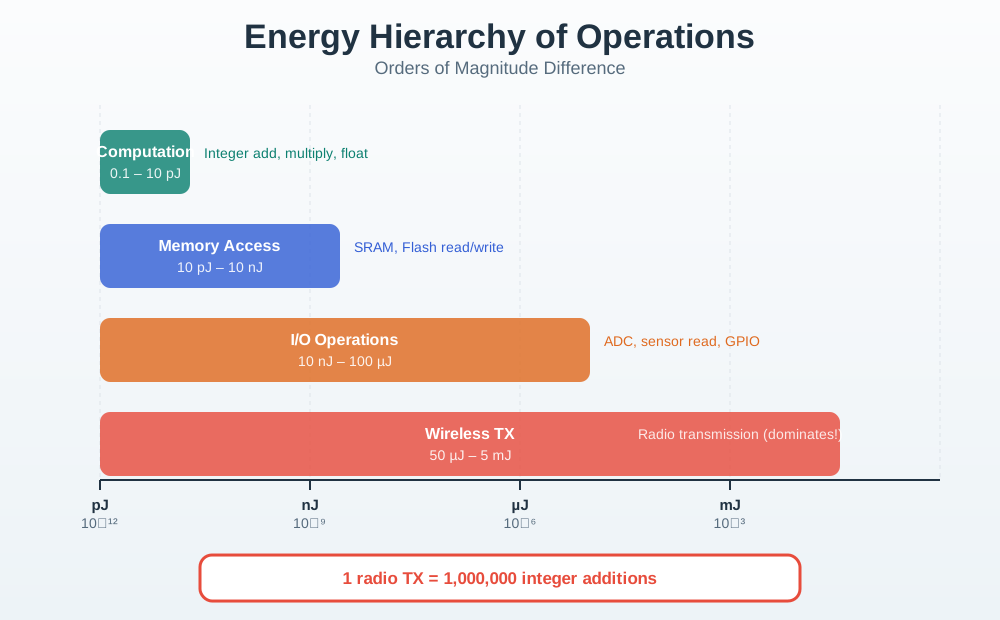
“Compute locally or transmit?” is only answerable after putting arithmetic, data movement, and radio work in the same unit.

  • Energy per operation is that common unit.
  • The table below records one published-style 45 nm CMOS example; it is useful for scale, not as a substitute for measurements on a modern target.

Key terms

Local processing
Local processing is an energy win only when $E_{saved}>0$ and the extra active time, latency, accuracy loss, and memory footprint remain acceptable.
Capacitor voltage rising in four discrete steps with a summed 22.2 nJ loss compared with an 84.5 nJ single jump.
iotclass.org

Major section

Arithmetic, Memory, and Radio Energy Hierarchy (continued)

A 32-bit SRAM read costs about 50 times the listed 32-bit integer add.

  • The DRAM read costs about 6,400 adds, or about 173 of the listed 32-bit floating-point multiplies.
  • The hierarchy is therefore not simply “integer cheap, floating point expensive.” Once operands travel to distant memory, movement can dominate either arithmetic choice.
  • Local processing is an energy win only when $E_{saved}>0$ and the extra active time, latency, accuracy loss, and memory footprint remain acceptable.
iotclass.org

Major section

Summary

Simple local work is often worthwhile when it removes radio sessions, payload, storage, or sensor activity that the service does not need.

  • Radio cost includes startup, listening, joins, acknowledgments, retries, payload, and shutdown, not only the bytes transmitted.
  • Batching, filtering, aggregation, compression, and offloading must preserve latency, freshness, loss, alarm, and evidence requirements.
Capacitor voltage rising in four discrete steps with a summed 22.2 nJ loss compared with an 84.5 nJ single jump.
iotclass.org

Deck summary

Key takeaways

Counting only the send time hides most of the cost.

  • The existing vineyard case already teaches that sensing can create operational value.
  • “Compute locally or transmit?” is only answerable after putting arithmetic, data movement, and radio work in the same unit.
  • A 32-bit SRAM read costs about 50 times the listed 32-bit integer add.
  • Simple local work is often worthwhile when it removes radio sessions, payload, storage, or sensor activity that the service does not need.
iotclass.org

Retrieval practice

Recall check 1 of 3

Battery Bruno says: answer from memory, then check your reasoning.

Q1A developer wants to save energy by rewriting a small temperature filter, but the measured trace shows most charge is spent on radio startup, receive windows, and retries. What is the best review finding?

AStart with the filter rewrite: shortening processing time lets the microcontroller return to sleep sooner.
BThe device should transmit more often so each report is smaller.
CThe first optimization should target the radio session pattern, such as filtering reports, batching, retry policy.
DThe review should ignore retries because only payload bytes use energy.
Show answer

Answer: C Energy optimization should start with the largest measured contributor in the whole duty cycle.

iotclass.org

Retrieval practice

Recall check 2 of 3

Battery Bruno says: answer from memory, then check your reasoning.

Q2A team batches sensor readings so the radio wakes less often, but the batch can now hold an alarm for several minutes. What should the practitioner review require?

AApprove the change because fewer radio starts reduce session overhead.
BMore flash logging by default, without checking write cost or reset behavior.
CRemove local filtering so the batch retains the original sensor detail.
DA service-constraint check that separates delay-tolerant data from alarms.
Show answer

Answer: D The ledger has to protect the service contract while proving the energy effect with before and after traces.

iotclass.org

Retrieval practice

Recall check 3 of 3

Battery Bruno says: answer from memory, then check your reasoning.

Q3A compression routine makes payloads smaller but keeps the device awake longer and does not reduce radio retries in weak-signal tests. What is the strongest conclusion?

AThe compression must save energy because payload bytes are the only cost in a radio session.
BThe weak-signal test should be ignored because it is inconvenient.
CCompression is unproven until charge per useful report falls.
DThe firmware should store every raw sample in flash to make compression easier.
Show answer

Answer: C A local optimization must reduce measured whole-cycle charge while preserving the service contract.

iotclass.org

Print reference

Answers

Answer key.

  1. C · Energy optimization should start with the largest measured contributor in the whole duty cycle.
  2. D · The ledger has to protect the service contract while proving the energy effect with before and after traces.
  3. C · A local optimization must reduce measured whole-cycle charge while preserving the service contract.
iotclass.org