Energy & Power · Study deck
Low-Power Design: Sleep-State Energy Accounting
A firmware team has reduced active time and selected a deep-sleep state.
Battery Bruno is your guide for this deck.

After studying this chapter
Learning objectives
You will be able to:
- Explain: Reading those labels as one chain clarifies that active, light sleep, and deep sleep mode comparison showing current range, wake latency, retained state, peripheral state, and best use case.
- Explain: The review must show active duration from a trace, conversion energy at the actual voltage and resolution, reference settling, temperature leakage, and the measurement instrument's own floor.
- Explain: A UART typically needs a clock high enough to generate and oversample the requested baud with acceptable error; SPI must meet minimum high/low times and transaction deadlines.
- Explain: The arithmetic is easy; proving every term is not.
Major section
Deeper Sleep Is Not Always Cheaper
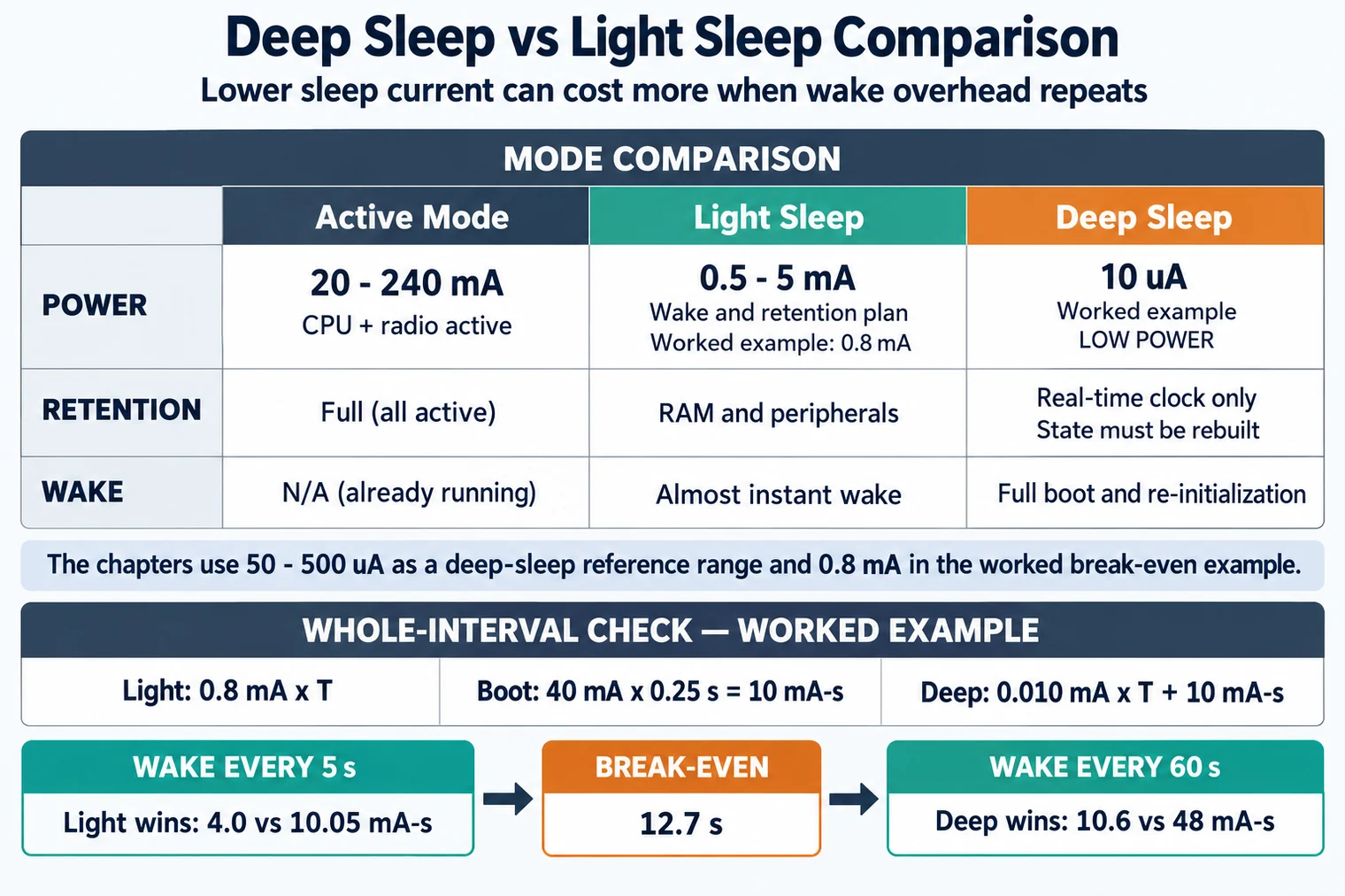
The practical question in deeper sleep is not always cheaper is where Active Mode hands responsibility to: Power.
- Reading those labels as one chain clarifies that active, light sleep, and deep sleep mode comparison showing current range, wake latency, retained state, peripheral state, and best use case.
Major section
Worked 1 nW Average Front-End Budget
The arithmetic is easy; proving every term is not.
- The review must show active duration from a trace, conversion energy at the actual voltage and resolution, reference settling, temperature leakage, and the measurement instrument's own floor.
- If the front end needs ten times longer to settle, its amplifier contribution becomes 2 nW and the budget fails before a single packet is transmitted.
- If a catalog front end clears the whole-device energy and accuracy budget, keep the design at practitioner depth.
Major section
Peripheral Clock-Current Budget
Including the still-running RCFAST source gives about 190.4 $\mu$A before peripheral baselines, CPU, memory, and load current.
- “Lower the clock” is only useful after separating clock-source current from the current switched inside each peripheral.
- Their frequency-dependent contribution is then.
- A clock that halves current but doubles active time may leave energy unchanged.
Major section
Peripheral Clock-Current Budget (continued)
where $f_s$ is the oscillator frequency, $f_i$ is the clock delivered to peripheral $i$, and $k_i$ is its measured current-per-frequency slope.
- If a 12 MHz RCFAST source is already required elsewhere but both peripherals need only 1 MHz, a divide-by-12 branch gives the required peripheral clock.
- The divider is a large improvement over clocking both peripherals at 12 MHz, but turning off the unnecessary fast parent is better.
- A UART typically needs a clock high enough to generate and oversample the requested baud with acceptable error; SPI must meet minimum high/low times and transaction deadlines.
Major section
Worked Radio-MCU Mode Ledger
Radio current spans orders of magnitude, so a linear average must be built from time in each mode.
- Supply voltage, temperature, RF settings, and silicon revision affect these historical values; use them to learn the ledger, then replace them with measured target data.
Major section
Worked CC2650 State Selection
At 48 MHz, the active-core model gives.
- A 151 $\mu$s standby-to-active transition consumes more than.
- Approximating the transition at the active current gives 0.444 $\mu$C, or about 1.33 $\mu$J at 3 V, before useful instructions.
- Retention uses more sleep current but may avoid cache refill or reinitialization.
Deck summary
Key takeaways
The practical question in deeper sleep is not always cheaper is where Active Mode hands responsibility to: Power.
- The arithmetic is easy; proving every term is not.
- Including the still-running RCFAST source gives about 190.4 $\mu$A before peripheral baselines, CPU, memory, and load current.
- where $f_s$ is the oscillator frequency, $f_i$ is the clock delivered to peripheral $i$, and $k_i$ is its measured current-per-frequency slope.
- Radio current spans orders of magnitude, so a linear average must be built from time in each mode.
Retrieval practice
Recall check 1 of 3

Battery Bruno says: answer from memory, then check your reasoning.
Q1Why is 'always use the deepest sleep mode' not universally correct?
Show answer
Answer: A Frequent wakeups can make repeated reboot and reinitialization energy larger than the current saved during sleep.
Retrieval practice
Recall check 2 of 3

Battery Bruno says: answer from memory, then check your reasoning.
Q2Light sleep draws 0.8 mA; deep sleep draws 10 uA but needs a 10 mA-s reboot to wake. For a device that wakes every 5 seconds, which mode is cheaper?
Show answer
Answer: D
Retrieval practice
Recall check 3 of 3

Battery Bruno says: answer from memory, then check your reasoning.
Q3A team power-gates an I2C sensor to remove its 1 mA sleep draw, but the measured sleep current barely improves. The I2C pull-ups are still powered and the SDA and SCL lines are high. What is happening?
Show answer
Answer: A Cutting only the main supply pin leaves a back-door path: the pull-ups drive the high I2C lines into the sensor's input protection diodes.
Print reference
Answers
Answer key.
- A · Frequent wakeups can make repeated reboot and reinitialization energy larger than the current saved during sleep.
- D
- A · Cutting only the main supply pin leaves a back-door path: the pull-ups drive the high I2C lines into the sensor's input protection diodes.