Energy & Power · Study deck
Low-Power Design: Duty-Cycle Energy Accounting
A duty cycle is the share of time a device spends awake.
Battery Bruno is your guide for this deck.

After studying this chapter
Learning objectives
You will be able to:
- Calculate folded duty-cycle math notes from stated measurements and limits.
- Validate label the strategy stack with a concrete scenario and pass criteria.
- Explain: That estimate is only useful when the measurement record includes wake time, sensor stabilization, radio join time, retries, queue flushes, and the real sleep current of the whole board.
- Explain: The MCU may be in deep sleep while sensors, pull-ups, level shifters, indicators, or a radio module continue drawing current.
Major section
Folded Duty-Cycle Math Notes
That estimate is only useful when the measurement record includes wake time, sensor stabilization, radio join time, retries, queue flushes, and the real sleep current of the whole board.
- Sleep current often dominates long-life designs: a small always-on regulator, pull-up, LED, sensor rail, or wake circuit can erase the benefit of a shorter active window.
- Current-only math is a shortcut, not the definition of energy.
- The transition term is only about 1 uA-s, but it sits next to a sleep term of about 4.8 uA-s and an active term of about 4.4 uA-s.
Major section
Peripheral Power Gating
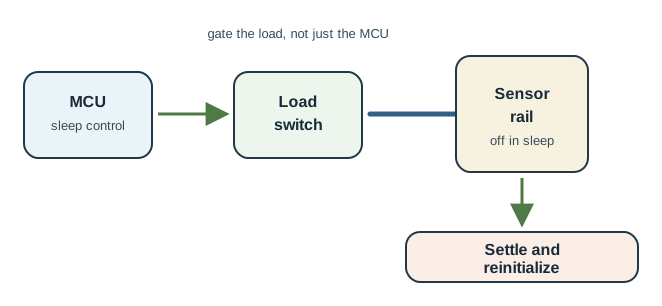
The MCU may be in deep sleep while sensors, pull-ups, level shifters, indicators, or a radio module continue drawing current.
- A low-power design needs a load inventory.
- They expose the two conditions that the surrounding argument must keep together.
- The chapter can now use peripheral power gating without dropping the conditions shown here.
- Reinitialize before use.
Major section
Separate Health From Data
Low-rate health reports can prove the node is alive without transmitting every raw sample.
- Cellular batching is the same fixed-cost problem with a larger state machine.
- An LTE-style modem may move from idle into continuous reception, then through short and long DRX windows before it can return to the low floor.
- If the application can send two small records every 60 seconds instead of one small record every 30 seconds, the useful payload doubles while the expensive on, listen, tail, and release path is paid less often.
- Short-range radios need the same state ledger.
Major section
Separate Health From Data (continued)
At long range, RF transmit energy may dominate.
- Sleep: every extra second the radio stays on is charge stolen straight from the sleep floor's savings.
- Life: GSM-class links run on the order of 10,000 nJ/bit -- worth checking before trusting cellular reach over a shorter local hop.
- At very short range, receiver electronics, startup, acknowledgments, and listening windows can dominate instead.
Major section
Clock and Voltage Scaling
If lower frequency stretches the active window enough, the total energy may stay the same or increase.
- Vendor-specific low-power states and clock trees are not portable across MCU families, so the review record should name the silicon, enabled clocks, retained peripherals, and measured charge per useful cycle.
- Dynamic voltage and frequency scaling can reduce instantaneous power, but it is not automatically an energy win.
Deck summary
Key takeaways
That estimate is only useful when the measurement record includes wake time, sensor stabilization, radio join time, retries, queue flushes, and the real sleep current of the whole board.
- The MCU may be in deep sleep while sensors, pull-ups, level shifters, indicators, or a radio module continue drawing current.
- Low-rate health reports can prove the node is alive without transmitting every raw sample.
- At long range, RF transmit energy may dominate.
- If lower frequency stretches the active window enough, the total energy may stay the same or increase.
Retrieval practice
Recall check 1 of 3

Battery Bruno says: answer from memory, then check your reasoning.
Q1A node uses 10 mA while active for 1 s and 0.01 mA while asleep for 9 s. What is its average current over the cycle?
Show answer
Answer: D Weighted charge divided by total time gives the cycle average.
Retrieval practice
Recall check 2 of 3
Battery Bruno says: answer from memory, then check your reasoning.
Q2A device wakes every 20 minutes, reads a sensor, may send a short report, and does not need RAM contents between cycles. What should drive the sleep-mode choice?
Show answer
Answer: A Sleep-mode choice is a requirements and evidence decision: wake source, retained state, wake latency, and measured charge per cycle all matter.
Retrieval practice
Recall check 3 of 3
Battery Bruno says: answer from memory, then check your reasoning.
Q3What determines when a processor and radio leave sleep using events and bounded timers?
Show answer
Answer: C Events and bounded timers decide when the processor and radio leave sleep.
Print reference
Answers
Answer key.
- D · Weighted charge divided by total time gives the cycle average.
- A · Sleep-mode choice is a requirements and evidence decision: wake source, retained state, wake latency, and measured charge per cycle all matter.
- C · Events and bounded timers decide when the processor and radio leave sleep.