Energy & Power · Study deck
Energy-Aware Design Basics
Picture a soil sensor that lasts months in a spreadsheet but dies after several wet, weak-signal nights.
Battery Bruno is your guide for this deck.

After studying this chapter
Learning objectives
Turn the maintenance promise into a measured average-current allowance.
- The service promise sets the energy allowance.The soil sensor’s sensing, reporting, response, and maintenance requirements must be defined before choosing its energy source.
- Average current must represent the repeating workload.Each measured state contributes its current multiplied by the time spent sleeping, sensing, communicating, or waiting.
- Usable capacity depends on deployment conditions.Cutoff, temperature, pulse load, age, and reserve can reduce the energy available from the battery label.
- A lifetime claim needs reproducible evidence.Retry behavior, environmental margin, and the board and firmware versions must accompany the current trace.
Major section
Start With a Device That Must Outlast Its First Week
A field lifetime claim starts with the repeating workload the battery must actually support.
- The workload must include every important operating state.Sleep, sensing, compute, storage, radio, retry, and alarm activity all contribute to the repeating cycle.
- State timing determines how much charge a cycle consumes.The evidence record needs each state’s current, duration, and event count before average demand can be calculated.
- The measurement setup must match the deployed device.Board, firmware, battery, and environmental records connect the current trace to the soil sensor’s actual configuration.
- Weak signal can invalidate the bench estimate.Additional radio attempts extend field activity even when the original peak current remains unchanged.
Activity 1 · Match
✎ Build the evidence record

I want you to match each lifetime assumption with evidence another engineer can inspect.
On paper, match reporting frequency, sleep current, usable capacity, retry count, and firmware version to service requirements, whole-device traces, source derating, field radio logs, and the build record. Explain why a battery label cannot replace this evidence.
3 minutes · Pen and paper · Answer: Activity 1
Major section
Start With a Device That Must Outlast Its First Week (continued)
By the final panel, the day-to-night trace repeats and can support a battery estimate.
- The design problem is not just choosing a bigger battery; it is deciding how often the device wakes, how long each radio burst lasts, and which service promise the battery must support.
- “Every milliamp is a day of battery — budget the sleep before you budget the features.”.
- Through this chapter, Bruno keeps one running ledger: what each state draws, how long the device sleeps, and what that means for life on one charge.
Major section
Usable Capacity and Pulse Headroom
Usable capacity combines separate source losses, while a radio pulse also tests voltage headroom.
- The nameplate energy is only the starting point.The chapter’s 2400 mAh source at 3.6 V stores 8.64 Wh before deployment losses are applied.
- Separate retention factors combine into usable capacity.The 95% shelf, 87% cold-and-pulse, and 85% cutoff factors leave 70.3%, or 1,686.1 mAh.
- The source resistance can consume the radio’s voltage margin.The voltage drop is 0.336 V through 8 ohms during a 42 mA pulse, leaving 0.864 V of brownout margin.
- A larger source resistance can prevent operation.At 40 ohms, the pulse leaves 1.92 V and fails the chapter’s 2.4 V limit.
Major section
Summary
Keep the service promise, usable source, measured workload, and remaining margin in one reviewable record.
- Long sleep does not guarantee a small average current.The chapter’s 592-second sleep still shares a cycle with a costly 3-second radio state.
- Usable capacity can be smaller than nominal capacity.Cutoff, temperature, pulse load, aging, converter behavior, and reserve determine what the workload can actually consume.
- Retries can reduce lifetime without changing peak current.Two extra radio attempts raise the example’s average to 0.6646 mA and reduce its estimate to about 105 days.
- Design changes require another ledger review.Firmware, hardware, source, environment, and service changes can invalidate the assumptions behind the accepted lifetime claim.
Major section
Energy Is A Design Budget
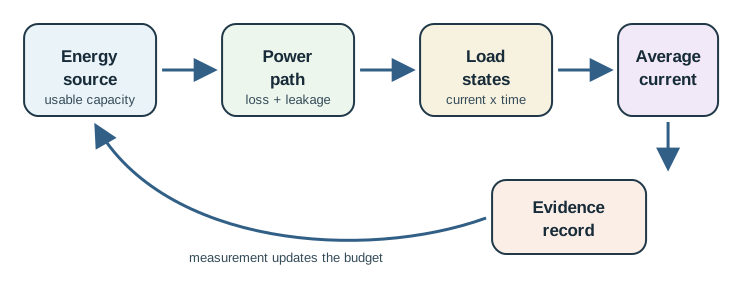
Follow usable capacity through the power path and load states, then return measurement evidence to the budget.
- The source label differs from usable capacity.The first budget step must account for temperature, cutoff, pulse load, age, and reserve under deployment conditions.
- The power path can consume part of the allowance.Regulator leakage and conversion losses reduce what remains for the sensors, processor, radio, and other loads.
- Load states determine the measured average-current demand.The budget combines each state’s current and duration before comparing the workload with the service allowance.
- The evidence loop can revise every budget assumption.Field retries or longer firmware states require corrections to the ledger rather than a single optimistic lifetime number.
Major section
The Four Budget Questions
Service, states, source, and evidence define different parts of the same lifetime claim.
- The service specifies what the device must deliver.Sensing, reporting, response, reliability, and maintenance behavior define the promise that consumes the energy budget.
- The state list describes where operating time goes.Sleeping, sensing, computing, storing, transmitting, receiving, retrying, and waiting must appear in the workload record.
- The source estimate describes energy available in deployment.Usable capacity must account for cutoff, temperature, pulse load, age, and reserve before supporting a lifetime claim.
- The evidence identifies how the budget was measured.The trace, firmware version, board configuration, and field record let another engineer review the same operating conditions.
Major section
Beginner Vocabulary
Separate the rate of consumption from the total accumulated over a workload.
- Power is the rate of energy consumption.A state’s voltage and current establish its power while the device is sleeping, computing, or transmitting.
- Energy and charge are totals accumulated over time.Energy is power accumulated over time, while charge is current accumulated over time for the battery-capacity calculation.
- Average current is the workload’s steady equivalent.The measured cycle charge must be divided by the complete cycle time, including long sleep intervals.
- Duty cycle and usable capacity describe different constraints.Duty cycle is a state’s time share; usable capacity is the part of the source available under deployment conditions.
Major section
Build The Energy Design Ledger
A useful ledger lets another engineer inspect the workload and challenge the assumptions.
- The ledger connects the service promise to measured demand.Allowed average current must be compared with whole-device state currents and durations from the repeating workload.
- The source derating belongs beside the demand estimate.A lifetime calculation needs usable capacity after deployment losses rather than the battery’s nominal label alone.
- Conservative assumptions make uncertainty visible.Expected and conservative ledgers show how retries, environmental conditions, and source limits can consume the remaining margin.
- Average current cannot replace every energy analysis.Mixed voltages, converter losses, pulse loads, and harvesting paths may require an energy-based comparison.
Major section
Budget Workflow
Set the allowance first, measure the cycle next, and review margin before accepting the design.
- The maintenance target determines the average-current allowance.The 2400 mAh source at 70 percent usable capacity allows about 96 uA over two years.
- The example board is already above the allowance.The total is about 110 uA from 80 uA sleep plus 30 uA other work, before retry or cold-weather margin.
- Measured state charge must include current and duration.Each sleep, wake, sensing, storage, transmit, and receive state contributes its current multiplied by measured time.
- Cycle charge must be compared with cycle time.Dividing total charge by the complete cycle duration reveals whether the required service fits the average-current allowance.
Major section
Review Ledger
Record the assumption, its evidence, its likely failure, and the change that demands retesting.
- A changed reporting interval reopens the service budget.Faster reporting changes wake frequency, while altered latency or maintenance targets can change the original allowance.
- Firmware and hardware changes require renewed state evidence.A new sensor, radio, clock, peripheral, or board assembly can alter measured current and state timing.
- A source change can alter usable capacity.Battery chemistry, regulator, enclosure, temperature range, and reserve policy are explicit triggers for reviewing source derating.
- Field failures can expose missing budget assumptions.Resets, missed reports, unexpected retries, and weak signal require renewed review of margin and measurement evidence.
Major section
What The Numbers Mean
The arithmetic is useful only when its states and source assumptions represent deployment.
- Whole-device traces can reveal hidden loads.Pull-ups, indicators, powered sensors, and regulator leakage may consume energy missing from individual component tables.
- Radio and firmware behavior can extend active states.Receive windows, joins, retries, storage writes, and delays may increase the workload beyond the ideal trace.
- Duration determines the accumulated energy cost.Voltage and current establish state power, but the time spent in that state determines its energy contribution.
- A precise calculation still depends on realistic assumptions.The lifetime number is only useful when measured behavior and usable source limits represent the intended deployment.
Major section
Worked Cycle Example
Weight each state by its duration before judging how much the sleeping device consumes.
- Sleep is the longest state in the measured cycle.The 600-second cycle includes 592 seconds at 0.008 mA, alongside warm-up, compute, radio, storage, and shutdown.
- The short radio state still uses substantial charge.The transmit-and-receive state has 42 mA for 3 seconds, contributing 126 mA*s to the cycle.
- The total cycle charge determines average current.The measured states sum to 146.736 mA*s; division by 600 seconds gives 0.2446 mA.
- Usable capacity turns average demand into a lifetime estimate.The chapter’s 1680 mAh usable capacity gives about 286 days before additional weak-signal retries.
Activity 2 · Work it out
✎ Price the radio retries
I want you to calculate the retry cost before trusting the battery-life estimate.
On paper, divide 146.736 mA*s by a cycle lasting 600 seconds. Then add the extra retry charge of 252 mA*s and divide by the same cycle time. Compare the chapter’s estimates of 286 days and 105 days, and explain what changed.
4 minutes · Pen and paper · Answer: Activity 2
Major section
Equations To Use Carefully
Choose the relationship that matches the quantities and boundary being reviewed.
- State power requires matching voltage and current.The relationship P = V x I applies when those quantities describe the operating state under review.
- Energy depends on power over the stated duration.The relationship E = P x t supports comparisons involving different voltages, converters, pulse loads, or harvesting paths.
- Average current requires the complete measured cycle.The sum of state current times duration must be divided by total cycle time, including sleep and waiting.
- Lifetime requires derated capacity and stated assumptions.Usable capacity divided by average current gives an estimate only after source losses and workload conditions are recorded.
Major section
Handoff Points That Break Budgets
A changed handoff can invalidate the budget without changing a component’s advertised active current.
- Faster reporting can increase the workload.The service-to-firmware handoff changes wake frequency and therefore the energy consumed across the reporting cycle.
- Radio coordination can cost more than the payload.Joins, acknowledgments, receive windows, and retries all add state time that the budget must include.
- The assembled board has loads beyond component ratings.Whole-device measurement includes regulators, sensors, leakage, and standby loads that individual tables may omit.
- Field conditions can invalidate a laboratory estimate.Weak signal, enclosure changes, dirty connectors, and firmware logging can change behavior after prototype testing.
Deck summary
Key takeaways
Accept a battery-life estimate only with reproducible workload measurements and explicit source assumptions.
- The service target must become an average-current allowance.The two-year example allows about 96 uA from a 2400 mAh cell at 70 percent usable capacity.
- The measured cycle must cover the whole device.Receive windows, retries, sleep leakage, and board loads belong beside sensing and transmit activity in the evidence record.
- The source derating and uncertainty must remain visible.Expected and conservative ledgers connect usable capacity, deployment conditions, and remaining margin to the lifetime estimate.
- Field evidence must keep the budget current.Reset logs, missed reports, weak signal, and changed workload are reasons to repeat the measurement and review.
Retrieval practice
Recall check 1 of 3
Battery Bruno says: answer from memory, then check your reasoning.
Q1A team claims a two-year battery life because the battery label has enough nominal mAh for the calculator. What should the review ask for first?
Show answer
Answer: A Nominal capacity alone does not prove a deployed lifetime claim; the review needs a service-bound evidence record.
Retrieval practice
Recall check 2 of 3
Battery Bruno says: answer from memory, then check your reasoning.
Q2A prototype meets its average-current budget on the bench, but only when radio retries are disabled and the battery is fresh at room temperature. What should be recorded before accepting the design?
Show answer
Answer: D The accepted claim must reflect deployment conditions, not only the easiest bench trace.
Retrieval practice
Recall check 3 of 3
Battery Bruno says: answer from memory, then check your reasoning.
Q3A current trace shows low active current, but field logs show frequent failed joins after wakeup. Which budget handoff should be investigated first?
Show answer
Answer: B The average budget must include real radio behavior after wakeup, not only the ideal active state.
Print reference
Answers
Answer key.
- A · Nominal capacity alone does not prove a deployed lifetime claim; the review needs a service-bound evidence record.
- D · The accepted claim must reflect deployment conditions, not only the easiest bench trace.
- B · The average budget must include real radio behavior after wakeup, not only the ideal active state.
Print reference
Activity 1 answer
Model answer.
Match: Reporting frequency belongs to service requirements; sleep current needs a whole-device trace; usable capacity needs source derating; retry count needs field radio logs; firmware version belongs to the build record. The label alone excludes state timing, deployment losses, and reproducible workload evidence.
Print reference
Activity 2 answer
Model answer.
Work it out: The baseline is 0.2446 mA, about 245 uA. With retries, (146.736 + 252) / 600 = 0.6646 mA. At 1680 mAh usable capacity, the chapter estimates about 286 days versus about 105 days. Radio state duration increased; peak current stayed unchanged.