Energy & Power · Study deck

Power Management Tools

A battery-life calculator can make a design look precise even when the inputs are guesses.

Battery Bruno is your guide for this deck.

awareinteractivetools
Battery Bruno, the module guide, in a scene from this chapter.
iotclass.org

After studying this chapter

Learning objectives

You will be able to:

  • Explain: The measured trace shows 8 mA active for 2.0 s, 42 mA transmit for 0.8 s, and 12 uA sleep for the rest of the 900 s period.
  • Explain: At 2% self-discharge per month, the cell adds an equivalent 27.8 microamps, lifting the total to 54.7 microamps and cutting the estimate to 2.09 years.
  • Explain: This progression makes the point concrete: Interactive tool review loop showing run tool, capture assumptions, replace guesses with evidence, test fail-closed cases, and record the decision.
  • Prepare measured inputs before running a battery-life estimate.
iotclass.org

Major section

Tool Workflow

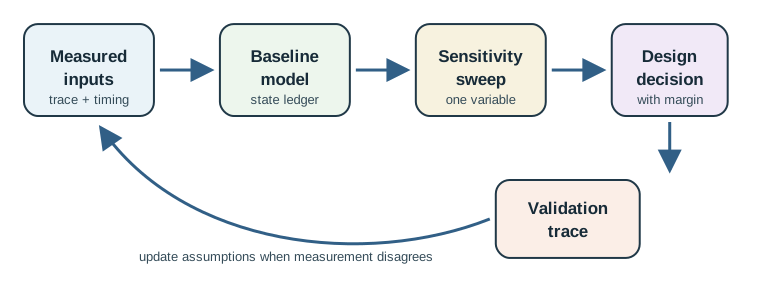
The useful path through an energy tool starts before the calculator opens.

  • The practical question in tool workflow is where inputs hands responsibility to trace + timing.
  • It therefore connects this diagram directly to the chapter's treatment of tool workflow.
Power-management tool workflow from measured inputs to model, sensitivity sweep, design decision, and validation.
iotclass.org

Major section

Worked Ledger

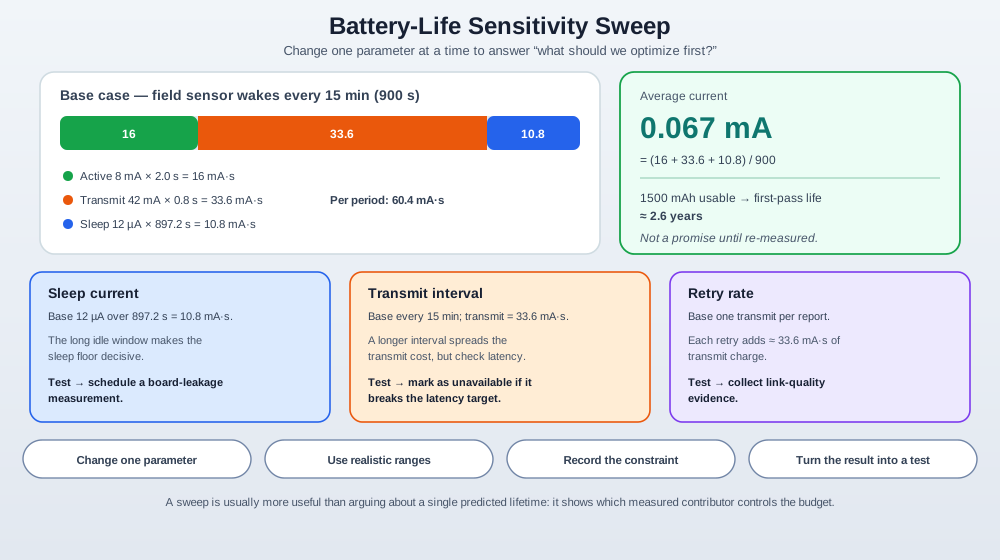
The measured trace shows 8 mA active for 2.0 s, 42 mA transmit for 0.8 s, and 12 uA sleep for the rest of the 900 s period.

  • With 1500 mAh usable capacity, first-pass lifetime is about 2.6 years.
  • That number is not a promise.
  • It becomes useful when the same firmware is measured again after design changes and when field logs confirm retry behavior.
iotclass.org

Major section

Sensitivity Sweeps

A sensitivity sweep answers "what should we optimize first?" It is usually more useful than arguing about a single predicted lifetime.

  • Against it,: Average current exposes the energy consequence; the later 0.067 mA adds a distinct review condition.

Numbers to remember

0.067 mAthe later 0.067 mA adds a distinct review condition.

Why it matters

Otherwise the sweep cannot tell you which change mattered.

Battery-life sensitivity sweep: from a base ledger averaging 0.067 mA (about 2.6 years on 1500 mAh), sweeping sleep current, transmit interval, and retry rate shows which measured contributor to optimize first.
iotclass.org

Major section

Validation Loop

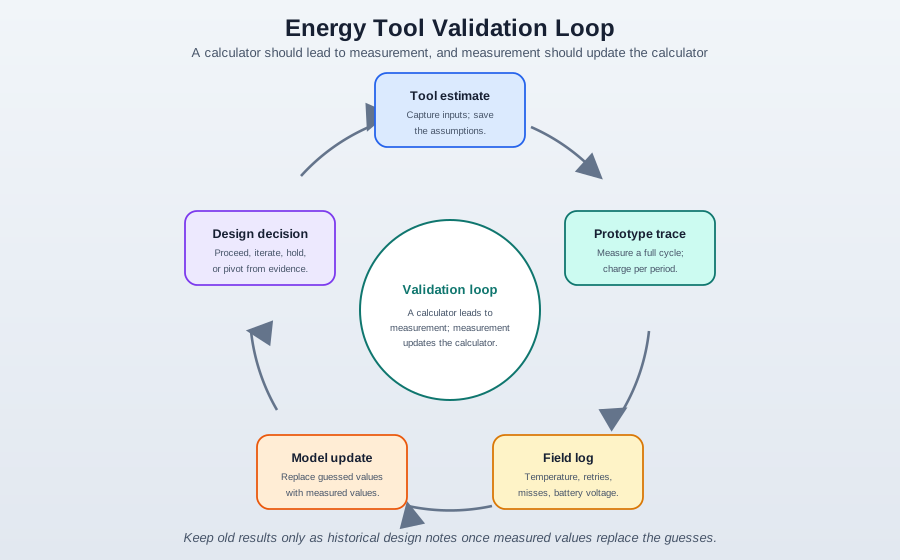
A calculator should lead to measurement, and measurement should update the calculator.

  • Their relationship shows which part of the claim still needs evidence.
  • The next checkpoint, measurement; measurement, states how the claim is checked, while updates the calculator adds a distinct review condition.
Validation loop connecting tool estimate, prototype trace, field log, model update, and design decision, so a calculator leads to measurement and measurement updates the calculator.
iotclass.org

Major section

Tool Review Checklist

Capacity is usable: Battery capacity reflects voltage cutoff, temperature, age, pulse limits, self-discharge, and reserved margin.

  • Protocol cost is complete: The model includes association, acknowledgments, receive windows, retries, and failed transmissions when relevant.
  • Output is a range: The design record shows best-case, expected, and conservative estimates, not a single polished number.
  • Validation is scheduled: The next bench or field check is named before the design is treated as accepted.
iotclass.org

Major section

A Calculator's Job Is To Show Sensitivity, Not Just A Number
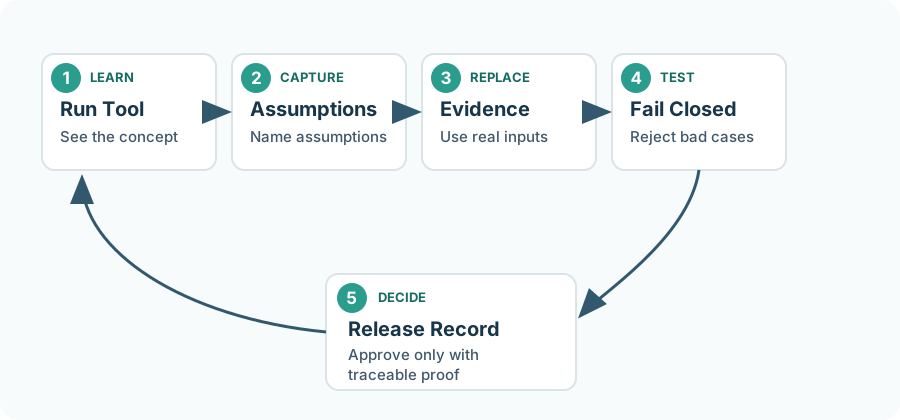
This progression makes the point concrete: Interactive tool review loop showing run tool, capture assumptions, replace guesses with evidence, test fail-closed cases, and record the decision.

  • The result feeds the chapter's a calculator's job is to show sensitivity, not just a number decision with the boundary still attached.
A trustworthy calculator pass turns a lifetime number into an evidence loop: run the model, name the assumptions, replace guesses with measurements, test failure cases, and record the release decision.
iotclass.org

Major section

Phoebe's Field Notes: The Sweep This Page's Own Baseline Never Ran

The mathematical gist.: A 1000 mAh cell powering the chapter's 26.9-microamp device gives a naive 4.24-year result.

  • At 2% self-discharge per month, the cell adds an equivalent 27.8 microamps, lifting the total to 54.7 microamps and cutting the estimate to 2.09 years.

Numbers to remember

2%At 2% self-discharge per month, the cell adds an equivalent 27.8 microamps
iotclass.org

Deck summary

Key takeaways

The useful path through an energy tool starts before the calculator opens.

  • The measured trace shows 8 mA active for 2.0 s, 42 mA transmit for 0.8 s, and 12 uA sleep for the rest of the 900 s period.
  • A sensitivity sweep answers "what should we optimize first?" It is usually more useful than arguing about a single predicted lifetime.
  • A calculator should lead to measurement, and measurement should update the calculator.
  • Capacity is usable: Battery capacity reflects voltage cutoff, temperature, age, pulse limits, self-discharge, and reserved margin.
iotclass.org

Retrieval practice

Recall check 1 of 4

Battery Bruno says: answer from memory, then check your reasoning.

Q1A battery-life calculator predicts four years, but the model uses datasheet sleep current, nominal battery capacity, and one successful radio transmission per cycle. What should the engineer do before accepting the result?

AMeasure the full device cycle, derate usable capacity, include retry behavior.
BAccept the result because the calculator already includes the energy formula.
CIncrease the battery size until the calculator reports at least eight years.
DRemove the sleep state from the model to simplify the calculation.
Show answer

Answer: A Power tools support design decisions only when measured device behavior and realistic deployment limits are included.

iotclass.org

Retrieval practice

Recall check 2 of 4

Battery Bruno says: answer from memory, then check your reasoning.

Q2Place each power-tool artifact where it lives so you can tell whether a lifetime claim survives measured validation.

AMeasured inputs
BMarketing claim
CDecorative title
DUntracked guess
Show answer

Answer: A Separate measured inputs, baseline and sensitivity modelling, and validation evidence so you can challenge a power estimate before committing a design.

Q3Beyond a single lifetime figure, what is the most useful thing a battery-life tool provides?

AA prettier chart of the same single number.
BA sensitivity view of which input moves the lifetime most.
CA guarantee that the battery will last exactly that long.
DConfirmation that active current is always what matters.
Show answer

Answer: B The lifetime number alone can mislead you into optimizing a term that barely matters.

iotclass.org

Retrieval practice

Recall check 3 of 4

Battery Bruno says: answer from memory, then check your reasoning.

Q4For a node that reports once per hour with a 0.5 s active burst, a sweep shows halving sleep current gives +59% life while halving active current gives +15%. Which optimization should the team pursue first, and why?

AReduce sleep current, because at this tiny duty cycle the sleep term dominates the average
BReduce active current, because 50 mA is a much bigger number than 20 uA.
CEither one, since both give the same lifetime gain.
DNeither; lifetime cannot be improved by changing currents.
Show answer

Answer: A The device sleeps for essentially the whole hour, so the sleep term carries about three-quarters of the average.

iotclass.org

Retrieval practice

Recall check 4 of 4

Battery Bruno says: answer from memory, then check your reasoning.

Q5A tool predicts 6.7 years using a 10 uA datasheet sleep current, but the board actually sleeps at 200 uA, giving a real life near 0.55 years. Why is this error so large from a single input?

AThe tool's arithmetic is wrong.
BActive current changed between the two runs.
CSleep current is the dominant term at this duty cycle.
DLifetime is proportional, not inversely proportional, to average current.
Show answer

Answer: C The answer is most sensitive to the dominant term.

iotclass.org

Print reference

Answers 1 of 2

Answer key.

  1. A · Power tools support design decisions only when measured device behavior and realistic deployment limits are included.
  2. A · Separate measured inputs, baseline and sensitivity modelling, and validation evidence so you can challenge a power estimate before committing a design.
  3. B · The lifetime number alone can mislead you into optimizing a term that barely matters.
  4. A · The device sleeps for essentially the whole hour, so the sleep term carries about three-quarters of the average.
iotclass.org

Print reference

Answers 2 of 2

Answer key.

  1. C · The answer is most sensitive to the dominant term.
iotclass.org