Energy & Power · Study deck

Energy Harvesting: Budgets, Conversion, and Storage

This first route moves from source measurement to energy-neutral ledgers, converter choice, MPPT gates, and storage design.

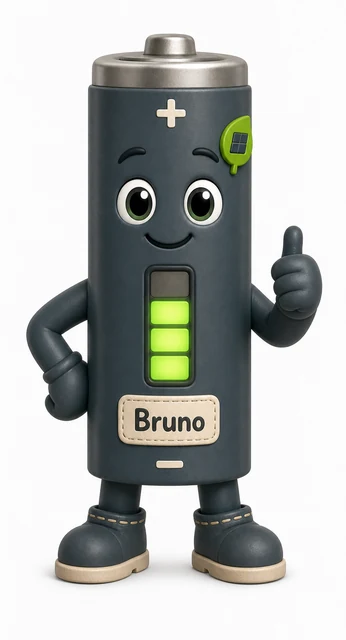
Battery Bruno is your guide for this deck.

awareharvesting
Battery Bruno, the module guide, in a scene from this chapter.
iotclass.org

After studying this chapter

Learning objectives

You will be able to:

  • Survey ambient energy sources and reject sources that are too weak or intermittent.
  • Build an energy-neutral ledger from measured harvest and measured load.
  • Size storage for autonomy, depth-of-discharge, self-discharge, and temperature effects.
  • Explain why solar, thermal, vibration, and RF harvesting have different design gates.
iotclass.org

Major section

Start With a Cloudy Week

A woodland monitor runs well in summer sun and stops during a wet week under leaves.

  • The field owner needs the device to measure, store, and report through the weakest expected period, not merely to balance energy on an average day.
  • Include conversion loss and the energy that storage can safely give back.
iotclass.org

Major section

Start With a Cloudy Week (continued)

Harvesting can extend life; it does not create unlimited power or remove upkeep.

  • The result is bounded by the measured site and storage condition.
  • Energy harvesting looks easy on a sunny bench and hard during a cloudy week, a dim corridor, or a vibration pattern that stops overnight.
  • The design question is whether the harvested trickle, storage buffer, and load policy can survive the weak periods.
iotclass.org

Major section

Minimum Viable Understanding

Harvesting helps only after the load is already low-power.

  • Source power must be measured at the deployment point, not assumed from a catalog peak rating.
  • Solar systems are usually sized by winter/dark-period energy, not summer peak output.
  • MPPT improves harvest only if its own quiescent current and cold-start behavior fit the source.

Why it matters

Storage is part of the energy budget because it has depth-of-discharge, leakage, aging, and temperature limits.

iotclass.org

Major section

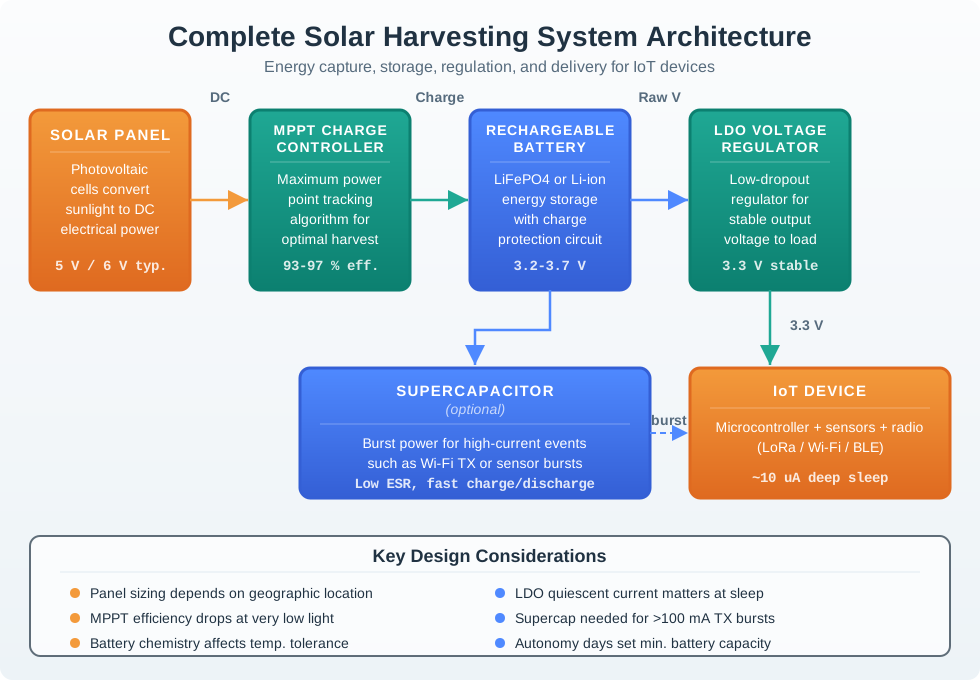
Harvesting Architecture

Photovoltaic adds a distinct review condition; cells convert adds a distinct review condition; sunlight to DC adds a distinct review condition.

  • The ongoing harvesting architecture analysis should preserve all three.
Solar energy harvesting system architecture: a photovoltaic panel feeds an MPPT charge controller that charges storage, with regulation delivering a stable rail to the IoT load.
iotclass.org

Major section

Load Policy

Converter detail matters most when the source is weak and the store is nearly empty.

  • A harvesting power-management IC must cold-start at the measured source voltage, tolerate the source impedance, regulate or gate the load, and expose a useful power-good decision before firmware assumes energy is available.
  • For small stores, the charge path itself can waste a surprising amount of energy.
  • Charging a storage capacitor in one large voltage jump loses roughly 1/2 x C x V^2 in the source and switch path.
  • Step charging splits the rise into smaller voltage increments, so each transfer has a smaller voltage difference and less loss.
iotclass.org

Major section

Source Reality Map

Source type alone does not tell us how much energy reaches storage.

  • Light is converted across cell area, but current must still travel through that collection grid; the chipped and obscured patches make the effects of damaged or shaded area tangible.
  • Harvesting technologies are not interchangeable.
  • Each source has a different failure mode.
A photovoltaic panel converts incident light directly at each cell, but the useful power available to an IoT node still depends on irradiance, angle, shading, temperature, and the converter's operating point. Photo: David Shankbone, CC BY 3.0
iotclass.org

Major section

Source Reality Map (continued)

The photograph therefore supports the chapter's next move from a named “solar panel” to a measured source under its real angle, condition, temperature, and converter load.

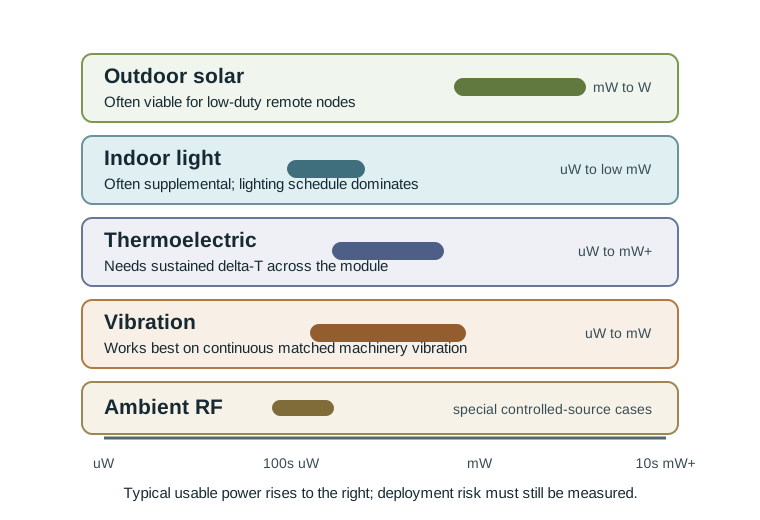
  • A hidden assumption between 100s uW and mW could overturn source reality map.
  • It sets the usable limit for source reality map.
  • Real delta-T across the module is much lower than surface-to-air temperature difference.
  • Ambient RF is usually too weak for normal sensor operation.
iotclass.org

Major section

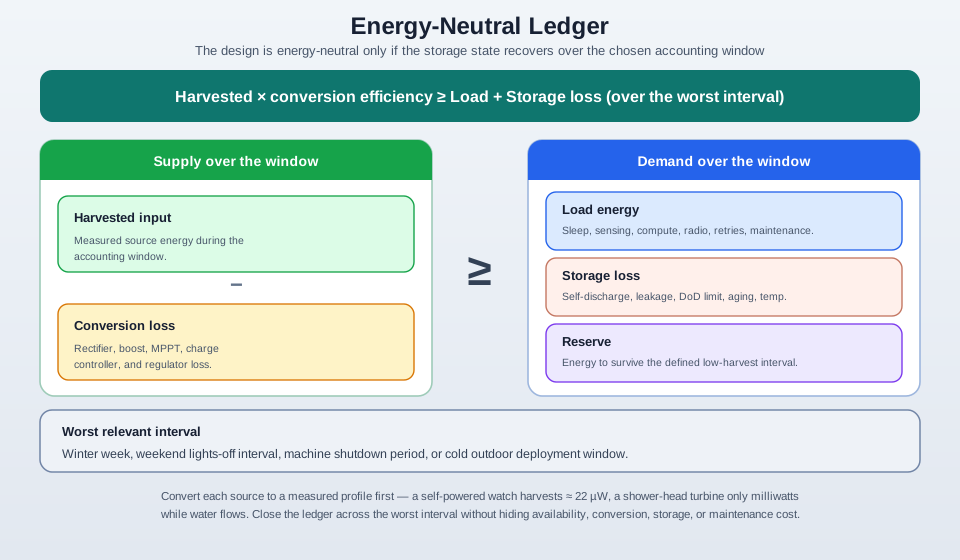
Energy-Neutral Ledger

The design is energy-neutral only if the storage state recovers over the chosen accounting window.

  • The visual next names: Harvested input to show where the review establishes the starting condition; accounting window finally adds a distinct review condition.
  • They keep energy-neutral ledger tied to observable evidence.
Energy-neutral ledger: harvested energy times conversion efficiency must be at least the load energy plus storage loss over the worst interval, with a reserve to survive the low-harvest window.
iotclass.org

Major section

Phoebe's Field Notes: Why Harvesting Is an Energy Balance, Not a Peak Rating
The mathematical gist.: The chapter's sleep, sensing, and radio states total 2.02 mAh/day, or 6.67 mWh/day at 3.3 V.

  • With two harvest hours and 80% charger efficiency, the source must supply at least 4.19 mW during those hours.

Numbers to remember

3.3 Vand radio states total 2.02 mAh/day, or 6.67 mWh/day at 3.3 V.
4.19 mWthe source must supply at least 4.19 mW during those hours.
iotclass.org

Major section

Communication Under Random Energy Dynamics

Source variability changes when the node can transmit, not only how much energy it uses per day.

  • A conventional battery-powered radio often starts from a fixed transmit-power budget.
  • The communication design must therefore respect both the channel and the storage state.
  • Finite storage changes the question.
  • Remotely powered communication adds one more coordination boundary.

Why it matters

If B_{\max} clips arrivals, the useful transmit budget is closer to the average of min(E_t, B_{\max}) because excess harvest is spilled instead of saved.

iotclass.org

Major section

Worked Example: Outdoor Solar Sensor

The review is not complete until the team measures the actual panel at the site, verifies charger cold start, and tests recovery after a multi-day dark interval.

  • Sleep: asleep almost the full hour between hourly reports — the 2-second radio burst dominates.

Why it matters

Design decision: The first sizing result is small because the node is already low-power.

iotclass.org

Major section

Storage Design

Storage must absorb the harvester's irregular supply and still serve the load's pulses.

  • The printed ratings describe individual parts, while the busbars, housings, and terminals reveal what changes when cells become a higher-energy assembly.
Commercial supercapacitors range from small cells to packaged modules; they tolerate rapid charge and discharge well, but leakage and low energy density limit how long they can bridge a harvesting gap. Photo: Sechsa, CC0
iotclass.org

Deck summary

Key takeaways

A woodland monitor runs well in summer sun and stops during a wet week under leaves.

  • Harvesting can extend life; it does not create unlimited power or remove upkeep.
  • Harvesting helps only after the load is already low-power.
  • Photovoltaic adds a distinct review condition; cells convert adds a distinct review condition; sunlight to DC adds a distinct review condition.
  • Converter detail matters most when the source is weak and the store is nearly empty.
iotclass.org

Retrieval practice

Recall check

Battery Bruno says: answer from memory, then check your reasoning.

Q1A solar-powered node works on a bright afternoon. What condition should determine its storage and workload plan?

AThe worst interval of available energy
BThe best observed harvest without converter losses
CThe presence of a panel as proof of energy neutrality
DThe sensor’s sampling code without storage aging
Show answer

Answer: A The chapter designs around intermittent supply and the workload’s continuing consumption.

Q2A photovoltaic panel supplies a harvesting node. Which architecture matches the chapter’s path?

ASource connected as a substitute for storage planning
BStorage without accounting for converter behavior
CA load schedule independent of the energy system
DSource, charge conversion, storage, and regulated load
Show answer

Answer: D The diagram couples collection, charging, storage, and the IoT load policy.

iotclass.org

Print reference

Answers

Answer key.

  1. A · The chapter designs around intermittent supply and the workload’s continuing consumption.
  2. D · The diagram couples collection, charging, storage, and the IoT load policy.
iotclass.org