Energy & Power · Study deck

Battery-Life Target Contracts

Picture a pasture sensor expected to run for five years.

Battery Bruno is your guide for this deck.

awareconsiderations
Battery Bruno, the module guide, in a scene from this chapter.
iotclass.org

After studying this chapter

Learning objectives

You will be able to:

  • Convert a battery-life target into a maximum average-current budget.
  • Build a current ledger for sleep, sensing, compute, radio, and exception states.
  • Explain why source derating, peak current, and end-of-life voltage matter.
  • Choose design changes based on the dominant energy drain rather than intuition.
iotclass.org

Major section

Start With a Battery-Life Contract

Firmware means the software stored on a device.

  • Budget the Bad Day, Not Only the Quiet Hour: Picture a pasture sensor expected to run for five years.
  • On the bench it sleeps well, but a weak field link makes it wake, search, and send again.
  • A protocol means the agreed rules used to exchange messages.

Key terms

If any part
If any part is vague, the final lifetime claim will be vague too.
iotclass.org

Major section

Start With a Battery-Life Contract (continued)
A lifetime claim based only on the calm average can fail in the first difficult season.

  • The largest drain should lead the next design change, and every estimate should keep its measured condition.
  • This budget does not guarantee field life or replace ageing tests.
  • The deeper sections show average-current arithmetic, source resistance, duty changes, network trade-offs, derating, and release evidence for the final claim.
iotclass.org

Major section

The Energy Design Gate

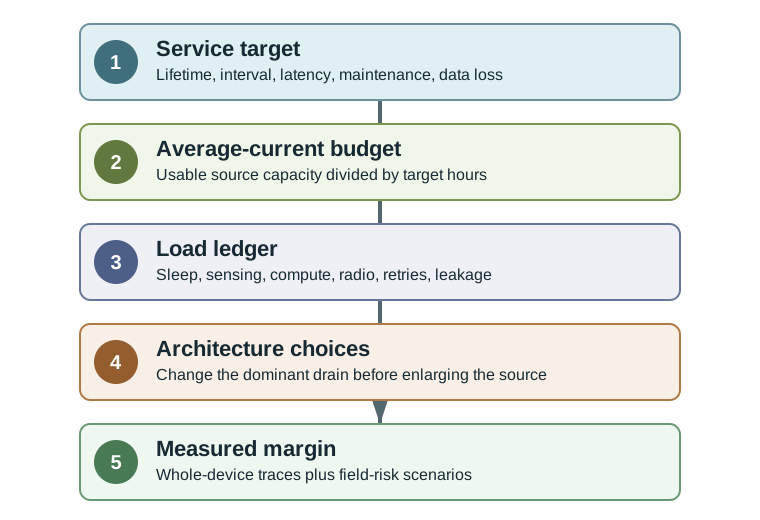
In particular, Average-current budget must be reconciled with: Load ledger before the result can guide implementation.

  • With those jobs separated, the chapter's the energy design gate claim remains testable.
Energy-aware design gate showing lifetime target, average-current budget, load ledger, architecture choices, and measured margin.
iotclass.org

Major section

Build the Load Ledger

A useful energy review separates states by current and time.

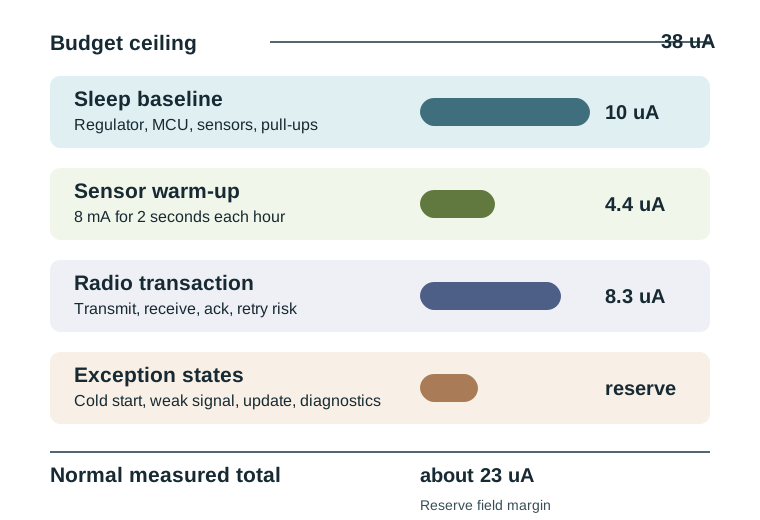
  • The example below uses one hourly sensing and reporting cycle.
  • The visible relationship between 38 uA and: Sleep baseline identifies what must remain true in the real system.
  • The ledger shows why both sleep and active states matter.

Key terms

Sleep
Sleep is the largest single state in this example, but the two short active states still use more than half of the available margin.
Energy load ledger showing sleep baseline, sensor warm-up, radio transaction, exception mode, and remaining margin.
iotclass.org

Major section

Protocol and Workload Decisions

The right choice trades lowest cost against highest reliability; it is not free to get both.

  • Communication energy depends on the workload, not only the protocol name.
  • A protocol that is efficient for one-byte status messages may be inefficient for firmware updates, and a protocol with low transmit current may still waste energy if it retries often in the deployment environment.
  • The common "send less, sleep more" rule is useful, but it is incomplete.
iotclass.org

Major section

Measurement Loop

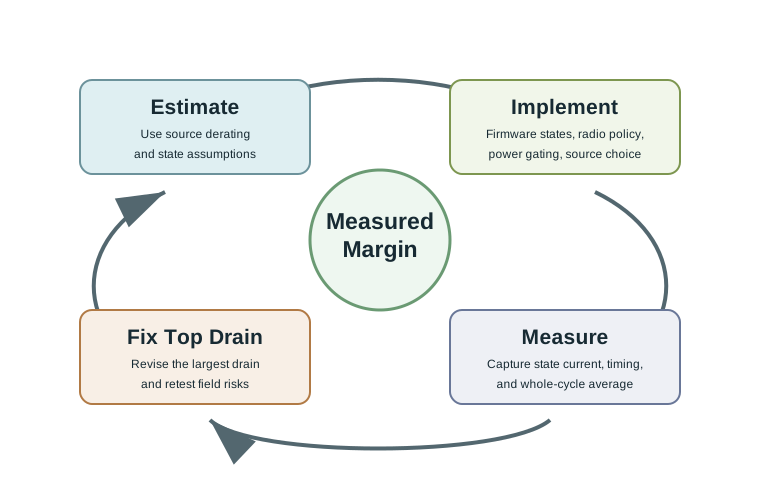
A spreadsheet can guide design, but a power trace catches firmware states, board leakage, retry behavior, and timing that the spreadsheet missed.

  • At this point, measurement loop needs an inspectable chain rather than another rule of thumb.
  • The first establishes the starting condition, the second adds a distinct review condition, and the third adds a distinct review condition.
Energy measurement loop showing estimate, implement, measure, compare, fix the dominant state, and preserve margin.
iotclass.org

Major section

Energy Design Review Checklist

Requirement: The service target states lifetime, reporting interval, latency, storage behavior, maintenance model, and acceptable data loss.

  • Budget: The source capacity is derated, and the maximum average-current budget is written as a number in uA or mA.
  • Ledger: The current ledger includes sleep, active work, radio behavior, exceptions, indicators, pull-ups, regulators, and disabled-but-powered peripherals.
  • Peak Load: Radio bursts and startup current do not pull the supply below the device minimum voltage at end of life.
iotclass.org

Major section

A Coin Cell's Real Limit Is Its Resistance, Not Its mAh

Average capacity can make a coin-cell design look comfortable while a short radio pulse still causes brownout.

  • Those markings support part selection and polarity checks, but the running design still needs aged internal resistance and pulse-current measurements to prove the radio stays above cutoff.
A CR2032's wide, thin case stores about 220 mAh, but the small internal electrode area and rising cell resistance limit how hard it can be pulsed. The engraved plus side also matters during assembly: reversing this cell is a physical fault, not a software setting. Photo: Krzysztof Woznica (KyloDee), Public domain
iotclass.org

Major section

A Coin Cell's Real Limit Is Its Resistance, Not Its mAh (continued)

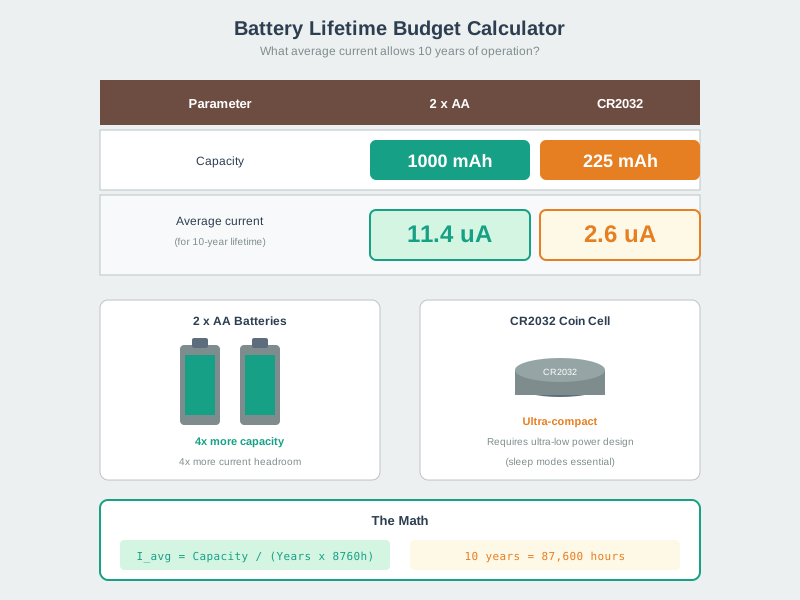
The risk in a coin cell's real limit is its resistance, not its mah lies between Parameter and 2 x AA.

  • The map at Figure: A CR2032 budget starts with a very small exposes that gap so the next design step can use a bounded conclusion rather than a slogan.
  • The first concrete marker in Figure: A CR2032 budget starts with a very small is Parameter: it adds a distinct review condition.
  • 2 x AA changes the question by adds a distinct review condition, and: CR2032 completes it by adds a distinct review condition.
iotclass.org

Deck summary

Key takeaways

Firmware means the software stored on a device.

  • A lifetime claim based only on the calm average can fail in the first difficult season.
  • In particular, Average-current budget must be reconciled with: Load ledger before the result can guide implementation.
  • A useful energy review separates states by current and time.
  • The right choice trades lowest cost against highest reliability; it is not free to get both.
iotclass.org

Retrieval practice

Recall check 1 of 5

Battery Bruno says: answer from memory, then check your reasoning.

Q1A node has a 40 uA average-current budget. Its measured cycle is: 12 uA sleep baseline, 8 mA sensor warm-up for 1 second every 10 minutes, and 100 mA radio transmit for 0.1 seconds every 10 minutes. Which change most directly brings the design under budget?

AReduce sensor warm-up from 1 second to 0.2 seconds if the reading remains valid
BIncrease battery capacity by 10 percent without changing the load ledger
CReduce sleep current by 1 uA and leave every active state unchanged
DSend two radio messages per cycle so each message can be smaller
Show answer

Answer: A Energy review starts with the measured ledger.

iotclass.org

Retrieval practice

Recall check 2 of 5

Battery Bruno says: answer from memory, then check your reasoning.

Q2Place each energy-design record where it lives so you can trace a service promise through the current budget to measured margin.

AService target
BTheme setting
CMarketing claim
DUnused footer
Show answer

Answer: A Link intent, complete load accounting, and measurement so you can reject a lifetime estimate that lacks service or reserve evidence.

iotclass.org

Retrieval practice

Recall check 3 of 5

Battery Bruno says: answer from memory, then check your reasoning.

Q3A CR2032-powered beacon resets during radio transmissions while a coulomb counter says over half the rated 220 mAh remains. What is the most likely cause?

AThe coulomb counter proves the cell is empty and the radio event is incidental.
BThe firmware sleep current is too low for the regulator to hold the rail.
CPulse current through internal resistance is sagging the rail below brownout.
DThe 220 mAh label guarantees stable voltage until all charge is used.
Show answer

Answer: C The 220 mAh label is a low-drain figure.

iotclass.org

Retrieval practice

Recall check 4 of 5

Battery Bruno says: answer from memory, then check your reasoning.

Q4A coin cell near end of life shows an internal resistance of about 40 ohm. A radio pulse draws 10 mA. Approximately how much does the terminal voltage sag during the pulse, and does the capacity label protect against it?

AAbout 0.04 V, and yes; the label keeps the pulse rail essentially fixed.
BAbout 0.4 V, and no; the label is an energy figure, not a pulse-sag guarantee.
CAbout 4 V, and no; the pulse exceeds the cell voltage before resistance matters.
DAbout 0.4 V, and yes; remaining mAh prevents brownout during the pulse.
Show answer

Answer: B

iotclass.org

Retrieval practice

Recall check 5 of 5

Battery Bruno says: answer from memory, then check your reasoning.

Q5Two CR2032 designs share the same average current and the same 220 mAh cell, but design A has a 2.0 V brownout and design B has a 2.4 V brownout. Which lasts longer under a pulsed radio load, and why?

ADesign B, because its higher cutoff avoids deep discharge.
BDesign A, because its lower brownout tolerates more sag.
CThey last exactly the same, because they share the same capacity and average current.
DNeither works, because coin cells cannot power radios.
Show answer

Answer: B Usable capacity for a pulsed load is set by when the sagging pulse voltage hits brownout.

iotclass.org

Print reference

Answers

Answer key.

  1. A · Energy review starts with the measured ledger.
  2. A · Link intent, complete load accounting, and measurement so you can reject a lifetime estimate that lacks service or reserve evidence.
  3. C · The 220 mAh label is a low-drain figure.
  4. B
  5. B · Usable capacity for a pulsed load is set by when the sagging pulse voltage hits brownout.
iotclass.org