Energy & Power · Study deck
Energy-Aware Case Studies
Picture two field sensors with the same battery where one lasts twice as long.
Battery Bruno is your guide for this deck.

After studying this chapter
Learning objectives
You will be able to:
- Explain: A case study is useful when it tells you what was measured, what was assumed, and what changed after deployment.
- Explain: Initial symptom: Firmware entered deep sleep correctly, but whole-board sleep current was far above the estimate.
- Explain: Transferable pattern: When a field sensor fails a battery target, first inspect the full-period trace.
- Explain: That point is the next premise in the cell discharges even when the sensor sleeps.
Major section
Start With the Evidence Record
Duty cycle means the share of time a device spends in an active state.
- This check explains selected workloads and conditions, not every deployment.
- The deeper cases examine trade-offs, measurement limits, maintenance, and transferable lessons.
- A case study is useful when it tells you what was measured, what was assumed, and what changed after deployment.
Major section
Case Study 1: Field Soil Sensor
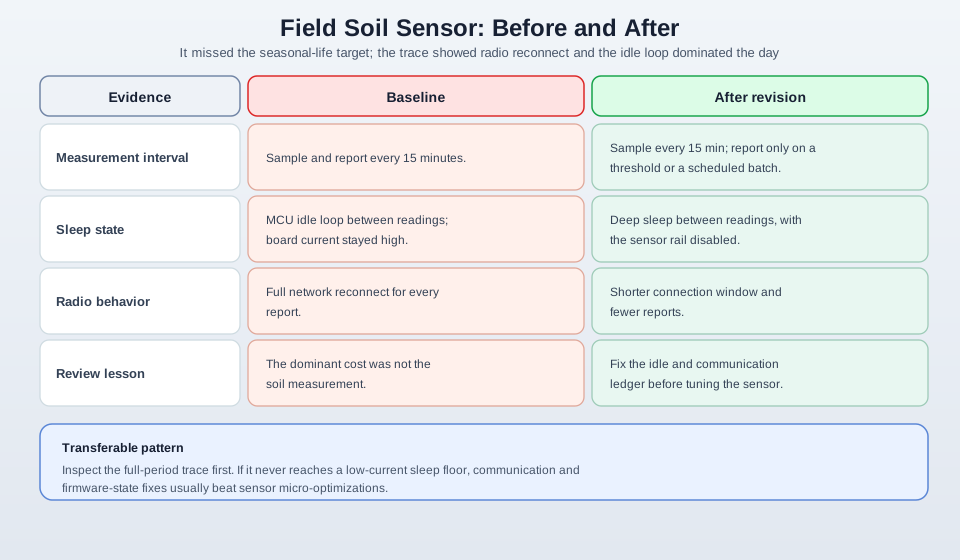
Shorter connection window and fewer reports.
- The dominant cost was not the soil measurement.
- If Baseline cannot be connected to: After revision, the surrounding conclusion is premature.
- Transferable pattern: When a field sensor fails a battery target, first inspect the full-period trace.
Major section
Case Study 4: Board Leakage Failure
Initial symptom: Firmware entered deep sleep correctly, but whole-board sleep current was far above the estimate.
- The MCU was not the problem; support circuitry stayed powered.
- Regulator current: The regulator quiescent current was larger than the MCU sleep current.
- Transferable pattern: A low-power MCU does not make a low-power product.
Major section
Pattern Map
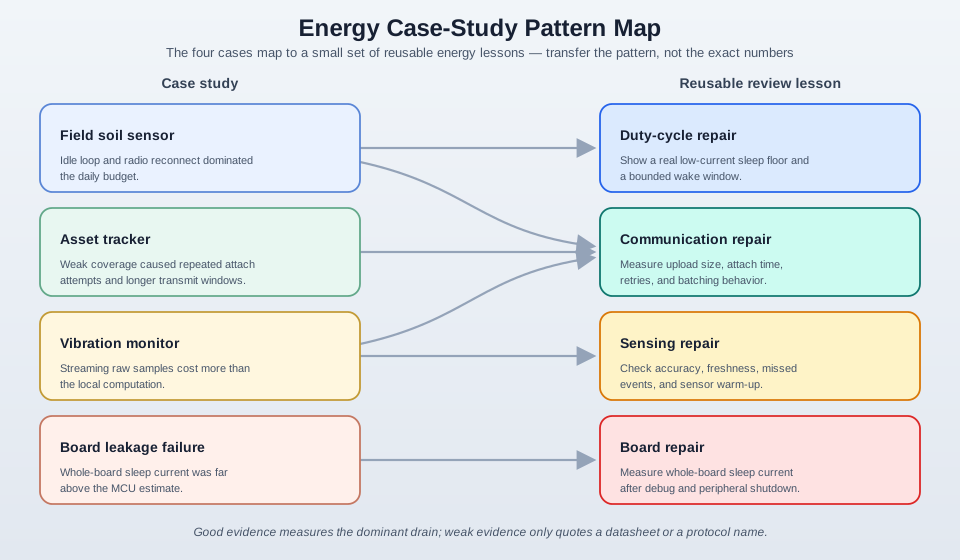
Current trace shows a real low-current sleep floor and bounded wake window.
- Upload size, attach time, retries, signal quality, and batching behavior are measured.
- Accuracy, freshness, missed events, and sensor warm-up are checked.
- Whole-board sleep current is measured after debug and peripheral shutdown.
Major section
The Cell Discharges Even When The Sensor Sleeps
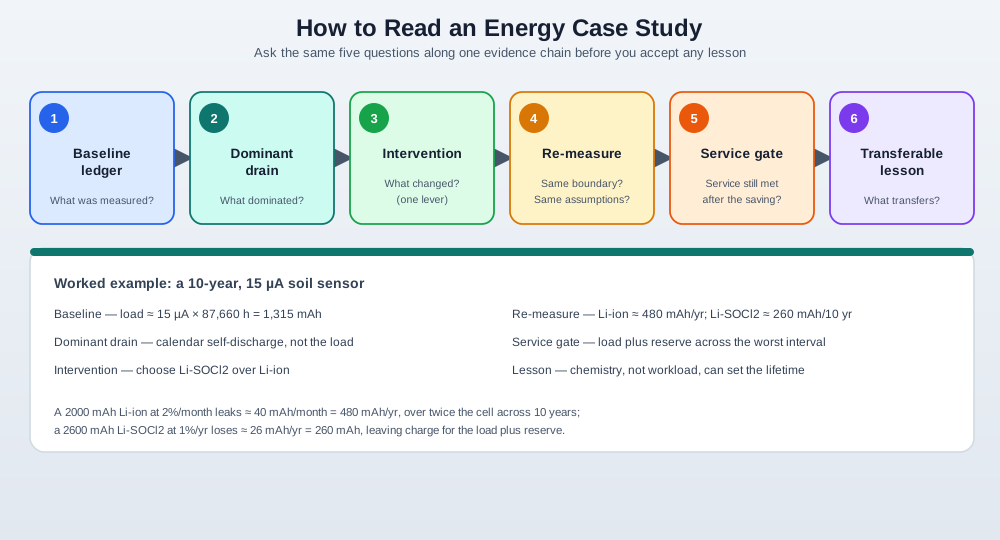
Its Baseline and ledger labels identify the conditions that must be checked together.
- That point is the next premise in the cell discharges even when the sensor sleeps.
Deck summary
Key takeaways
Duty cycle means the share of time a device spends in an active state.
- Shorter connection window and fewer reports.
- Initial symptom: Firmware entered deep sleep correctly, but whole-board sleep current was far above the estimate.
- Current trace shows a real low-current sleep floor and bounded wake window.
- Its Baseline and ledger labels identify the conditions that must be checked together.
Retrieval practice
Recall check 1 of 6

Battery Bruno says: answer from memory, then check your reasoning.
Q1A case study claims multi-year battery life after changing protocols, but provides no current trace, retry count, or payload size. What is the strongest review response?
Show answer
Answer: B A credible energy case study exposes the same evidence boundary before and after the change: payload, timing, retries, sleep current, and service result.
Retrieval practice
Recall check 2 of 6

Battery Bruno says: answer from memory, then check your reasoning.
Q2A vibration monitor saves energy by extracting features locally before upload. Which lesson is safest to transfer to a new design?
Show answer
Answer: C A case-study lesson transfers when the underlying evidence pattern matches: data size, compute cost, service requirement, and measurement boundary.
Retrieval practice
Recall check 3 of 6

Battery Bruno says: answer from memory, then check your reasoning.
Q3Place each case-study record where it lives so you can separate measured evidence from a targeted fix and a transferable service result.
Show answer
Answer: A Follow measure, change, and transfer so you can tell a demonstrated energy improvement from an attractive but unproven claim.
Retrieval practice
Recall check 4 of 6

Battery Bruno says: answer from memory, then check your reasoning.
Q4A soil sensor must run unattended for 10 years drawing an average of about 15 uA. Why is a standard Li-ion cell a poor chemistry choice here, even at a generous capacity?
Show answer
Answer: A On a 2000 mAh cell, 2%/month is about 40 mAh/month, an equivalent leak near 55 uA - several times the 15 uA load.
Retrieval practice
Recall check 5 of 6

Battery Bruno says: answer from memory, then check your reasoning.
Q5A 2000 mAh Li-ion cell self-discharges at about 2% per month. Modeled as a constant parallel leak, what equivalent current does that represent?
Show answer
Answer: A 2% of 2000 mAh is 40 mAh lost per month; dividing by about 730 hours gives 0.055 mA, or 55 uA.
Retrieval practice
Recall check 6 of 6

Battery Bruno says: answer from memory, then check your reasoning.
Q6A design budgets a Li-SOCl2 self-discharge equivalent of 3 uA measured at 20 C, but the sensor is sealed in a dark enclosure that runs near 40 C in summer. What is the most defensible correction to the self-discharge budget?
Show answer
Answer: A A 20 C to 40 C rise spans two 10 C steps, so the equivalent leak can be on the order of four times the bench figure.
Print reference
Answers 1 of 2
Answer key.
- B · A credible energy case study exposes the same evidence boundary before and after the change: payload, timing, retries, sleep current, and service result.
- C · A case-study lesson transfers when the underlying evidence pattern matches: data size, compute cost, service requirement, and measurement boundary.
- A · Follow measure, change, and transfer so you can tell a demonstrated energy improvement from an attractive but unproven claim.
Print reference
Answers 2 of 2
Answer key.
- A · On a 2000 mAh cell, 2%/month is about 40 mAh/month, an equivalent leak near 55 uA - several times the 15 uA load.
- A · 2% of 2000 mAh is 40 mAh lost per month; dividing by about 730 hours gives 0.055 mA, or 55 uA.
- A · A 20 C to 40 C rise spans two 10 C steps, so the equivalent leak can be on the order of four times the bench figure.