Design Methodology · Study deck
End-to-End Testing: Claims and Layers
A green unit test does not prove that a field alert reaches a person.
Blueprint Bina is your guide for this deck.
After studying this chapter
Learning objectives
You will be able to:
- Convert IoT requirements into traceable verification and validation evidence.
- Choose the right test layer for firmware, hardware, network, cloud, environmental, security, and field risks.
- Separate fast regression checks from slower release-gate evidence.
- Define acceptance criteria, test fixtures, data capture, and defect rules before a test begins.
Major section
Start With the Decision · Start With the Release Claim
Telemetry is a time-linked record of a device or process.
- A green unit test does not prove that a field alert reaches a person.
- Each release claim needs a test at the layer where it can fail.
- Firmware is the software stored inside a device.
Major section
Validate Claims at the Right Layer
IoT validation fails when every claim is pushed through the same test layer.
- A unit test can prove a parser rejects malformed MQTT payloads.
- A field pilot can reveal real installation behavior.
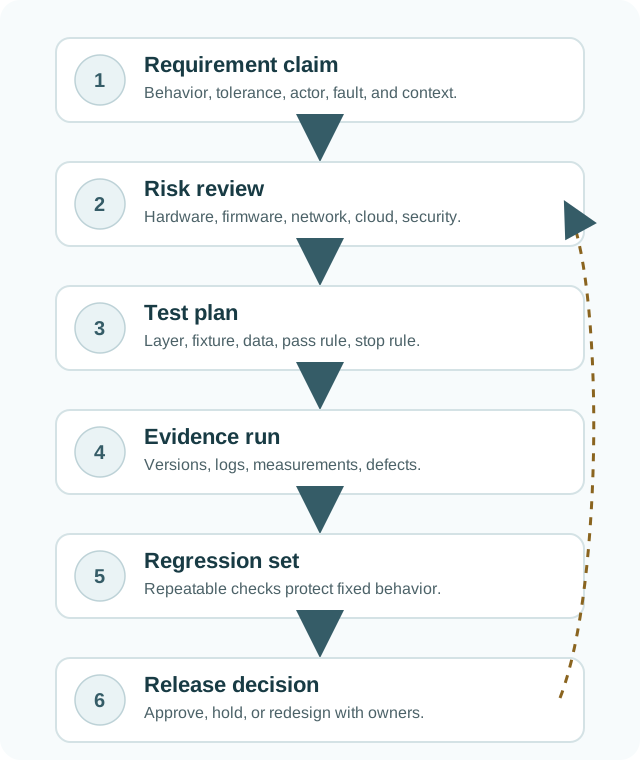
- A test route starts with the claim, not the tool.
- Firmware logic may fit Vitest, pytest, GoogleTest, or Zephyr Twister.
Major section
Validate Claims at the Right Layer (continued)
This route prevents validation from becoming a pile of disconnected screenshots.
- The test plan then chooses the layer, fixture, data, pass rule, and stop rule before the run begins.
- The evidence run saves versions, logs, measurements, and defects; the regression set guards behavior after fixes.
- Unit tests can protect queue serialization and duplicate-ID logic.
Major section
Validate Claims at the Right Layer (continued)
The test plan then names the layer, fixture, data, acceptance rule, stop rule, and evidence that must be saved before anyone sees the result.
- This order prevents a green parser test from being used as proof of cold-start, weak-link, or field recovery behavior.
- Driver timing may need a logic analyzer, bus capture, and hardware-in-the-loop fixture.
- Fleet behavior may need staged rollout telemetry, broker logs, OpenTelemetry traces, and support-runbook checks.
Major section
Validate Claims at the Right Layer (continued)
For a battery gateway, "messages are delivered after reconnect" is not one test.
- Shift next to: Risk review because it uses: Risk review to expose invalidating risk, and close on: Hardware, firmware, network, cloud, security, which uses: Hardware, firmware, network, cloud, security to expose invalidating risk.
- Integration tests can use Mosquitto or EMQX to force disconnects and retained sessions.
- The release decision should show the chain from claim to evidence.
Major section
Validate Claims at the Right Layer (continued)
This route carries: Validate Claims at the Right Layer from Testing and validation starts with traceable requirements, builds layered evidence, and ends with a documented release decision into the project record.
- System tests can capture firmware logs, MQTT broker logs, packet traces, cloud records, and dashboard state during network loss.
- Field validation can show whether real installers, weak Wi-Fi, and support workflows expose a different failure.
- Physical evidence: HIL, bench instruments, RF checks, current traces, environmental runs, and enclosure trials test the assembled device.
- Operational evidence: staged rollout, monitoring, incident drills, rollback, privacy checks, and support workflows decide whether release is responsible.
Major section
Choose Tools by Failure Mode
GoogleTest can protect C++ conversion logic.
- Vitest can protect web-app state and widget parsing. Pytest can drive Python services and hardware scripts.
- Robot Framework can orchestrate end-to-end flows.
- Zephyr Twister can exercise firmware tests across board configurations.
- Renode or QEMU can make firmware and system-image checks repeatable before scarce hardware is available.
Major section
IoT Release Risk Is Cross-Layer
A connected device is usually a state machine spread across firmware, hardware, radio, cloud services, mobile apps, and operations.
- A duplicate-message defect might involve MQTT QoS behavior, packet loss, retained sessions, queue IDs, timestamp ordering, backend idempotency, and dashboard refresh.
- Evidence also has timing and observability limits.
- Regression design is another hidden layer.
Major section
IoT Release Risk Is Cross-Layer (continued)
A cloud metric can show ingestion latency, but it may not distinguish RF loss from backend throttling.
- A failed OTA update might involve bootloader slots, image signatures, battery state, flash wear, interrupted downloads, schema migration, and rollback rules.
- Validation has to combine artifacts at the same scenario boundary.
- The release decision is a systems decision.
Major section
IoT Release Risk Is Cross-Layer (continued)
The reviewer should see which claim was tested, which state was forced, which logs and measurements were captured, which defect or waiver remains, and which owner can act if the field signal changes.
- A green dashboard without this chain can hide a skipped environmental run, a quarantined security test, or a failure that only appears during reconnect.
- A firmware log can prove the device queued a reading, but it may not prove the broker accepted it once.
- A current trace can show sleep entry, but it may not prove the same behavior at low temperature or after an interrupted OTA update.
Major section
IoT Release Risk Is Cross-Layer (continued)
Waivers should be treated as active risk objects, not polite notes.
- The first failing scenario is often expensive: a bench setup, a field pilot, or a chamber run.
- After the root cause is understood, convert the smallest credible part into a repeatable guard.
- If the waiver has no expiry or no owner, it is not release evidence; it is hidden debt.
Major section
What This Chapter Adds · It Worked Once Is Not Validation
Testing and validation asks whether the complete evidence set is strong enough to release or whether the design must loop back.
- Layer Use the cheapest useful test Unit tests, integration tests, HIL, environmental checks, security tests, and field trials answer different questions.
- Stress Test the deployment context Power, radio conditions, temperature, enclosure, firmware timing, updates, and cloud dependencies must be represented.
- Gate Release on evidence Green dashboards are not enough.
Major section
Verification, Validation, and Acceptance · Keep the Question Visible
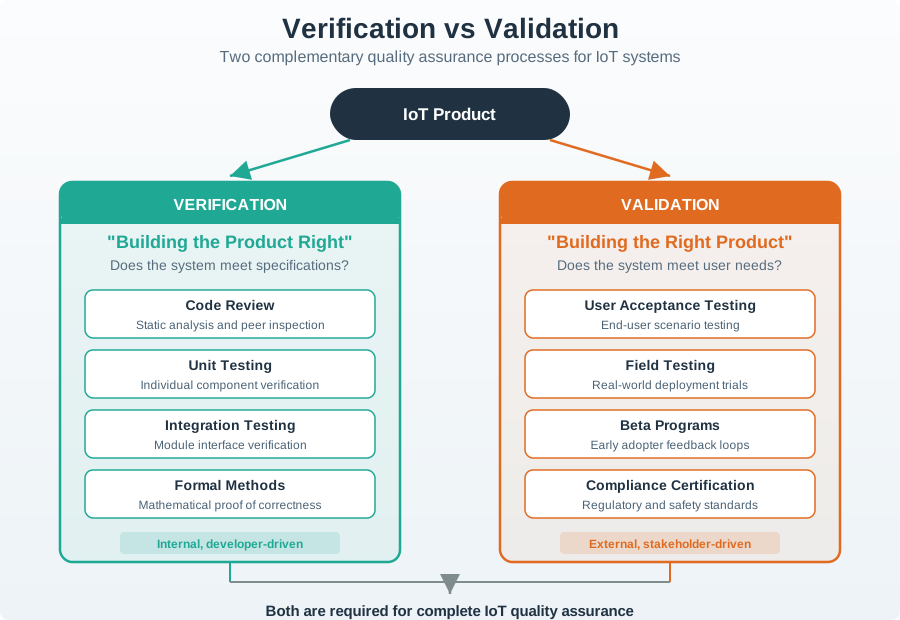
The firmware samples a sensor at the configured interval and rejects invalid readings.
- Unit tests, integration tests, register traces, static analysis, and reviewed test vectors.
- The installed node reports useful data when temperature, battery state, RF path, and enclosure effects are realistic.
- System tests, environmental runs, field trials, user observation, and operational telemetry.
Major section
Build the Traceability Matrix · Choose the Right Test Layer
A traceability matrix is a compact map from requirement to evidence.
- It keeps the test program from becoming a pile of disconnected scripts and screenshots.
- REQ-PWR-04: node wakes, samples, transmits, and returns to sleep within the defined state budget.
- "Battery should last long.".
Deck summary
Key takeaways
Telemetry is a time-linked record of a device or process.
- IoT validation fails when every claim is pushed through the same test layer.
- This route prevents validation from becoming a pile of disconnected screenshots.
- The test plan then names the layer, fixture, data, acceptance rule, stop rule, and evidence that must be saved before anyone sees the result.
- For a battery gateway, "messages are delivered after reconnect" is not one test.
Retrieval practice
Recall check 1 of 5

Blueprint Bina says: answer from memory, then check your reasoning.
Q1A release dashboard shows green checks but no link to product requirements. What should the validation record add?
Show answer
Answer: B Traceability makes a green result reviewable.
Retrieval practice
Recall check 2 of 5
Blueprint Bina says: answer from memory, then check your reasoning.
Q2A field test starts without a failure threshold or capture plan. What must be set before running it?
Show answer
Answer: A Prewritten rules make the result reviewable and repeatable.
Retrieval practice
Recall check 3 of 5
Blueprint Bina says: answer from memory, then check your reasoning.
Q3A release packet is green except that a required cold-start chamber run was skipped. What should the gate decide?
Show answer
Answer: A The release record must expose the missing physical evidence and its owner.
Retrieval practice
Recall check 4 of 5
Blueprint Bina says: answer from memory, then check your reasoning.
Q4A parser unit test passes, and the team claims the battery node survives weak Wi-Fi. What evidence is missing?
Show answer
Answer: B A parser test cannot establish cold-start, radio, queue, and outage behavior.
Retrieval practice
Recall check 5 of 5
Blueprint Bina says: answer from memory, then check your reasoning.
Q5A field pilot found a duplicate alarm after reconnect. Which test plan protects future changes?
Show answer
Answer: B Fast regression checks and slower release evidence have distinct roles.
Q6A board intermittently misses an I2C interrupt during boot. Which instrument matches the boundary?
Show answer
Answer: A The chapter uses logic traces for interfaces and boot sequencing.
Print reference
Answers
Answer key.
- B · Traceability makes a green result reviewable.
- A · Prewritten rules make the result reviewable and repeatable.
- A · The release record must expose the missing physical evidence and its owner.
- B · A parser test cannot establish cold-start, radio, queue, and outage behavior.
- B · Fast regression checks and slower release evidence have distinct roles.
- A · The chapter uses logic traces for interfaces and boot sequencing.