Design Methodology · Study deck

End-to-End Testing: Field Conditions and Evidence

A battery device can pass on a bench and fail after a cold radio retry.

Blueprint Bina is your guide for this deck.

testingvalidationtradeoff
iotclass.org

After studying this chapter

Learning objectives

You will be able to:

  • Explain: That progression connects A release gate approves, holds, waives, or redesigns only after traceability, defects, regression proof, release environment, recovery readiness, and ownership are explicit to the next: Release Gate Evidence check.
  • Explain: The pair turns A release gate approves, holds, waives, or redesigns only after traceability, defects, regression proof, release environment, recovery readiness, and ownership are explicit into something the team can verify.
  • Explain: GoogleTest, pytest, or Vitest checks that malformed sensor payloads are rejected, timestamps are ordered, units are normalized, and the alarm state machine moves through normal, warning, alarm, mute, and clear states.
iotclass.org

Major section

Phoebe's Field Notes: Why a Battery-Budget Test Needs More Than mAh × V

The mathematical gist.: A 2400 mAh, 3.6 V cell stores 8.64 Wh by nameplate, but a 120 mA pulse through 3 Ω sags 0.360 V.

  • After an explicit 80% derate, 1920 mAh at an 80 µA average gives 24,000 hours, or 2.74 years.

Numbers to remember

3.6 V3.6 V cell stores 8.64 Wh by nameplate
8.64 Wh3.6 V cell stores 8.64 Wh by nameplate
iotclass.org

Major section

Release Gate Evidence
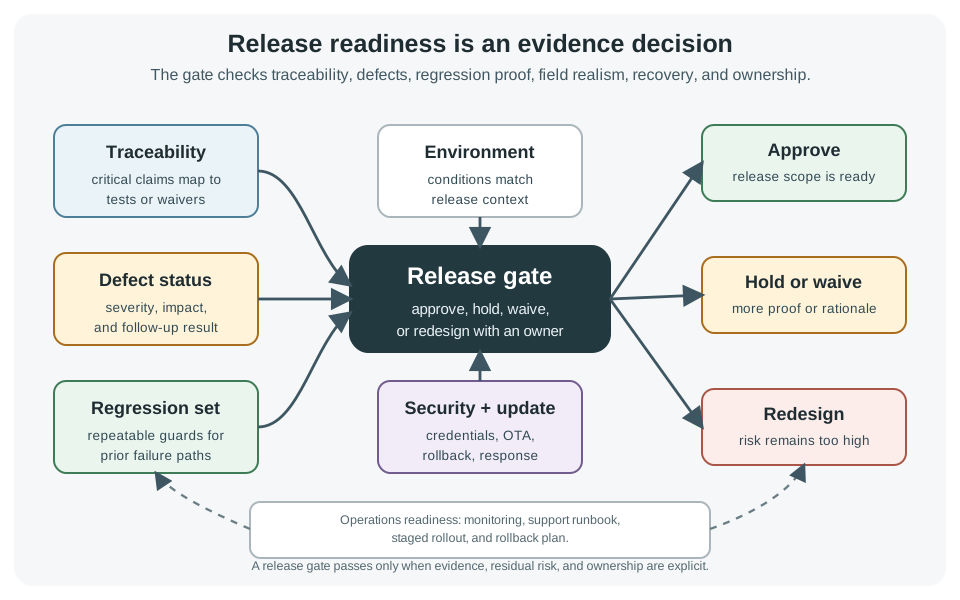
The pair turns A release gate approves, holds, waives, or redesigns only after traceability, defects, regression proof, release environment, recovery readiness, and ownership are explicit into something the team can verify.

  • Critical requirements map to passed tests or accepted waivers.
  • Important claims have no test, no owner, or no result.

Key terms

Critical defects
Critical defects are closed with a repeated failing scenario or equivalent regression check; remaining defects have severity, impact, owner, and decision.
Known failures
Known failures are hidden in notes or deferred without review.
A release gate approves, holds, waives, or redesigns only after traceability, defects, regression proof, release environment, recovery readiness, and ownership are explicit.
iotclass.org

Major section

Release Gate Evidence (continued)

That progression connects A release gate approves, holds, waives, or redesigns only after traceability, defects, regression proof, release environment, recovery readiness, and ownership are explicit to the next: Release Gate Evidence check.

  • Critical defects are closed with a repeated failing scenario or equivalent regression check; remaining defects have severity, impact, owner, and decision.
  • Known failures are hidden in notes or deferred without review.
  • Fixes added or updated repeatable tests that run in the right pipeline.
iotclass.org

Major section

Release Gate Evidence (continued)

A defect was fixed manually but has no guard against returning.

  • The product is approved from a clean lab run only.
  • Credential flow, update flow, rollback, logging, and incident response are tested for release scope.
  • OTA and recovery behavior were not tested under failure conditions.
  • Monitoring, support runbooks, staged rollout, and rollback plan are ready.
iotclass.org

Major section

Plan Tests Before Running Them

A test plan does not need to be long.

  • It needs to prevent ambiguity when results arrive.
  • Results cannot be reproduced because the environment was not recorded.
  • Disconnect network for defined periods during sampling, transmit, update, and idle states.
  • Pass if all queued readings are delivered once, timestamps remain ordered, and power returns to sleep budget.

Why it matters

Running a test because the tool exists, not because a requirement needs evidence.

iotclass.org

Major section

Metrics Without False Confidence

Metrics should guide review, not replace judgment.

  • A large number can still be meaningless if the test does not assert the right behavior.
  • Assertions are weak, negative paths are absent, or hardware effects are outside the test.
  • Skipped, quarantined, or non-critical tests hide the risky areas.
  • Helps track triage load and repeated failure areas.

Key terms

Late field failures
Late field failures are excluded from the metric.
iotclass.org

Major section

Incremental Examples

A first validation pass can protect isolated firmware or service logic.

  • GoogleTest, pytest, or Vitest checks that malformed sensor payloads are rejected, timestamps are ordered, units are normalized, and the alarm state machine moves through normal, warning, alarm, mute, and clear states.
  • The evidence is a CI run with test vectors and expected outputs.
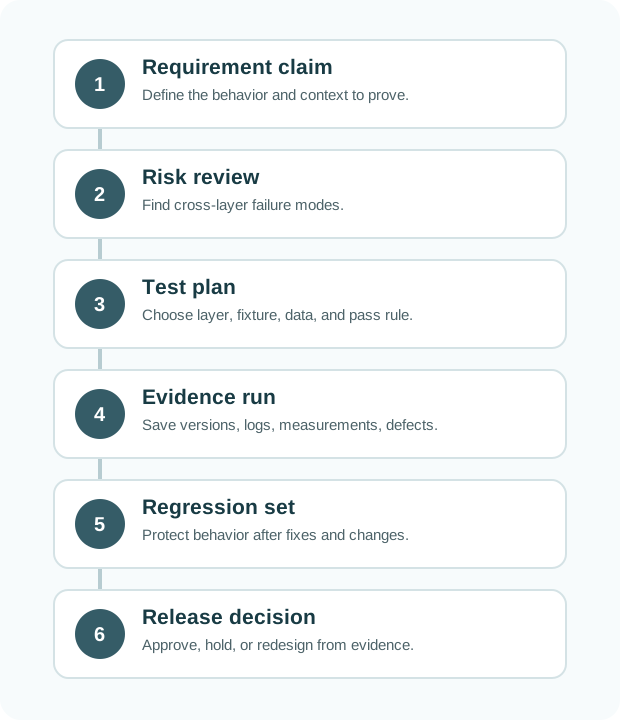
The validation route can be checked by asking which evidence belongs at each stage before a release decision.
iotclass.org

Major section

Incremental Examples (continued)

If duplicate messages appear only after reconnect, the regression check should repeat that failure path instead of only rerunning happy-path unit tests.

  • A gateway reconnect claim needs integration and system evidence.
  • Wireshark or tcpdump shows packet behavior; OpenTelemetry, CloudWatch, Azure Monitor, or Grafana shows backend timing.
  • A field release for OTA firmware needs hardware, cloud, and operations evidence.
iotclass.org

Major section

Incremental Examples (continued)

A Mosquitto or EMQX broker can force disconnects, duplicate deliveries, retained sessions, and delayed acknowledgements while firmware logs, MQTT broker logs, packet captures, and dashboard records are saved together.

  • The release decision should say which firmware build, device cohort, monitoring alerts, and rollback trigger are covered.
  • The pair turns The validation route can be checked by asking which evidence belongs at each stage before a release decision into something the team can verify.
  • Together they explain why The validation route can be checked by asking which evidence belongs at each stage before a release decision matters to: Hold an OTA Release Gate.
iotclass.org

Major section

Debate: IoT System Design Trade-off Scenarios

A debate is useful only when its assumptions and exit path are visible.

  • Firmware means the program stored on a device to control its hardware.
  • A real-time operating system means software that schedules device tasks within known timing rules; it is shortened to RTOS.
  • This exercise supports a bounded decision, not a universal winner.
iotclass.org

Major section

Debate: IoT System Design Trade-off Scenarios (continued)

The scenarios below expose architecture, data, support, ethics, power, and compatibility trade-offs.

  • Scenario: A startup is building a fleet management platform expected to scale from 100 to 100,000 vehicles over 3 years.
  • Scenario: An energy company needs to store and query 10 years of smart meter data (15-minute intervals, 1 million meters).
  • Scenario: A fitness wearable company has anonymized health data from 10 million users.
iotclass.org

Deck summary

Key takeaways

The mathematical gist.: A 2400 mAh, 3.6 V cell stores 8.64 Wh by nameplate, but a 120 mA pulse through 3 Ω sags 0.360 V.

  • The pair turns A release gate approves, holds, waives, or redesigns only after traceability, defects, regression proof, release environment, recovery readiness, and ownership are explicit into something the team can verify.
  • That progression connects A release gate approves, holds, waives, or redesigns only after traceability, defects, regression proof, release environment, recovery readiness, and ownership are explicit to the next: Release Gate Evidence check.
  • A defect was fixed manually but has no guard against returning.
iotclass.org

Retrieval practice

Recall check 1 of 5

Blueprint Bina says: answer from memory, then check your reasoning.

Q1Place each end-to-end testing responsibility where it lives so you can trace a requirement through risk, executable evidence, regression protection, and a release decision.

ARequirement Claim
BCross-layer Risk Review
CVersioned Evidence Run
DRelease Decision
Show answer

Answer: A End-to-end confidence comes from a traceable chain: frame the claim and risk, run versioned cross-layer evidence, then protect behavior and make an owned release decision.

iotclass.org

Retrieval practice

Recall check 2 of 5

Blueprint Bina says: answer from memory, then check your reasoning.

Q2A battery sensor has strong unit tests for its state machine, but field pilots show duplicate cloud messages after intermittent network loss. What evidence is missing?

AIntegration or system evidence for reconnect, queue handling, message IDs, and backend network-fault behavior.
BMore state-machine unit tests with mocked reconnect events, to confirm the firmware resumes its sending state.
CA release waiver with no owner because the unit-test suite is green.
DA better marketing explanation for why duplicate messages are expected.
Show answer

Answer: A IoT field behavior often crosses layers.

iotclass.org

Retrieval practice

Recall check 3 of 5

Blueprint Bina says: answer from memory, then check your reasoning.

Q3A release gate shows one critical requirement marked as skipped because the environmental chamber was unavailable. What is the most defensible release decision?

AHold release or issue a scoped waiver with rationale, owner, expiry, monitoring, and rollback plan.
BApprove release because the dashboard is mostly green and the missing chamber test is only one row.
CDelete the requirement from the traceability matrix and recalculate the pass rate.
DUse a unit-test coverage number as a substitute for environmental evidence.
Show answer

Answer: A Release decisions must expose evidence gaps, defects, waivers, and residual risk instead of hiding them behind a pass rate.

iotclass.org

Retrieval practice

Recall check 4 of 5

Blueprint Bina says: answer from memory, then check your reasoning.

Q4This chapter's smart-meter storage scenario asks you to choose between InfluxDB/TimescaleDB and PostgreSQL for 10 years of data from 1 million meters at 15-minute intervals. Which discussion points does the chapter explicitly list for that decision?

AQuery patterns (recent vs historical), compression requirements, the team's existing expertise, and integration with BI tools
BThe programming language used to write the meter firmware
CWhether the utility company is publicly or privately owned
DThe physical size of the meter enclosure
Show answer

Answer: A The chapter lists four discussion points for the time-series-vs-SQL scenario: query patterns (recent vs historical), compression requirements, the team's existing expertise, and integration with BI tools.

iotclass.org

Retrieval practice

Recall check 5 of 5

Blueprint Bina says: answer from memory, then check your reasoning.

Q5The chapter's cattle health monitor scenario constrains the design to one CR2032 battery and a 5-year life target. Which three features does the chapter say compete for that power budget?

AGPS location (high power), temperature sensing (low power), and heart rate monitoring (medium power)
BWi-Fi connectivity, a color touchscreen, and voice alerts
CSolar charging, satellite uplink, and camera imaging
D5-year battery life, GPS location, and cellular data
Show answer

Answer: A The chapter's scenario names exactly three features competing for one CR2032 battery's power budget over a 5-year target life: GPS location (called out as high power), temperature sensing (low power), and heart rate monitoring (medium power).

iotclass.org

Print reference

Answers 1 of 2

Answer key.

  1. A · End-to-end confidence comes from a traceable chain: frame the claim and risk, run versioned cross-layer evidence, then protect behavior and make an owned release decision.
  2. A · IoT field behavior often crosses layers.
  3. A · Release decisions must expose evidence gaps, defects, waivers, and residual risk instead of hiding them behind a pass rate.
iotclass.org

Print reference

Answers 2 of 2

Answer key.

  1. A · The chapter lists four discussion points for the time-series-vs-SQL scenario: query patterns (recent vs historical), compression requirements, the team's existing expertise, and integration with BI tools.
  2. A · The chapter's scenario names exactly three features competing for one CR2032 battery's power budget over a 5-year target life: GPS location (called out as high power), temperature sensing (low power), and heart rate monitoring (medium power).
iotclass.org