Cryptography · Study deck
Key Renewal and Rotation (E5)
Picture a water meter that wakes only once a month.
Shield Shelly is your guide for this deck.

After studying this chapter
Learning objectives
You will be able to:
- Explain: The deeper layer explains the mechanism behind the sharpest E5 distinction, rotation versus forward secrecy, and the engineering of overlap windows and certificate rollover that keep renewal from becoming an availability or trust failure.
- Explain: A cryptoperiod written in a document means nothing if the device and service do not actually track key version, activation time, expiry, and revocation state and act on them.
- Explain: Rotation Versus Forward Secrecy: Future Risk and Past Traffic These are often confused, and the difference is exactly what an attacker who records traffic cares about.
- Distinguish key rotation from forward secrecy
Major section
Keys Age, So Renewal Is Part of the Design · Run the Renewal Flow and Its Gates
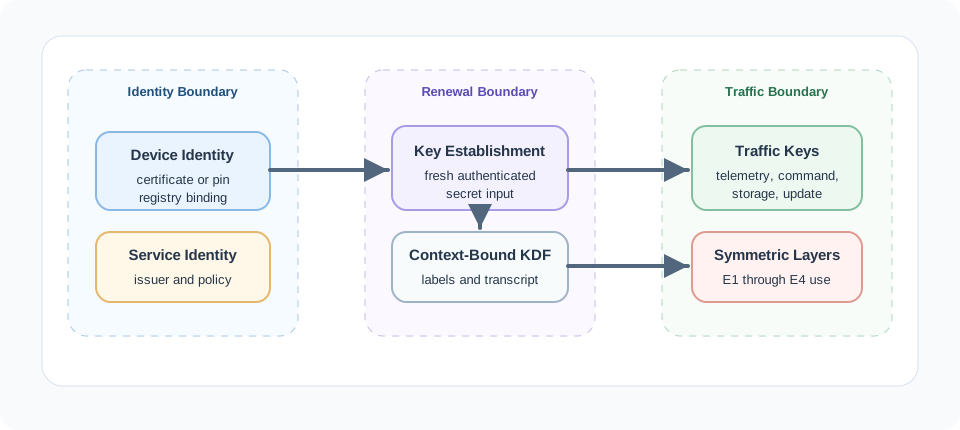
Its owner changes while it is asleep, and the old service key should no longer be trusted.
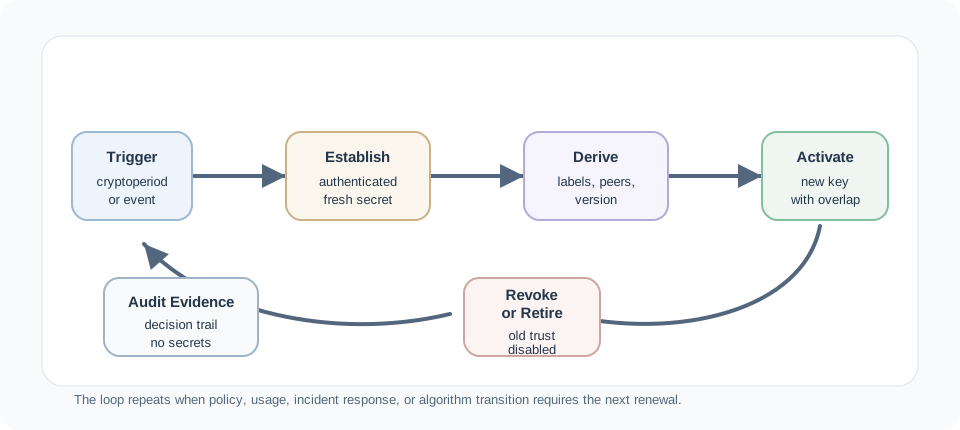
- A new key is useful only if the meter receives it safely and the old one is retired without locking out a valid device.
Major section
Forward Secrecy, Overlap, and Issuer Rollover
The deeper layer explains the mechanism behind the sharpest E5 distinction, rotation versus forward secrecy, and the engineering of overlap windows and certificate rollover that keep renewal from becoming an availability or trust failure.
- The advanced question is what a future compromise can reveal.
- Keys are actually renewed, not just scheduled on paper.
Major section
Forward Secrecy, Overlap, and Issuer Rollover (continued)
Rotation limits how long one key remains useful, but forward secrecy is what protects old recorded traffic after a later long-term key leak.
- Rotation Versus Forward Secrecy: Future Risk and Past Traffic These are often confused, and the difference is exactly what an attacker who records traffic cares about.
- Rotation periodically replaces a key, which limits how much future data any one compromised key can cover.
- Disabled trust cannot obtain fresh key material.
Major section
Forward Secrecy, Overlap, and Issuer Rollover (continued)
That binding is what stops a key derived for one role from being accepted in another.
- The rule that matters for review is that the trigger must be enforceable by the system.
- At the end of the window the old key is disabled or destroyed.
- A document-only cryptoperiod leaves stale keys live indefinitely.
Major section
Forward Secrecy, Overlap, and Issuer Rollover (continued)
Each derived key is distinct and cannot cross roles.
- A cryptoperiod written in a document means nothing if the device and service do not actually track key version, activation time, expiry, and revocation state and act on them.
- KDF Context Is a Security Boundary: Bind Each Key to a Job After establishment, the shared secret is never used directly as a traffic key.
- A single reused key lets one error cross security boundaries.
Major section
Forward Secrecy, Overlap, and Issuer Rollover (continued)
A good release gate can simulate offline devices, delayed messages, duplicate renewal commands, stale versions, and a revoked device attempting renewal.
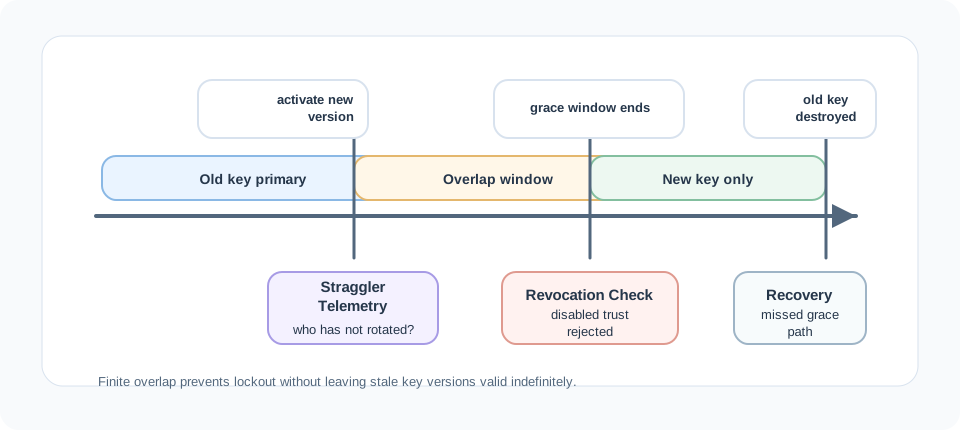
- Below the timeline, straggler telemetry identifies devices that have not rotated, the revocation check blocks disabled trust, and recovery handles devices that missed the window.
- This order balances availability with closure, connecting lockout prevention to proof that stale credentials eventually stop working.
- Offline devices rotate without lockout; stale keys still expire.
Major section
Forward Secrecy, Overlap, and Issuer Rollover (continued)
A device certificate should be renewed before expiry and bound to the same registry identity and authorization.
- An intermediate issuer rollover must accept old and new chains during migration, then remove trust for the old issuer at a planned cutover.
- Both depend on a working revocation path so devices and services can reject revoked certificates, disabled issuers, and blocked key versions.
- Key transport alone gives no forward secrecy; a later leak exposes recorded renewals.
Deck summary
Key takeaways
Its owner changes while it is asleep, and the old service key should no longer be trusted.
- The deeper layer explains the mechanism behind the sharpest E5 distinction, rotation versus forward secrecy, and the engineering of overlap windows and certificate rollover that keep renewal from becoming an availability or trust failure.
- Rotation limits how long one key remains useful, but forward secrecy is what protects old recorded traffic after a later long-term key leak.
- That binding is what stops a key derived for one role from being accepted in another.
- Each derived key is distinct and cannot cross roles.
Retrieval practice
Recall check 1 of 3

Shield Shelly says: answer from memory, then check your reasoning.
Q1Why should a long-lived symmetric key be renewed even when it uses a strong, unbroken cipher?
Show answer
Answer: B Key management, not cipher strength, is the issue.
Retrieval practice
Recall check 2 of 3

Shield Shelly says: answer from memory, then check your reasoning.
Q2A team adds a yearly job that sends each device a new symmetric key, but the renewal message has no replay protection and the old key stays valid forever. What is the main review finding?
Show answer
Answer: A Sending a replacement key is not renewal.
Retrieval practice
Recall check 3 of 3

Shield Shelly says: answer from memory, then check your reasoning.
Q3A fleet rotates its symmetric keys yearly by encrypting each new key to the device's long-term public key (key transport), and assumes recorded past traffic is safe if a key later leaks. An attacker records months of traffic, then steals the device's long-term private key. What happens?
Show answer
Answer: C Rotation limits future exposure but does not protect the past.
Print reference
Answers
Answer key.
- B · Key management, not cipher strength, is the issue.
- A · Sending a replacement key is not renewal.
- C · Rotation limits future exposure but does not protect the past.