Cryptography · Study deck

Cipher Challenge Game

Picture a puzzle that rewards finding repeated patterns in a secret message.

Shield Shelly is your guide for this deck.

encryptiongames
Shield Shelly, the module guide, in a scene from this chapter.
iotclass.org

After studying this chapter

Learning objectives

You will be able to:

  • Explain: Observation identifies a clue without overclaiming; a small hypothesis test checks the suspected weakness; explanation names why it matters; mapping selects the production control; and the gate records the decision and evidence.
  • Explain: For example, "I cracked the Caesar shift" is a puzzle result. "The design has a small key space and no approved algorithm, so it fails the cryptographic-mechanism gate" is review evidence.
  • Explain: That observation should lead to questions about IV or nonce uniqueness, padding, compression before encryption, metadata outside the protected envelope, and whether the system uses authenticated encryption.
iotclass.org

Major section

Start With the Pattern You Can Break

The same trick becomes a product failure if a team copies the classroom method into a device.

  • A protocol means an agreed set of rules for exchanging information.
  • A secure one must name the reviewed mechanism, key handling, unique inputs, integrity check, and rejection behavior.
  • That clue is the lesson.
iotclass.org

Major section

What the Game Is Teaching
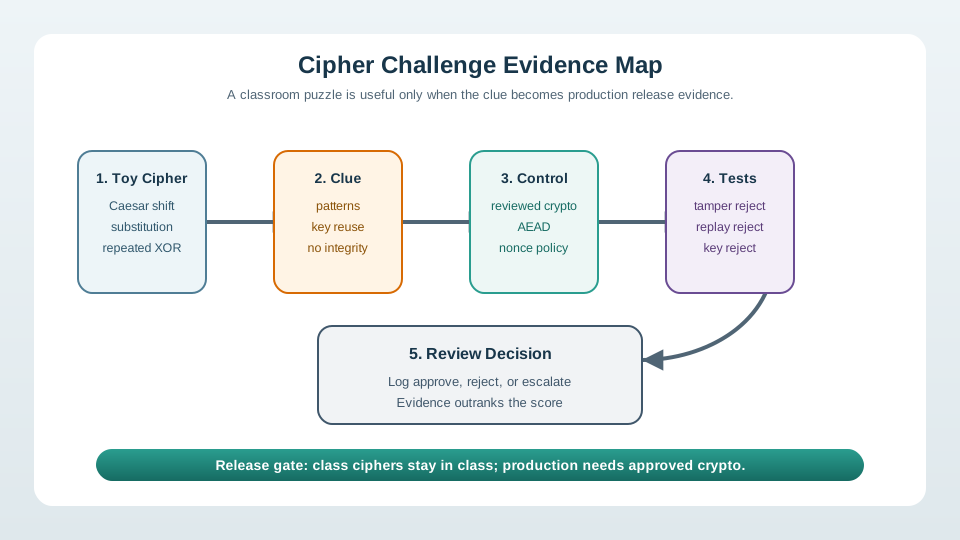
The first two stages explain what failed; the control states the production remedy; the test proves that remedy under failure conditions; and the decision records whether the evidence is sufficient.

  • That progression is the chapter's running purpose: use play to practise the reasoning that a real review demands, not to promote puzzle ciphers as deployable mechanisms.
A good cipher challenge moves learners through five evidence stages: identify the toy cipher clue, name the attacker finding, map it to a safe control, require release tests, and record an approve, reject, or escalate decision.
iotclass.org

Major section

Break Ciphers to Learn Their Limits

Cipher challenges are useful because breaking a code teaches what makes one strong.

  • Classical ciphers such as a Caesar shift or a full substitution alphabet can feel secure because the output looks like gibberish.
  • That translation keeps the game honest.
  • A Caesar puzzle can teach pattern leakage, but it cannot justify a production cipher.
iotclass.org

Major section

Reuse Turns Theory Into Failure

For IoT telemetry, this becomes a packet-design question.

  • Its security depends entirely on one rule: the random key is as long as the message, truly random, distributed safely, and used once.
  • Break the single-use rule and the unbreakable becomes breakable.
  • The game is complete only when the answer names those operational checks.
iotclass.org

Major section

Modern Cipher Reviews Look Beyond the Primitive

Modern ciphers defeat frequency analysis by design, but a release review still needs more than a strong primitive name.

  • The reviewer needs to know the mode of operation, key owner, nonce or counter rule, integrity mechanism, downgrade behavior, and failure handling.
  • AES in an unsafe mode, or AES-GCM with nonce reuse, can fail even though AES itself is strong.
  • Confusion and diffusion are design goals, not release evidence by themselves.
iotclass.org

Major section

Modern Cipher Reviews Look Beyond the Primitive (continued)

Confusion makes the relationship between key and ciphertext complex.

  • Those properties help explain why modern ciphertext should not visibly preserve input structure, but the review still needs protocol traces, test vectors, library/API settings, and rejection cases.
  • If two similar sensor messages produce outputs with obvious shared patterns, the construction or mode is suspect.
  • The evidence should record which library and mode produced the trace.
iotclass.org

Major section

Modern Cipher Reviews Look Beyond the Primitive (continued)

That observation should lead to questions about IV or nonce uniqueness, padding, compression before encryption, metadata outside the protected envelope, and whether the system uses authenticated encryption.

  • Substitution boxes and key mixing make key-to-output relationships hard to infer.
  • Small plaintext changes spread across many ciphertext bits so language statistics do not survive.
  • Strong primitives fail when the mode, nonce, key lifecycle, or authentication checks are wrong.
iotclass.org

Major section

Challenge Levels

Learner explains which repeated pattern made the cipher easy to attack.

  • Confidentiality must not rely on hiding the algorithm or using a tiny key space.
  • Learner identifies the reused material and states the expected release control.
  • Production encryption needs key separation, nonce policy, and replay handling.
  • Recognize when ciphertext can be modified without detection.

Key terms

Confidentiality alone
Confidentiality alone is not enough for commands, firmware, or safety-relevant data.
Good cryptography
Good cryptography is selected, configured, tested, and logged as a system control.
iotclass.org

Major section

Feedback Loop for Learners

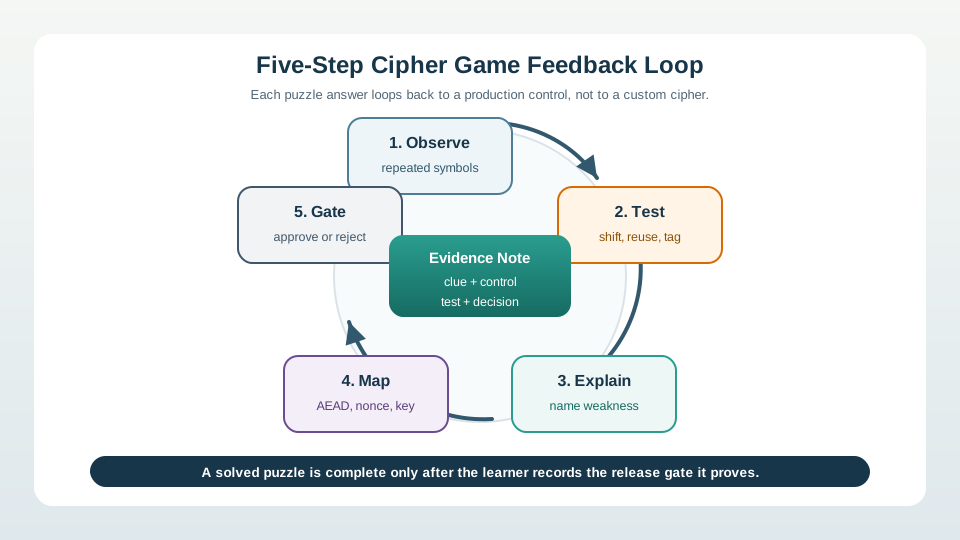
Every round should end with a short evidence note.

  • Observation identifies a clue without overclaiming; a small hypothesis test checks the suspected weakness; explanation names why it matters; mapping selects the production control; and the gate records the decision and evidence.
  • The learner can repeat the loop when a hypothesis fails.
The learning loop should connect each puzzle answer to a safe production control through five review steps: observe the clue, test a hypothesis, explain the weakness, map the control, and gate the release decision.
iotclass.org

Major section

From Puzzle to Production Evidence

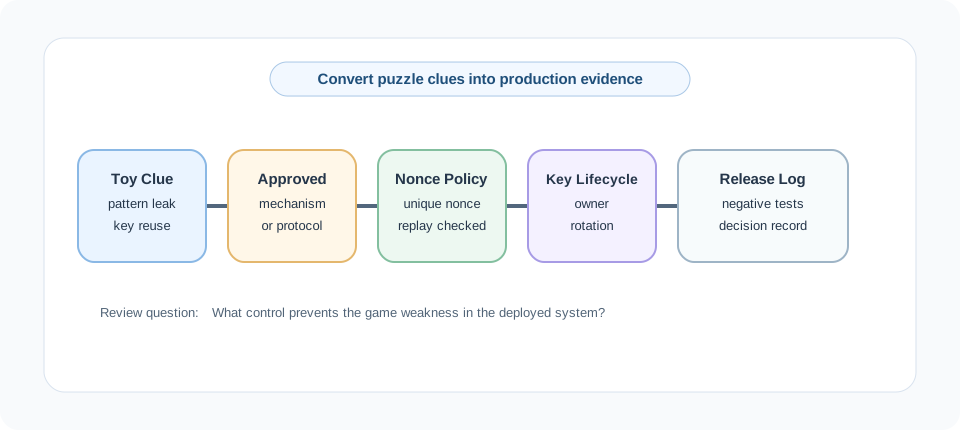
A game answer is not release evidence until it names the production control.

  • For example, "I cracked the Caesar shift" is a puzzle result. "The design has a small key space and no approved algorithm, so it fails the cryptographic-mechanism gate" is review evidence.
Puzzle clues become useful when they map to production controls and release logs.
iotclass.org

Major section

From Puzzle to Production Evidence (continued)

Those observations are useful only if the learner can move from a visible clue to a defensible engineering decision.

  • Each step closes a weakness the game can reveal but cannot itself remediate.
  • The path completes the chapter's narrative by converting learner insight into the evidence language used to approve, reject, or escalate a production design.
  • Control Authenticated encryption Use a standardized AEAD construction or a protocol that supplies confidentiality and integrity together.
iotclass.org

Major section

Common Game-to-Production Mistakes

Mistake Shipping a teaching cipher Caesar, substitution, XOR puzzles, and home-built variants are for learning.

  • Mistake Ignoring integrity A game may focus on hiding text, but IoT commands and firmware also need tamper detection and origin evidence.
  • Mistake Counting only key length Large keys do not fix nonce reuse, wrong modes, unauthenticated metadata, weak identity checks, or leaked private material.
  • Mistake Skipping negative tests A demo that decrypts valid data is incomplete.
iotclass.org

Deck summary

Key takeaways

The same trick becomes a product failure if a team copies the classroom method into a device.

  • The first two stages explain what failed; the control states the production remedy; the test proves that remedy under failure conditions; and the decision records whether the evidence is sufficient.
  • Cipher challenges are useful because breaking a code teaches what makes one strong.
  • For IoT telemetry, this becomes a packet-design question.
  • Modern ciphers defeat frequency analysis by design, but a release review still needs more than a strong primitive name.
iotclass.org

Retrieval practice

Recall check 1 of 5

Shield Shelly says: answer from memory, then check your reasoning.

Q1Why does a simple substitution cipher, where each letter always maps to the same other letter, fall quickly to frequency analysis?

AIt exposes the letter mapping in a message header
BIt reuses a short XOR key across the message
CIt preserves the language's letter-frequency pattern
DThey cannot be broken because frequency analysis is a myth
Show answer

Answer: C A fixed per-letter mapping leaks frequency statistics straight into the ciphertext.

iotclass.org

Retrieval practice

Recall check 2 of 5

Shield Shelly says: answer from memory, then check your reasoning.

Q2Two messages are encrypted with a one-time pad using the same key. What can an attacker compute without knowing the key?

ANothing, because one-time pads remain safe after reuse
BThe key itself, directly recovered from either ciphertext
COnly message length, with no useful relation between texts
DThe XOR of the plaintexts because identical keys cancel
Show answer

Answer: D Reusing the key makes C1 XOR C2 reveal P1 XOR P2.

iotclass.org

Retrieval practice

Recall check 3 of 5

Shield Shelly says: answer from memory, then check your reasoning.

Q3A designer keeps their encryption algorithm secret and argues this makes it secure. Which principle does this violate, and why?

AKerckhoffs's principle: security should rest on the secret key
BThe Nyquist principle, because algorithms must be sampled twice
CNone; hiding the algorithm is the strongest possible defense
DDiffusion, because secret algorithms cannot diffuse bits
Show answer

Answer: A Robust systems assume the algorithm is public and protect the key.

iotclass.org

Retrieval practice

Recall check 4 of 5

Shield Shelly says: answer from memory, then check your reasoning.

Q4A learner solves a Caesar-shift puzzle and suggests using a larger secret shift for device telemetry. What is the correct production response?

AReject it; use approved crypto and integrity evidence
BApprove it because the learner found the secret shift
CKeep the algorithm secret and hide it in firmware
DUse the same cipher but rotate the shift once per year
Show answer

Answer: A Cipher games are for intuition.

iotclass.org

Retrieval practice

Recall check 5 of 5

Shield Shelly says: answer from memory, then check your reasoning.

Q5Place each cipher-challenge artifact where it lives so you can separate a teaching puzzle from a production release decision.

AToy Cipher
BProduction Secret
CTrust Anchor
DDevice Clock
Show answer

Answer: A The toy cipher and attacker clue create learning evidence, the safe control turns the lesson into engineering, and release tests drive an explicit approve-or-reject decision so you can avoid shipping the puzzle.

Q6Complete the cipher challenge release gate:

Areturn 'CLASSIFY_LEARNING_CIPHER'
Breturn 'SHIP_CLASSROOM_CIPHER'
Creturn 'HIDE_ALGORITHM_IN_FIRMWARE'
Dreturn 'INCREASE_SHIFT_VALUE'
Show answer

Answer: A The gate keeps learning ciphers out of production and requires authenticated protection, nonce evidence, reviewed mechanisms, and negative tests.

iotclass.org

Print reference

Answers 1 of 2

Answer key.

  1. C · A fixed per-letter mapping leaks frequency statistics straight into the ciphertext.
  2. D · Reusing the key makes C1 XOR C2 reveal P1 XOR P2.
  3. A · Robust systems assume the algorithm is public and protect the key.
  4. A · Cipher games are for intuition.
  5. A · The toy cipher and attacker clue create learning evidence, the safe control turns the lesson into engineering, and release tests drive an explicit approve-or-reject decision so you can avoid shipping the puzzle.
iotclass.org

Print reference

Answers 2 of 2

Answer key.

  1. A · The gate keeps learning ciphers out of production and requires authenticated protection, nonce evidence, reviewed mechanisms, and negative tests.
iotclass.org