Cryptography · Study deck
Elliptic-Curve Cryptography for IoT
Picture a small tracker that must prove who sent an update without carrying a large key.
Shield Shelly is your guide for this deck.

After studying this chapter
Learning objectives
You will be able to:
- Explain: Deterministic nonce generation protects the private-key calculation, but approval also depends on signing the intended bytes, mapping the verification key to the real authority, and enforcing identity, rollback, and expiry.
- Explain: The chapter’s comparison places that curve near a 128-bit security target, while an RSA alternative is roughly 3,072 bits, or 3072/8=384 bytes, before its own encoding.
- Explain: Validation rejects the wrong group or malformed value before computation; the KDF binds transcript, role, and endpoint context; and separate outputs become scoped session keys.
- choose standard curves and algorithms for IoT roles
Major section
Overview: Strong Public-Key Security in a Small Package
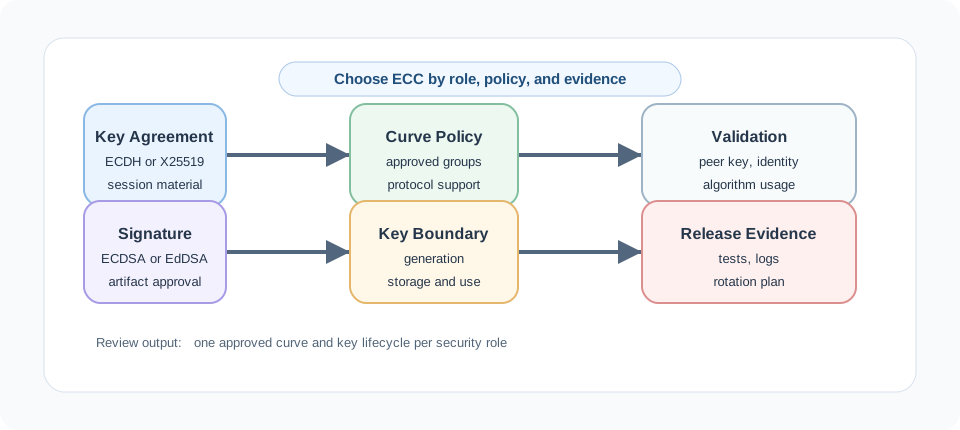
ECDH or X25519 establishes session material; ECDSA or EdDSA approves artifacts or identities.
- This route connects ECC's compact representation to an evidence-backed lifecycle rather than a benchmark-only decision.
Major section
Practitioner: Pick the Role, the Curve, and the Validation
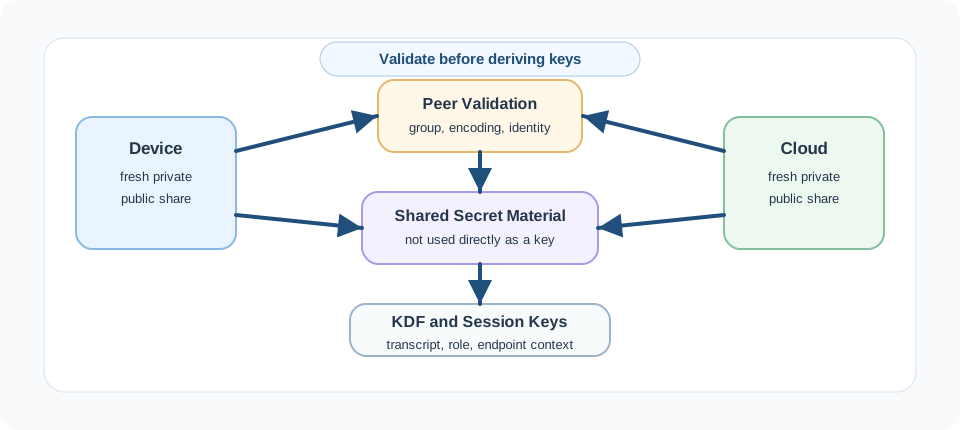
Validation rejects the wrong group or malformed value before computation; the KDF binds transcript, role, and endpoint context; and separate outputs become scoped session keys.
- The raw ECDH result is never used directly.
- This sequence connects the mathematical agreement to the authenticated, purpose-bound channel the system actually needs.
Major section
Under the Hood: The Hard Problem, the Curves, and the Sharp Edges
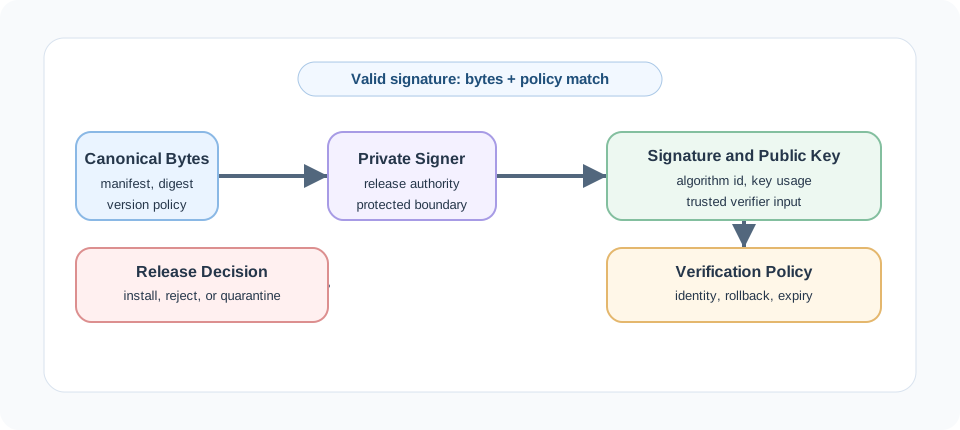
Deterministic nonce generation protects the private-key calculation, but approval also depends on signing the intended bytes, mapping the verification key to the real authority, and enforcing identity, rollback, and expiry.
- The visual connects the nonce hazard to the complete evidence chain rather than letting one correct signature equation stand in for policy.
Major section
Fit a Signed Update Into the Radio Budget
The private signing key never needs to travel with the update.
- The chapter’s comparison places that curve near a 128-bit security target, while an RSA alternative is roughly 3,072 bits, or 3072/8=384 bytes, before its own encoding.
- ECC security also depends on validating inputs and using the operation correctly.
Deck summary
Key takeaways
ECDH or X25519 establishes session material; ECDSA or EdDSA approves artifacts or identities.
- Validation rejects the wrong group or malformed value before computation; the KDF binds transcript, role, and endpoint context; and separate outputs become scoped session keys.
- Deterministic nonce generation protects the private-key calculation, but approval also depends on signing the intended bytes, mapping the verification key to the real authority, and enforcing identity, rollback, and expiry.
- The private signing key never needs to travel with the update.
Retrieval practice
Recall check 1 of 3

Shield Shelly says: answer from memory, then check your reasoning.
Q1Why is ECC often preferred over RSA on small, battery-powered IoT devices?
Show answer
Answer: C For a given security level an elliptic-curve key is far smaller than an RSA key, which is exactly the advantage constrained devices need.
Retrieval practice
Recall check 2 of 3

Shield Shelly says: answer from memory, then check your reasoning.
Q2A device and a cloud endpoint need fresh session keys for an authenticated transport session. Which ECC role is the right starting point, and what must happen to its output?
Show answer
Answer: D Key agreement sets up the shared secret, and the KDF, bound to transcript and role, turns it into separate, scoped session keys.
Retrieval practice
Recall check 3 of 3

Shield Shelly says: answer from memory, then check your reasoning.
Q3A constrained device signs messages with ECDSA but its weak random generator produces the same per-signature value for two different messages. What is the consequence?
Show answer
Answer: A ECDSA's security depends on a unique, unpredictable nonce per signature.
Print reference
Answers
Answer key.
- C · For a given security level an elliptic-curve key is far smaller than an RSA key, which is exactly the advantage constrained devices need.
- D · Key agreement sets up the shared secret, and the KDF, bound to transcript and role, turns it into separate, scoped session keys.
- A · ECDSA's security depends on a unique, unpredictable nonce per signature.