Reference Architectures · Study deck
IoT Enablers: Compute and Readiness
A platform feature is not an enabler if the team cannot operate it.
Blueprint Bina is your guide for this deck.

After studying this chapter
Learning objectives
You will be able to:
- assess compute and development enablers for an IoT release
- review coupling, ownership, and rollout constraints
- Explain: Buying a faster chip will not fix a bad case or a weak service plan.
- Explain: The design may need more local compute, a better communication path, a safer interface, lower energy use, clearer tooling, or a production review before it can leave the prototype stage.
Major section
Start With the Release Constraint
Buying a faster chip will not fix a bad case or a weak service plan.
- An enabler is a capability that lets the whole design work in its real setting.
- A protocol is an agreed set of rules for how devices exchange data.
- A gateway is a device or service that joins one system boundary to another.
Major section
Start With the Release Constraint (continued)
The design may need more local compute, a better communication path, a safer interface, lower energy use, clearer tooling, or a production review before it can leave the prototype stage.
- One enabler can weaken another.
- More radio use can drain power.
- More local work can raise heat and support cost.
- A real need sets the job.
Major section
Start With the Release Constraint (continued)
Architectural enablers are easiest to understand when a release constraint blocks progress.
- Under the Hood builds the readiness record and tests coupled limits.
- Those details may reopen a green gate.
- They never make a part name proof of system readiness.
- A field limit blocks release.
Major section
Overview: Enablers Are Evidence Gates
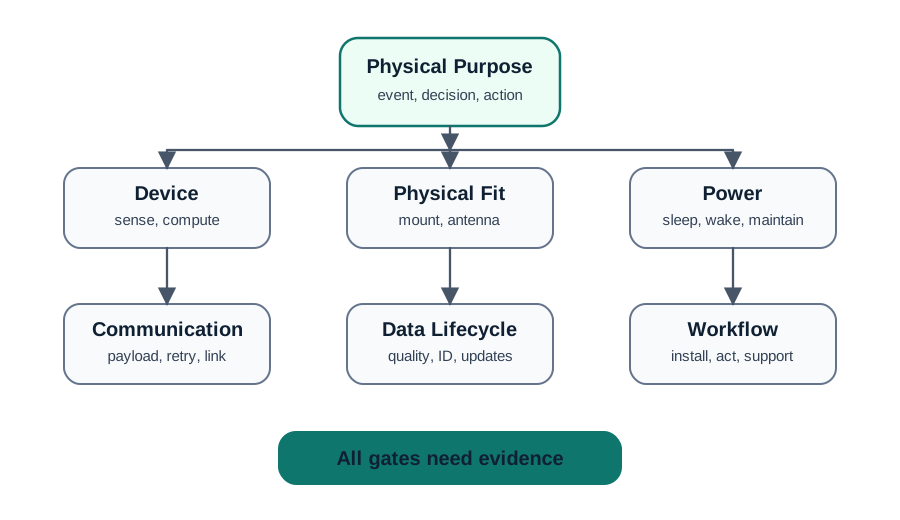
Architectural enablers are the conditions that make an IoT system practical, supportable, and worth operating.
- The later labels sleep, wake, maintain and: All gates need evidence widen that review.
- With: All gates need evidence included, their combined meaning is: Use enablers as a readiness gate before treating a component choice as a deployable architecture.
Major section
Overview: Enablers Are Evidence Gates (continued)
Available Component Exists A part, protocol, library, profile, or service can be used.
- Plausible Subsystem Works A prototype shows one part of the system working under controlled conditions.
- The result still needs site, lifecycle, and support evidence.
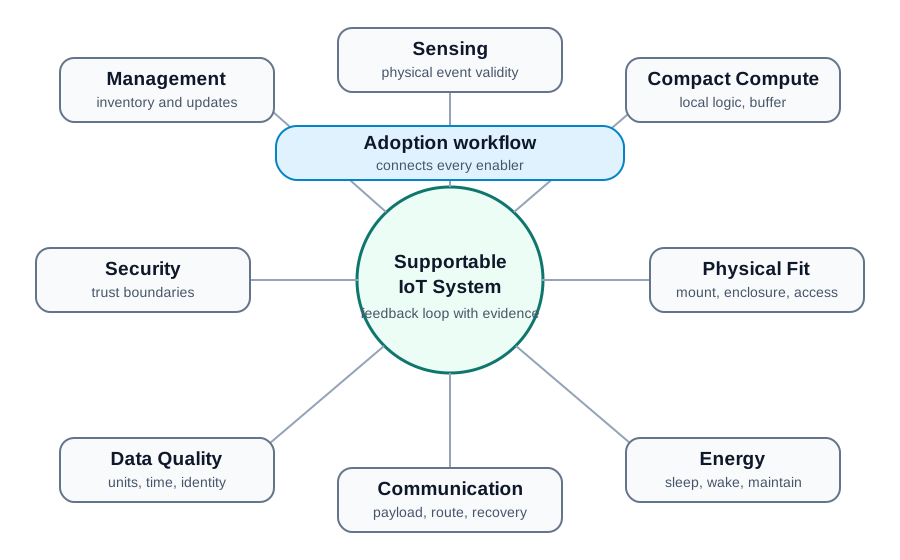
- For overview: enablers are evidence gates, inspect Figure: The foundation set exposes the responsibilities a deployed at Supportable.
Major section
Overview: Enablers Are Evidence Gates (continued)
Ready System Has Evidence The installed design has evidence across physical sensing, power, communication, data quality, security, lifecycle, and workflow.
- Its visible premise is: The foundation set exposes the responsibilities a deployed IoT system must carry.
- This map identifies what the system must provide.
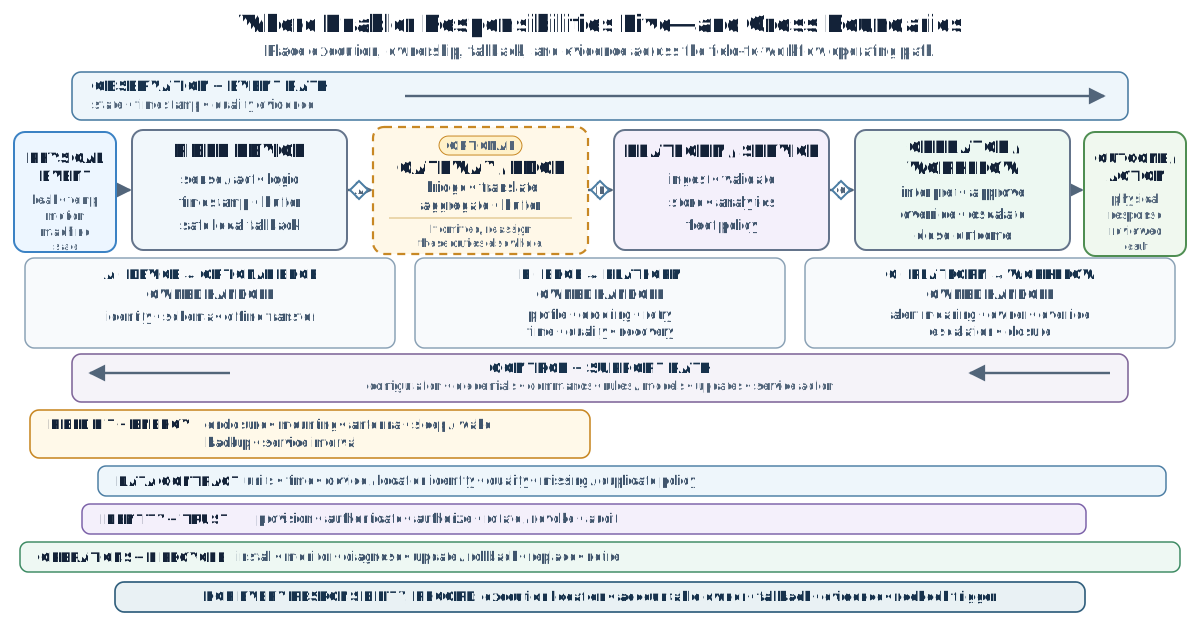
- The Practitioner placement map later identifies where those responsibilities execute and who owns the interfaces between them.
Major section
Overview: Enablers Are Evidence Gates (continued)
The resulting visual statement is: The foundation set exposes the responsibilities a deployed IoT system must carry.
- The Foundation Set Sensing and Actuation Define the physical event, validity limits, calibration state, false positives, false negatives, and safe behavior when a sensor or actuator fails.
- Physical and Energy Fit Review enclosure, mounting, antenna position, service access, sleep states, transmit windows, charging, replacement, and outage behavior together.
- Communication and Data Match payload timing, coverage, capacity, retries, topology, identity, units, timestamps, missing-data handling, and quality flags to the decision.
Major section
Computing and Development Enablers
Earlier CMOS generations benefited from Dennard scaling: as transistors shrank, voltage and capacitance also fell, so designers could raise clock frequency without making power density grow without bound.
- where $\alpha$ is the fraction of gates switching, $C_L$ is switched capacitance, $V$ is supply voltage, and $f$ is clock frequency.
- When voltage scaling slowed, raising $f$ pushed power and heat upward even though transistors were still becoming smaller.
- Leakage power also became a larger share of the budget.
Major section
Computing and Development Enablers (continued)
The response was architectural.
- Extra transistors were spent on multiple cores, larger caches, vector units, accelerators, radios, and power-management domains instead of indefinitely faster single-thread execution.
- If a workload has parallel fraction $p$ and runs on $n$ cores, Amdahl's law gives the upper bound.
- The radio sends a compact, authenticated message.
Major section
Computing and Development Enablers (continued)
The serial part, coordination overhead, memory bandwidth, and energy budget remain.
- Moore-style transistor-count growth can provide more possible machinery, but it does not guarantee proportional application speed, and economics and fabrication limits bound how long density growth can continue.
- For IoT, the consequence is more useful than the history: capability comes from a distributed stack of specialised resources.
- A tiny always-on core can qualify an event; a radio accelerator can move a short authenticated frame; an edge gateway can batch or infer; a cloud service can aggregate across a fleet.
Major section
Review Couplings Before Rollout
Enablers are not independent checklist items.
- Most IoT failures appear where dimensions meet: a smaller enclosure blocks the antenna, a stronger security boundary changes provisioning, a longer sleep interval changes data freshness, or a dashboard creates alerts no one owns.
- A practitioner should review the interfaces between enablers before approving a pilot or release candidate.
Major section
Review Couplings Before Rollout (continued)
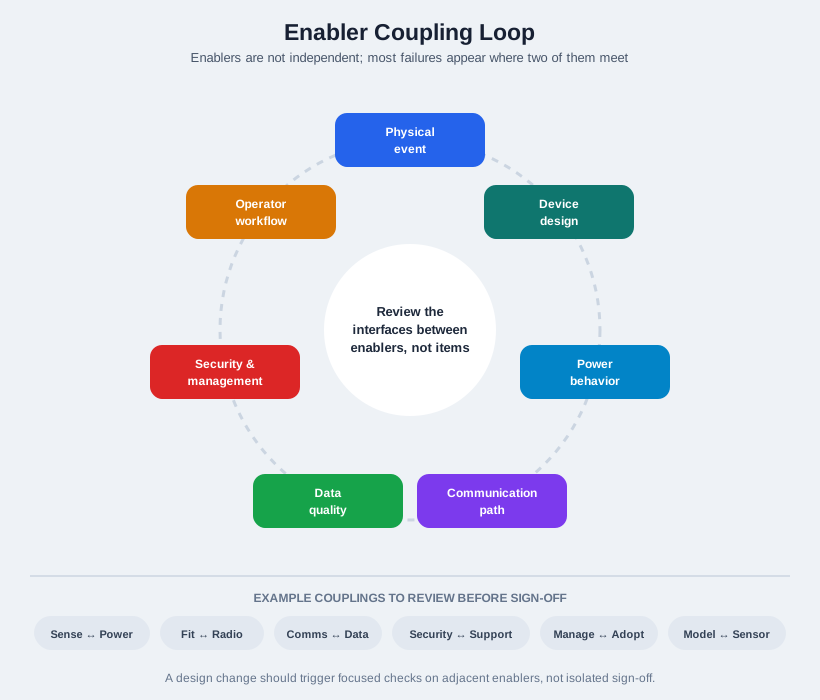
At place responsibilities before testing couplings, Enabler Coupling Loop makes the architecture testable.
- The foundation set names the capabilities a supportable system needs, but it does not decide where those capabilities execute.
- A typical software stack gives each of those three tiers a recognizable shape.
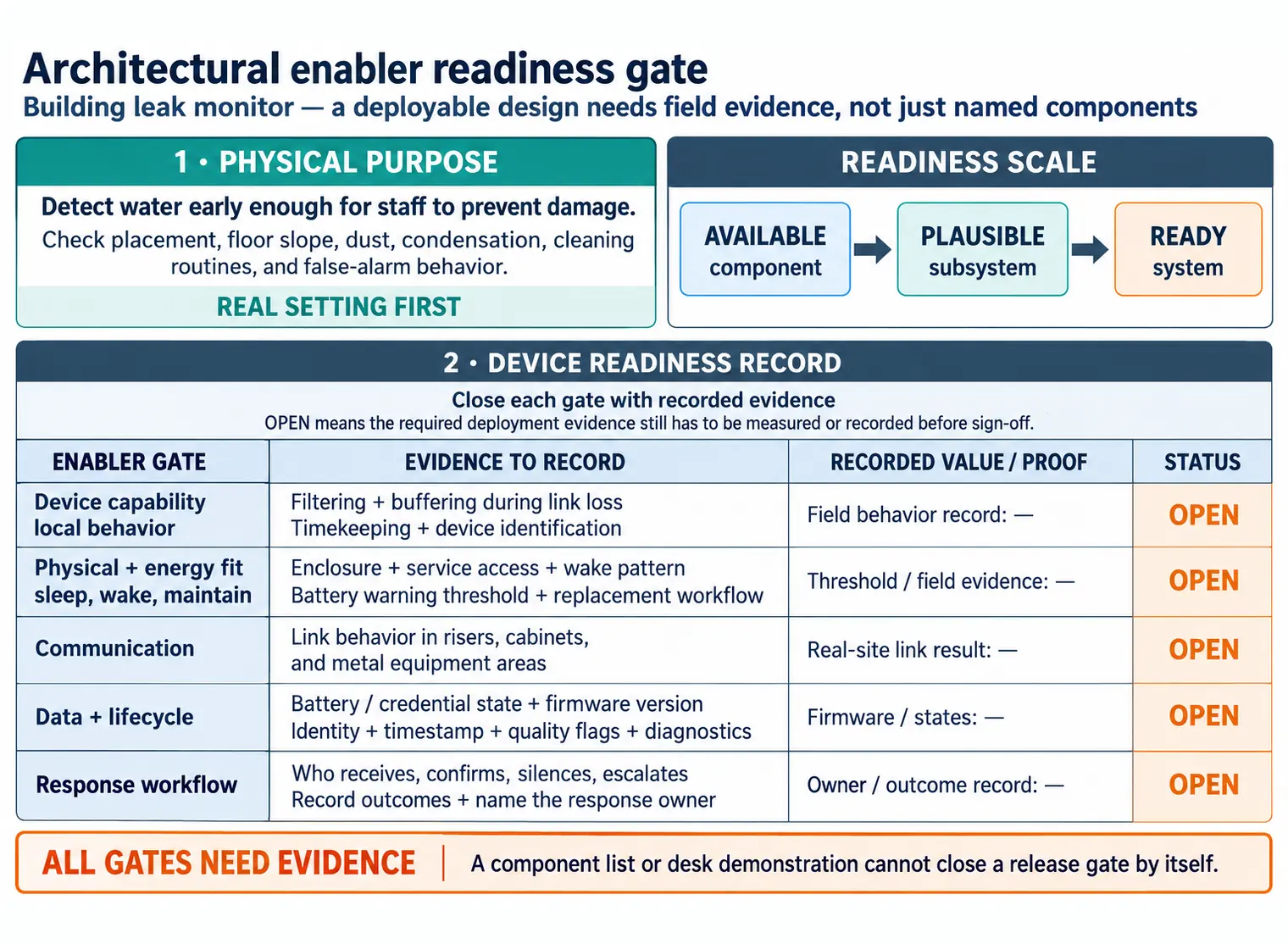
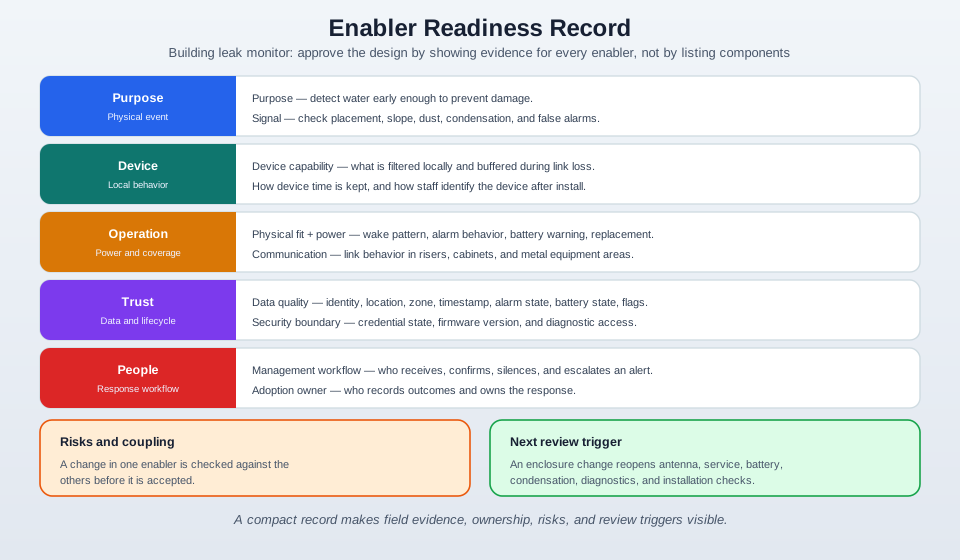
- Purpose Physical Event Detect water early enough for staff to prevent damage.
Major section
Review Couplings Before Rollout (continued)
The resulting visual statement is: A compact record makes field evidence, ownership, risks, and review triggers visible.
- A constrained field device usually carries a hardware abstraction layer, an RTOS or bare-metal scheduler, and a communication block split into field protocols and IoT protocols, with a remote-management path threaded through all three.
- Naming which of those specific blocks a given design provides -- and which it is missing -- is a more testable placement sentence than "the gateway handles local processing.".
- The architecture should not be approved merely because a leak sensor, gateway, and dashboard can be demonstrated on a desk.
Major section
Review Couplings Before Rollout (continued)
With that placement visible, use the coupling loop below to identify which adjacent enablers must be rechecked when a location, interface, or owner changes.
- In Figure: Design changes should trigger focused checks on adjacent,: Data frames this claim: Design changes should trigger focused checks on adjacent enablers, not isolated sign-off.
- Together: Enabler Coupling Loop and: Model ↔ Sensor connect to the claim: Design changes should trigger focused checks on adjacent enablers, not isolated sign-off.
- Device Local Behavior Decide what is filtered locally, what is buffered during link loss, how time is maintained, and how staff identify the device after installation.
Deck summary
Key takeaways
Buying a faster chip will not fix a bad case or a weak service plan.
- The design may need more local compute, a better communication path, a safer interface, lower energy use, clearer tooling, or a production review before it can leave the prototype stage.
- Architectural enablers are easiest to understand when a release constraint blocks progress.
- Architectural enablers are the conditions that make an IoT system practical, supportable, and worth operating.
- Available Component Exists A part, protocol, library, profile, or service can be used.
Retrieval practice
Recall check 1 of 2

Blueprint Bina says: answer from memory, then check your reasoning.
Q1A clinic vaccine-refrigerator pilot shows a temperature sensor, gateway, and dashboard working on a bench. The release design will mount sensors inside packed metal refrigerators, use backup power, alert nurses, and receive updates. What is the best enabler-based response?
Show answer
Answer: A Architectural enablers keep teams from confusing component availability or bench success with deployable system readiness.
Retrieval practice
Recall check 2 of 2

Blueprint Bina says: answer from memory, then check your reasoning.
Q2During a leak-monitoring pilot, the team changes the enclosure to improve water resistance. Which review action best follows enabler coupling?
Show answer
Answer: A Enabler coupling means changes in physical design, power, radio, support, or workflow should reopen focused evidence checks.
Print reference
Answers
Answer key.
- A · Architectural enablers keep teams from confusing component availability or bench success with deployable system readiness.
- A · Enabler coupling means changes in physical design, power, radio, support, or workflow should reopen focused evidence checks.