Electronics & Circuits · Study deck
Components in Systems: Passive and Active Contracts
A floating input can switch an actuator without a command.
Voltage Vera is your guide for this deck.

After studying this chapter
Learning objectives
You will be able to:
- Distinguish passive and active component roles at an IoT interface.
- Size pull resistors, conductors, and insulation from electrical limits.
- Explain why high-impedance CMOS inputs become undefined when left floating.
- Choose pull-up or pull-down resistors to give logic inputs a safe default state.
Major section
Passive vs Active Components
A floating input is a pin with no defined high or low level.
- A pull resistor sets a default level.
- A shared ground gives the control signal a reference; test the complete interface and its limits before calling it safe.
- Why this matters: Passive components set voltage/current levels and filter noise, while active components make decisions and drive loads.
Major section
Floating Input and Pull Resistor Contracts
Stray charge, coupled noise, and nearby switching set it at random, so it can read HIGH and LOW unpredictably and even oscillate.
- Without that answer, the node is an antenna and a tiny capacitor, not a logic signal.
- Think of the pull resistor as a contract for every moment when no active circuit is driving the node.
Major section
Floating Input and Pull Resistor Contracts (continued)
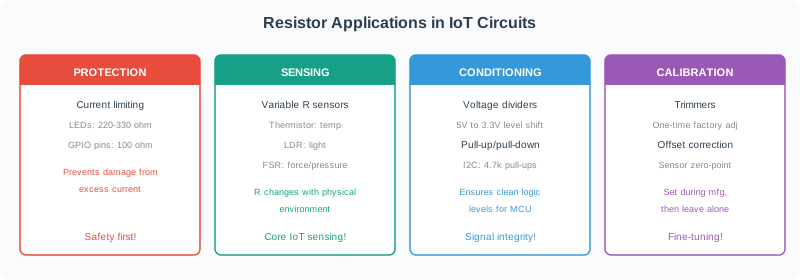
A push button connects a 3.3 V input to ground when pressed, with a 10 kΩ pull-up to 3.3 V.
- Idle (button open): the pull-up holds the input at 3.3 V (HIGH) and draws essentially no current.
- The pull resistor and the node capacitance make a simple RC edge: a larger resistor or longer cable charges more slowly.
- If low sleep current matters, document why an internal weak pull is acceptable or why the stronger external pull is worth the current.
Major section
Floating Input and Pull Resistor Contracts (continued)
Any device can pull the line LOW strongly, but the pull-up is the only thing that returns the line HIGH after release.
- Schmitt-trigger inputs can add hysteresis so slow or noisy edges do not chatter, but they do not replace the pull.
- They still need the node to be biased toward a real idle level.
- FR4 PCB substrate has a surface resistance of approximately 10^12 ohm per square — high enough to be treated as insulating for normal circuits.
Deck summary
Key takeaways
A floating input is a pin with no defined high or low level.
- Stray charge, coupled noise, and nearby switching set it at random, so it can read HIGH and LOW unpredictably and even oscillate.
- A push button connects a 3.3 V input to ground when pressed, with a 10 kΩ pull-up to 3.3 V.
- Any device can pull the line LOW strongly, but the pull-up is the only thing that returns the line HIGH after release.
Retrieval practice
Recall check 1 of 4

Voltage Vera says: answer from memory, then check your reasoning.
Q1Why does an unused or button-driven CMOS logic input usually need a pull-up or pull-down resistor?
Show answer
Answer: A A floating high-impedance input has no defined voltage, so noise decides its state.
Retrieval practice
Recall check 2 of 4

Voltage Vera says: answer from memory, then check your reasoning.
Q2Choosing a pull-up resistor, what is the core trade-off between a strong (small) and a weak (large) value?
Show answer
Answer: A Smaller resistance means a stiffer, faster node at the cost of higher current when the line is pulled the other way; larger resistance saves current but gives slower edges and more noise sensitivity.
Retrieval practice
Recall check 3 of 4

Voltage Vera says: answer from memory, then check your reasoning.
Q3A board with several unused CMOS input pins left floating runs unexpectedly hot and draws extra current. What is the mechanism, and the fix?
Show answer
Answer: A Mid-level inputs bias both transistors of the CMOS input pair partly on, conducting straight through.
Retrieval practice
Recall check 4 of 4

Voltage Vera says: answer from memory, then check your reasoning.
Q4Place each electronics concept where it lives so you can choose the right material role and then keep the finished component inside its safe limits.
Show answer
Answer: A These boundaries keep carry or block, control current, stay in limits distinct so you can choose the right material role and then keep the finished component inside its safe limits.
Q5Complete the material classifier using rough resistivity ranges:
Show answer
Answer: A Very low resistivity materials behave as conductors, extremely high resistivity materials behave as insulators, and the broad middle range covers semiconductors whose conductivity can be controlled by doping and circuit conditions.
Print reference
Answers 1 of 2
Answer key.
- A · A floating high-impedance input has no defined voltage, so noise decides its state.
- A · Smaller resistance means a stiffer, faster node at the cost of higher current when the line is pulled the other way; larger resistance saves current but gives slower edges and more noise sensitivity.
- A · Mid-level inputs bias both transistors of the CMOS input pair partly on, conducting straight through.
Print reference
Answers 2 of 2
Answer key.
- A · These boundaries keep carry or block, control current, stay in limits distinct so you can choose the right material role and then keep the finished component inside its safe limits.
- A · Very low resistivity materials behave as conductors, extremely high resistivity materials behave as insulators, and the broad middle range covers semiconductors whose conductivity can be controlled by doping and circuit conditions.