Electronics & Circuits · Study deck
Electronics Materials: Conductors to Components
Current moves through a conductor but stops at an insulator.
Voltage Vera is your guide for this deck.

After studying this chapter
Learning objectives
You will be able to:
- Classify materials as conductors, insulators, or semiconductors based on their electrical properties and explain why semiconductors are essential to IoT electronics
- Identify passive and active electronic components and describe their roles in common IoT circuit patterns
- Select appropriate resistors, capacitors, and transistors for IoT applications using datasheet specifications and rating guidelines
- relate conductor, insulator, and semiconductor behaviour to circuit roles
Major section
A Clear First Route
The designer must choose where charge should flow, where it should stop, and where it should be controlled.
- This page starts with one job.
- Last, choose use a conductor, an insulator, a controlled material, or a safe mix.
- A material class is only a start.
- Heat, dirt, water, wear, and high voltage can change real behaviour.
Major section
A Clear First Route (continued)
This first route is a guide to the main choice.
- The Practitioner sections add part types, ratings, board use, and worked circuit checks.
- Under the Hood adds atomic structure, resistance, heat, doping, leakage, and part equations.
- They do not reverse its main claim.
- If two sources differ, keep that fact in the record.
Major section
A Clear First Route (continued)
A late result may be true about the past and still be unsafe now.
- A missing result is also useful news when the system shows it at once.
- A person may inspect the site.
- A local rule may hold a safe state.
- A remote team may ask for more proof.
Major section
Conductors and Semiconductors
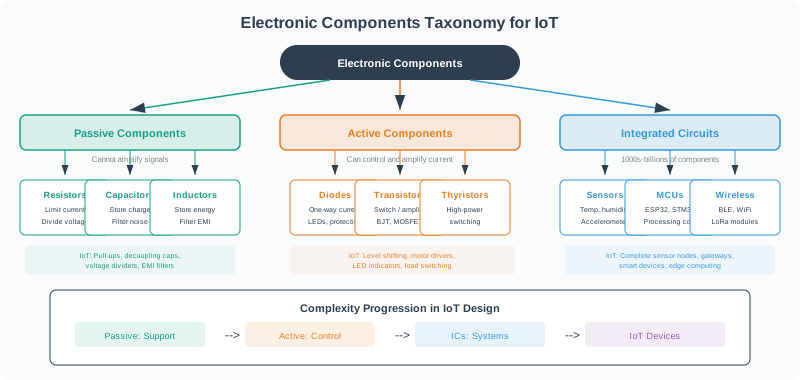
If you can tell which parts only store or dissipate energy and which parts control current, the later material categories will feel less abstract.
- The running electronic components taxonomy narrative uses that consequence to decide what is safe and measurable.
- Understanding their properties is essential for IoT design.
Major section
Deep dive: Putting Numbers to It
After 5τ (5 ms), voltage reaches 99.3% of final value -- eliminating false triggers.
- A practical reference for selecting and using electronic components in IoT projects, with specifications and real-world use cases.
- The visual is specifically about ultrasonic sensor module used in IoT distance measurement and proximity detection.
Major section
Deep dive: Putting Numbers to It (continued)
They keep iot component reference tied to evidence that can be inspected on the schematic, part, or trace.
- Capacitors: Voltage rating must be ≥ 2× operating voltage for reliability.
- Inductors: Saturation current must exceed maximum expected current.
- For essential active components, that order identifies what to measure or calculate before accepting the hardware choice.
Major section
Deep dive: Putting Numbers to It (continued)
The labelled progression means capacitors store electrical charge and are essential for power supply filtering, signal coupling, and timing circuits.
- The chapter carries that evidence into essential active components so the selection rests on circuit behaviour rather than appearance.
- The: IEC Symbol is the schematic counterpart to those physical forms.
- Its purpose is to reveal understanding resistor schematic symbols enables quick circuit reading.
- Those labels show understanding resistor schematic symbols enables quick circuit reading.
Major section
Deep dive: Putting Numbers to It (continued)
Core material and geometry change frequency response and saturation, so the drawing leads into a datasheet check for inductance, current rating, loss, and adjustment range rather than a choice based on the coil's appearance.
- In Figure: Understanding resistor schematic symbols enables quick circuit reading, Resistor Symbols establishes the first electrical role, while: IEC Symbol marks the contrasting role and: Variable supplies the operating detail.
- This connects the visual to essential active components by making the relevant component behaviour part of the design check.
- Wrong: "Any resistor will work.": Fix: calculate exact value and power rating.
Major section
Deep dive: Putting Numbers to It (continued)
Colour bands help identify a through-hole value; the power-resistor branch warns that value alone does not establish safe dissipation.
- That distinction carries the component survey into two separate checks: resistance and tolerance for signal paths, then package and wattage for current-sensing or load duties.
- Wrong: connecting a motor directly to GPIO.: Fix: use a transistor/MOSFET switch.
- For the LED, subtract the diode's forward voltage before choosing a resistor, round to an available value that stays within GPIO and LED current limits, and verify dissipation.
Deck summary
Key takeaways
The designer must choose where charge should flow, where it should stop, and where it should be controlled.
- This first route is a guide to the main choice.
- A late result may be true about the past and still be unsafe now.
- If you can tell which parts only store or dissipate energy and which parts control current, the later material categories will feel less abstract.
- After 5τ (5 ms), voltage reaches 99.3% of final value -- eliminating false triggers.
Retrieval practice
Recall check

Voltage Vera says: answer from memory, then check your reasoning.
Q1A board powers a motor beside a touch surface. What should guide its material choices?
Show answer
Answer: C The route links conductors, insulation, and controlled materials to the physical task.
Q2A learner sees copper traces and plastic insulation on a board. What distinction explains their roles?
Show answer
Answer: B The chapter uses those materials to explain deliberate conduction and isolation.
Print reference
Answers
Answer key.
- C · The route links conductors, insulation, and controlled materials to the physical task.
- B · The chapter uses those materials to explain deliberate conduction and isolation.