Electronics & Circuits · Study deck
Electronics for IoT: Signals and Calculators
This first route connects electronics roles and signal boundaries to checkable calculations.
Voltage Vera is your guide for this deck.

After studying this chapter
Learning objectives
You will be able to:
- Classify Semiconductor Materials: Distinguish conductors, insulators, and semiconductors by their electrical properties
- Differentiate N-type and P-type: Describe doping processes and predict semiconductor behavior based on impurity type
- Analyze Diode Operation: Trace one-way current flow through PN junctions and select diodes for protection circuits
- Compare Transistor Types: Evaluate BJT versus FET transistors and justify selection for specific IoT applications
Major section
Condition, signal, decision
One day, Temperature Terry detected that a room was getting too hot. "It's 30 degrees!
Temperature change → sensor output → microcontroller decision. Mark the physical condition and the electrical signal separately.
Major section
Command and load current
The Electricity people can ONLY pass when the Transistor opens the gate!
Controller output → transistor control; load supply → load → transistor → return. The signal path and load path are different.
Major section
Identifying IC Packages and Breakout Boards
Diode, transistor, BJT, and FET are now names instead of mysteries.
- It helps just as much to recognize what those parts look like in your hands -- both as bare chips and as the breakout boards that package them for hobbyist and IoT use.
- Those claims must come from the exact part number and package drawing.

Major section
Identifying IC Packages and Breakout Boards (continued)
The: Public domain credit identifies the photograph's source, not a package property.
- The photograph shows a surface-mount package rather than the internal circuit represented by its schematic symbol.
- Its visible leads establish assembly scale and access, but they do not establish pin function, supply limits, thermal performance, or the correct footprint.
- A thermal-camera breakout built around a small infrared sensor array is a representative example.
Major section
Identifying IC Packages and Breakout Boards (continued)
This distinction supports the chapter's identification method: recognize the package family in hand, then use the datasheet to bind pin numbering, land pattern, handling, and electrical limits before placing or powering the device.
- The board makes a small surface-mount device accessible, but it may also add regulation, level shifting, pull-ups, filtering, or indicator loads that change the interface.
- Silkscreen and visible traces help locate power, ground, bus, and interrupt pins; they do not replace the breakout schematic or the sensor datasheet.
- Photo: SparkFun Electronics, then adds ground as the detail that changes the circuit interpretation.
Major section
From Electricity to Electronics
Electronics is the study and application of devices that control electron flow using semiconductors.
- While electrical devices (motors, heaters, lamps) just use current flow, electronic devices (computers, sensors, microcontrollers) actively control and manipulate current using semiconductors.
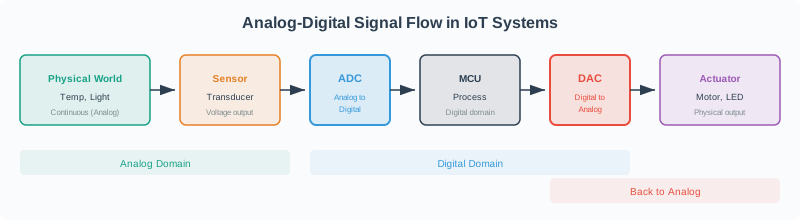
- They keep analog-to-digital iot flow tied to evidence that can be inspected on the schematic, part, or trace.
Major section
Signal Domain Boundaries
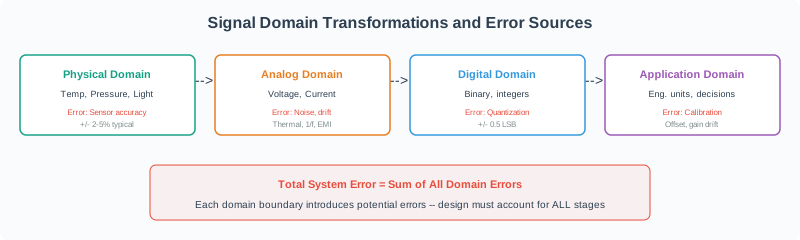
This layered variant emphasizes the domain boundaries between physical, analog, and digital realms, helping students understand where signal transformations occur and what challenges exist at each transition.
- The calculation ahead needs a visual reference.
- The signal changes form at each boundary, and each change can add error.
- Analog conditioning follows, where noise, offset, and drift can alter the voltage.
Major section
Signal Domain Boundaries (continued)
Physical → Sensor: Environmental changes (temperature rises from 20°C to 25°C) are converted to electrical signals.
- Sampling at the ADC adds quantization and reference error before digital processing brings rounding and filter assumptions.
- The application then applies thresholds or a model to make a decision.
- Digital Processing: Microcontroller applies calibration, averages readings, detects thresholds.
Major section
Worked Example: Using the Ohm's Law Calculator
Supply voltage: LED forward voltage = voltage across resistor.
- LEDs are everywhere in IoT - status indicators, displays, and debugging.
- Voltage dividers are essential for reading analog sensors and interfacing different voltage levels.
- This tool helps you design voltage dividers for IoT applications.
- Understanding battery life is critical for IoT devices.
Major section
Worked Example: Using the Ohm's Law Calculator (continued)
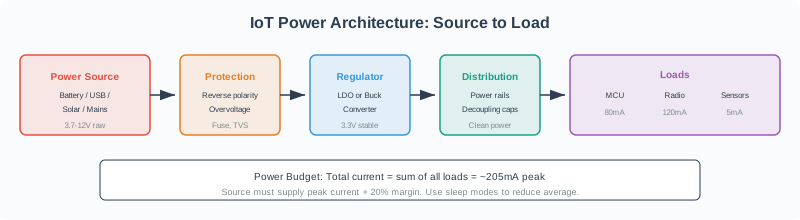
The high-power branch therefore uses a transistor switch, flyback path, surge clamp, or fuse.
- Battery, USB, and solar power first reach the charge and power stages.
- LDOs, buck units, and load switches make usable rails there.
- The MCU, radio, and sensors share the digital branch.
Major section
Worked Example: Using the Ohm's Law Calculator (continued)
Large start, stall, and coil currents from a motor can upset that rail.
- A GPIO only controls the switch; it does not carry the load.
- A sound energy plan must include conversion loss, rail split, switch loss, and a safe fault-current path.
- This decision tree helps IoT designers select the optimal power source based on deployment constraints.
Deck summary
Key takeaways
One day, Temperature Terry detected that a room was getting too hot. "It's 30 degrees!
- The Electricity people can ONLY pass when the Transistor opens the gate!
- Diode, transistor, BJT, and FET are now names instead of mysteries.
- The: Public domain credit identifies the photograph's source, not a package property.
- This distinction supports the chapter's identification method: recognize the package family in hand, then use the datasheet to bind pin numbering, land pattern, handling, and electrical limits before placing or powering the device.
Retrieval practice
Recall check 1 of 2
Voltage Vera says: answer from memory, then check your reasoning.
Q1A smart planter resets when its pump starts despite correct moisture readings. What should the investigation trace?
Show answer
Answer: A The example tests the complete circuit chain when the load changes.
Retrieval practice
Recall check 2 of 2
Voltage Vera says: answer from memory, then check your reasoning.
Q2A microcontroller must switch a real load. Why might the circuit need a transistor or diode?
Show answer
Answer: D The section connects component choices to signal levels, current limits, and switching.
Print reference
Answers
Answer key.
- A · The example tests the complete circuit chain when the load changes.
- D · The section connects component choices to signal levels, current limits, and switching.